
Sign In Start Free Trial
Account

Add to playlist

Create a Playlist

Modal Close icon
You need to login to use this feature.
  • Book Overview & Buying Hands-On GPU Programming with Python and CUDA
  • Table Of Contents Toc
  • Feedback & Rating feedback
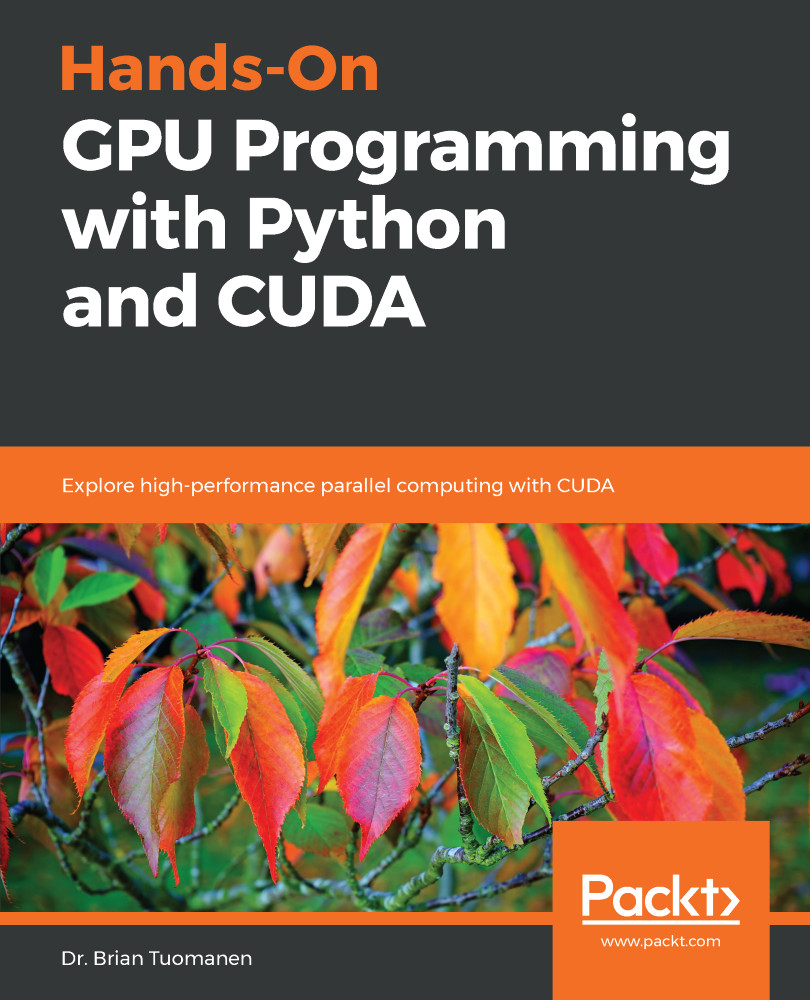
Hands-On GPU Programming with Python and CUDA

Hands-On GPU Programming with Python and CUDA

By : Tuomanen
5 (7)
close
close
Hands-On GPU Programming with Python and CUDA

Hands-On GPU Programming with Python and CUDA

5 (7)
By: Tuomanen

Overview of this book

Hands-On GPU Programming with Python and CUDA hits the ground running: you’ll start by learning how to apply Amdahl’s Law, use a code profiler to identify bottlenecks in your Python code, and set up an appropriate GPU programming environment. You’ll then see how to “query” the GPU’s features and copy arrays of data to and from the GPU’s own memory. As you make your way through the book, you’ll launch code directly onto the GPU and write full blown GPU kernels and device functions in CUDA C. You’ll get to grips with profiling GPU code effectively and fully test and debug your code using Nsight IDE. Next, you’ll explore some of the more well-known NVIDIA libraries, such as cuFFT and cuBLAS. With a solid background in place, you will now apply your new-found knowledge to develop your very own GPU-based deep neural network from scratch. You’ll then explore advanced topics, such as warp shuffling, dynamic parallelism, and PTX assembly. In the final chapter, you’ll see some topics and applications related to GPU programming that you may wish to pursue, including AI, graphics, and blockchain. By the end of this book, you will be able to apply GPU programming to problems related to data science and high-performance computing.
Table of Contents (15 chapters)
close
close

Getting Started with PyCUDA

In the last chapter, we set up our programming environment. Now, with our drivers and compilers firmly in place, we will begin the actual GPU programming! We will start by learning how to use PyCUDA for some basic and fundamental operations. We will first see how to query our GPU—that is, we will start by writing a small Python program that will tell us what the characteristics of our GPU are, such as the core count, architecture, and memory. We will then spend some time getting acquainted with how to transfer memory between Python and the GPU with PyCUDA's gpuarray class and how to use this class for basic computations. The remainder of this chapter will be spent showing how to write some basic functions (which we will refer to as CUDA Kernels) that we can directly launch onto the GPU.

The learning outcomes for this chapter are as follows...

Visually different images
CONTINUE READING
83
Tech Concepts
36
Programming languages
73
Tech Tools
Icon Unlimited access to the largest independent learning library in tech of over 8,000 expert-authored tech books and videos.
Icon Innovative learning tools, including AI book assistants, code context explainers, and text-to-speech.
Icon 50+ new titles added per month and exclusive early access to books as they are being written.
Hands-On GPU Programming with Python and CUDA
notes
bookmark Notes and Bookmarks search Search in title playlist Add to playlist download Download options font-size Font size

Change the font size

margin-width Margin width

Change margin width

day-mode Day/Sepia/Night Modes

Change background colour

Close icon Search
Country selected

Close icon Your notes and bookmarks

Confirmation

Modal Close icon
claim successful

Buy this book with your credits?

Modal Close icon
Are you sure you want to buy this book with one of your credits?
Close
YES, BUY

Submit Your Feedback

Modal Close icon
Modal Close icon
Modal Close icon