
Sign In Start Free Trial
Account

Add to playlist

Create a Playlist

Modal Close icon
You need to login to use this feature.
  • Book Overview & Buying Mastering Arduino
  • Table Of Contents Toc
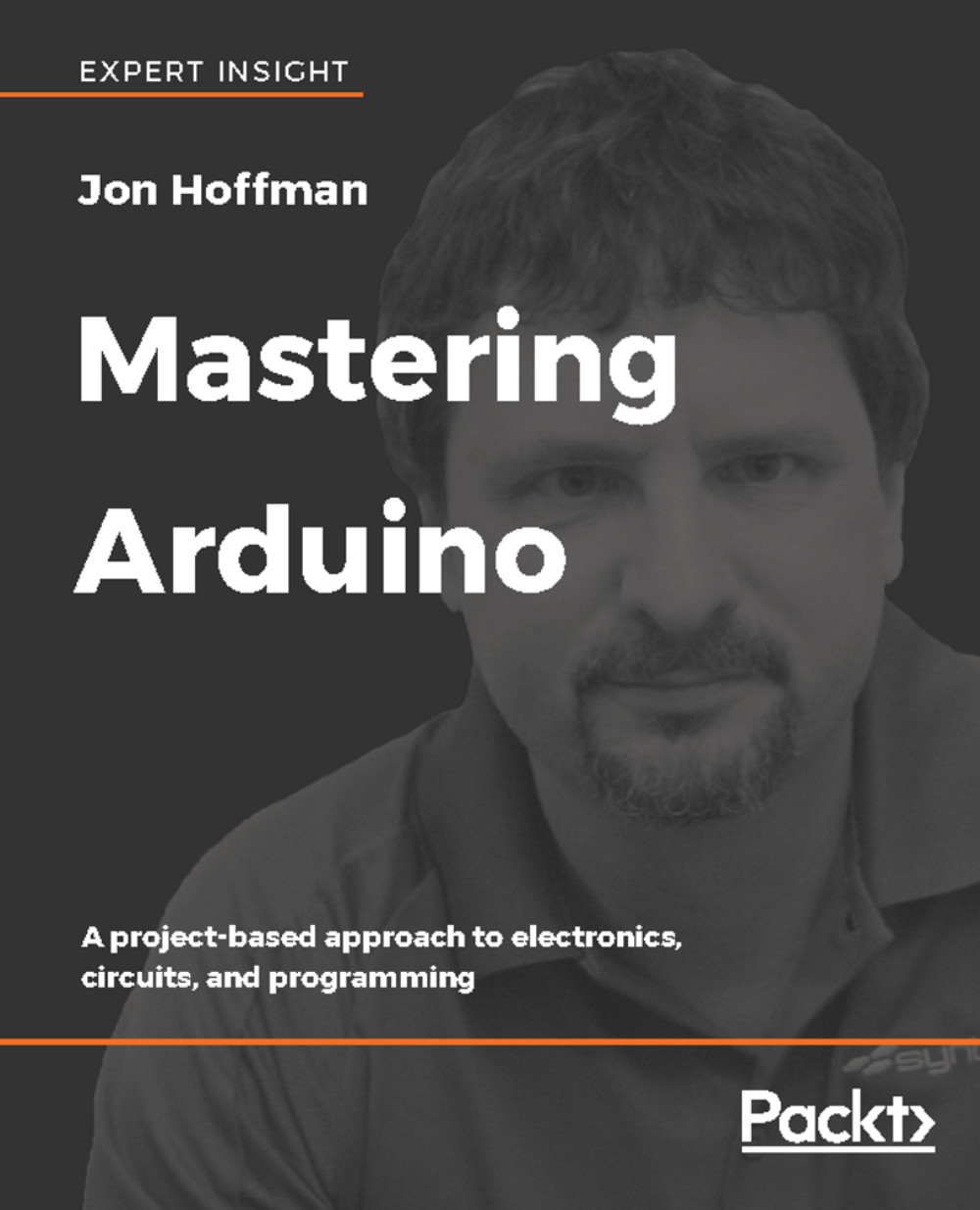
Mastering Arduino

Mastering Arduino

By : Jon Hoffman
4 (5)
close
close
Mastering Arduino

Mastering Arduino

4 (5)
By: Jon Hoffman

Overview of this book

Mastering Arduino is an all-in-one guide to getting the most out of your Arduino. This practical, no-nonsense guide teaches you all of the electronics and programming skills that you need to create advanced Arduino projects. This book is packed full of real-world projects for you to practice on, bringing all of the knowledge in the book together and giving you the skills to build your own robot from the examples in this book. The final two chapters discuss wireless technologies and how they can be used in your projects. The book begins with the basics of electronics, making sure that you understand components, circuits, and prototyping before moving on. It then performs the same function for code, getting you into the Arduino IDE and showing you how to connect the Arduino to a computer and run simple projects on your Arduino. Once the basics are out of the way, the next 10 chapters of the book focus on small projects centered around particular components, such as LCD displays, stepper motors, or voice synthesizers. Each of these chapters will get you familiar with the technology involved, how to build with it, how to program it, and how it can be used in your own projects.
Table of Contents (23 chapters)
close
close

Hello World

For our first Sketch, we will create the traditional Hello World application with the Arduino. This application will output the words "Hello World" to the serial monitor; however, before we create this application we need to understand what the setup() and loop() functions do.

The setup() function is run once and only once when the application first starts. This function enables us to initiate any variables or hardware when the application first starts. After the setup() function completes, the loop() function is then called for the first time. When the loop() function finishes it will be called again and will continue to loop until the Arduino is powered down.

Let's demonstrate how these functions work. We will need to start off by creating a new sketch in either the Arduino IDE or the Web Editor. To create a new sketch with the Arduino IDE we can use...

Visually different images
CONTINUE READING
83
Tech Concepts
36
Programming languages
73
Tech Tools
Icon Unlimited access to the largest independent learning library in tech of over 8,000 expert-authored tech books and videos.
Icon Innovative learning tools, including AI book assistants, code context explainers, and text-to-speech.
Icon 50+ new titles added per month and exclusive early access to books as they are being written.
Mastering Arduino
notes
bookmark Notes and Bookmarks search Search in title playlist Add to playlist download Download options font-size Font size

Change the font size

margin-width Margin width

Change margin width

day-mode Day/Sepia/Night Modes

Change background colour

Close icon Search
Country selected

Close icon Your notes and bookmarks

Confirmation

Modal Close icon
claim successful

Buy this book with your credits?

Modal Close icon
Are you sure you want to buy this book with one of your credits?
Close
YES, BUY

Submit Your Feedback

Modal Close icon
Modal Close icon
Modal Close icon