


In the previous section, we were checking the entity constructor parameter to be valid to ensure the newly created entity object is also correct. We applied a constraint, which does not allow creating a new entity without specifying the valid parameter value. By doing this, we are guarding our domain model against getting objects that aren't valid. It is one of the essential functions of the domain model as such, and since we are embracing the behavior-first approach, this type of code needs to be a part of the domain model implementation and not outsourced to external layers, like UI or application service layer. Of course, since our domain model is the system core, it takes a few hops for data to move from the user interface to domain objects. It is a valid approach to do a preliminary quality check on the data that tries to enter the domain model before...
-
Book Overview & Buying
-
Table Of Contents

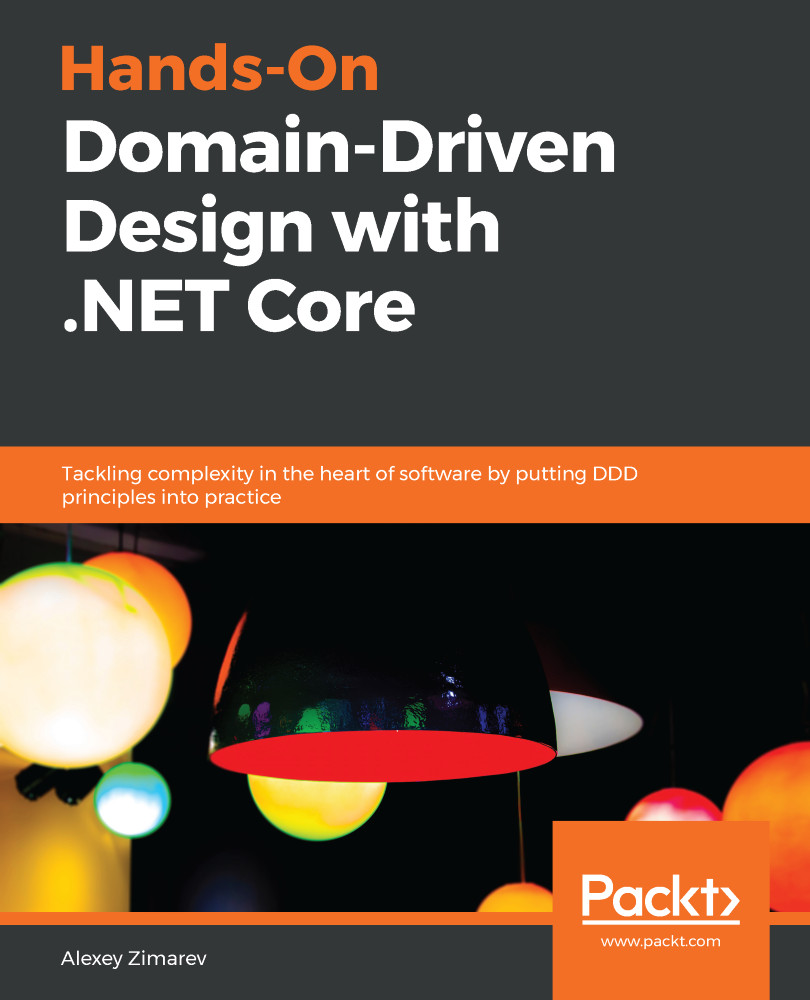
Hands-On Domain-Driven Design with .NET Core
By :


Hands-On Domain-Driven Design with .NET Core
By:
Overview of this book
Developers across the world are rapidly adopting DDD principles to deliver powerful results when writing software that deals with complex business requirements. This book will guide you in involving business stakeholders when choosing the software you are planning to build for them. By figuring out the temporal nature of behavior-driven domain models, you will be able to build leaner, more agile, and modular systems.
You’ll begin by uncovering domain complexity and learn how to capture the behavioral aspects of the domain language. You will then learn about EventStorming and advance to creating a new project in .NET Core 2.1; you’ll also and write some code to transfer your events from sticky notes to C#. The book will show you how to use aggregates to handle commands and produce events. As you progress, you’ll get to grips with Bounded Contexts, Context Map, Event Sourcing, and CQRS. After translating domain models into executable C# code, you will create a frontend for your application using Vue.js. In addition to this, you’ll learn how to refactor your code and cover event versioning and migration essentials.
By the end of this DDD book, you will have gained the confidence to implement the DDD approach in your organization and be able to explore new techniques that complement what you’ve learned from the book.
Table of Contents (14 chapters)
Preface

 Free Chapter
Why Domain-Driven Design?
Language and Context
EventStorming
Designing the Model
Implementing the Model

Acting with Commands
Consistency Boundary
Aggregate Persistence
CQRS - The Read Side
Event Sourcing
Projections and Queries
Bounded Context
Other Books You May Enjoy


