
Sign In Start Free Trial
Account

Add to playlist

Create a Playlist

Modal Close icon
You need to login to use this feature.
  • Book Overview & Buying Hands-On Domain-Driven Design with .NET Core
  • Table Of Contents Toc
  • Feedback & Rating feedback
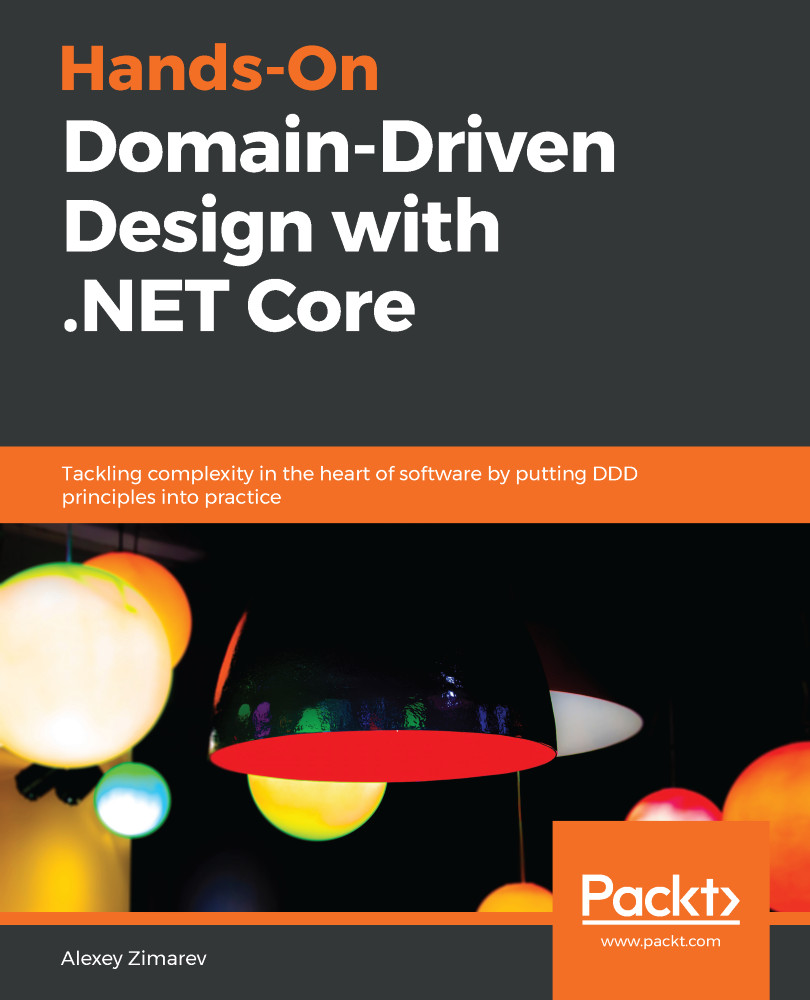
Hands-On Domain-Driven Design with .NET Core

Hands-On Domain-Driven Design with .NET Core

By : Alexey Zimarev
4.3 (22)
close
close
Hands-On Domain-Driven Design with .NET Core

Hands-On Domain-Driven Design with .NET Core

4.3 (22)
By: Alexey Zimarev

Overview of this book

Developers across the world are rapidly adopting DDD principles to deliver powerful results when writing software that deals with complex business requirements. This book will guide you in involving business stakeholders when choosing the software you are planning to build for them. By figuring out the temporal nature of behavior-driven domain models, you will be able to build leaner, more agile, and modular systems. You’ll begin by uncovering domain complexity and learn how to capture the behavioral aspects of the domain language. You will then learn about EventStorming and advance to creating a new project in .NET Core 2.1; you’ll also and write some code to transfer your events from sticky notes to C#. The book will show you how to use aggregates to handle commands and produce events. As you progress, you’ll get to grips with Bounded Contexts, Context Map, Event Sourcing, and CQRS. After translating domain models into executable C# code, you will create a frontend for your application using Vue.js. In addition to this, you’ll learn how to refactor your code and cover event versioning and migration essentials. By the end of this DDD book, you will have gained the confidence to implement the DDD approach in your organization and be able to explore new techniques that complement what you’ve learned from the book.
Table of Contents (14 chapters)
close
close

Acting with Commands

In the previous chapter, we went through the implementation process for a simple domain model. This model has one entity, and several value objects and domain services. The model represents just one area of our system, and we deliberately kept everything else out of scope. We discussed how the domain model project needs to be isolated from anything else, and how domain services can be part of the model although their implementation can be done in the application layer. Now, we are going to learn about putting our domain model in action. Hitherto, we have not been referencing the domain model from anywhere, which makes it rather useless. To start using the model in our application, we need to be able to call the model. In addition, we need to be able to persist all changes that happen in the model, so we do not lose the system state.

The following topics will...

Visually different images
CONTINUE READING
83
Tech Concepts
36
Programming languages
73
Tech Tools
Icon Unlimited access to the largest independent learning library in tech of over 8,000 expert-authored tech books and videos.
Icon Innovative learning tools, including AI book assistants, code context explainers, and text-to-speech.
Icon 50+ new titles added per month and exclusive early access to books as they are being written.
Hands-On Domain-Driven Design with .NET Core
notes
bookmark Notes and Bookmarks search Search in title playlist Add to playlist download Download options font-size Font size

Change the font size

margin-width Margin width

Change margin width

day-mode Day/Sepia/Night Modes

Change background colour

Close icon Search
Country selected

Close icon Your notes and bookmarks

Confirmation

Modal Close icon
claim successful

Buy this book with your credits?

Modal Close icon
Are you sure you want to buy this book with one of your credits?
Close
YES, BUY

Submit Your Feedback

Modal Close icon
Modal Close icon
Modal Close icon