
Sign In Start Free Trial
Account

Add to playlist

Create a Playlist

Modal Close icon
You need to login to use this feature.
  • Book Overview & Buying Hands-On Data Structures and Algorithms with Rust
  • Table Of Contents Toc
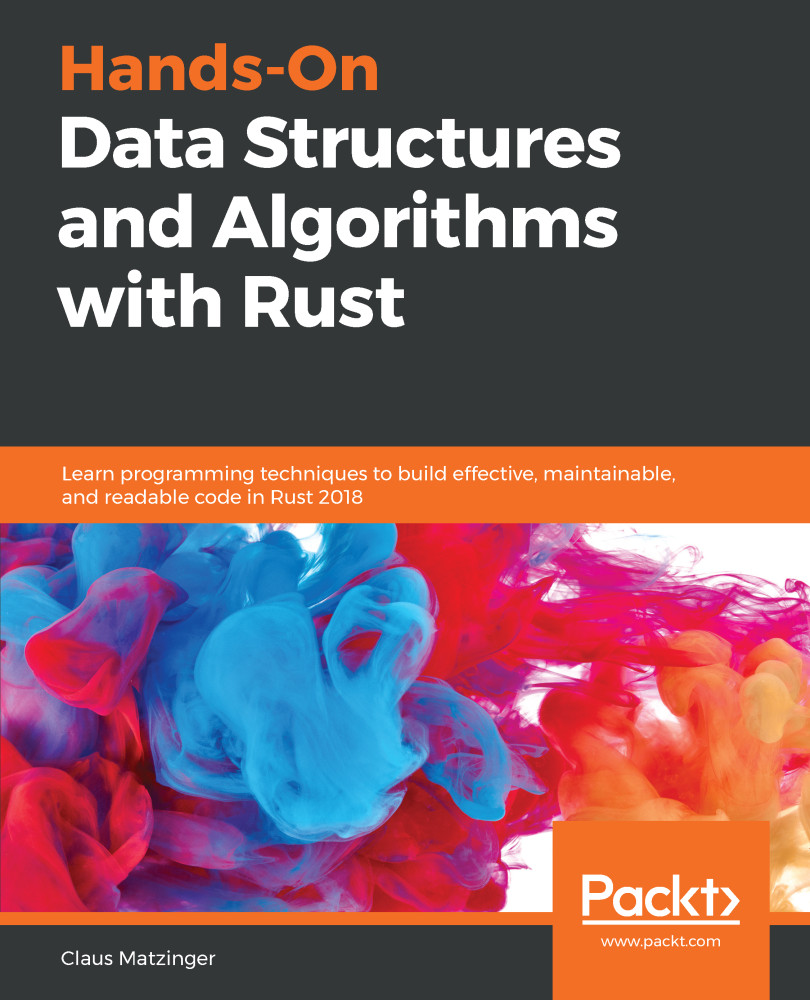
Hands-On Data Structures and Algorithms with Rust

Hands-On Data Structures and Algorithms with Rust

By : Claus Matzinger
2.7 (3)
close
close
Hands-On Data Structures and Algorithms with Rust

Hands-On Data Structures and Algorithms with Rust

2.7 (3)
By: Claus Matzinger

Overview of this book

Rust has come a long way and is now utilized in several contexts. Its key strengths are its software infrastructure and resource-constrained applications, including desktop applications, servers, and performance-critical applications, not forgetting its importance in systems' programming. This book will be your guide as it takes you through implementing classic data structures and algorithms in Rust, helping you to get up and running as a confident Rust programmer. The book begins with an introduction to Rust data structures and algorithms, while also covering essential language constructs. You will learn how to store data using linked lists, arrays, stacks, and queues. You will also learn how to implement sorting and searching algorithms. You will learn how to attain high performance by implementing algorithms to string data types and implement hash structures in algorithm design. The book will examine algorithm analysis, including Brute Force algorithms, Greedy algorithms, Divide and Conquer algorithms, Dynamic Programming, and Backtracking. By the end of the book, you will have learned how to build components that are easy to understand, debug, and use in different applications.
Table of Contents (15 chapters)
close
close

Pseudo-random numbers

In the last few years, random number generation has seen an interesting rise in popularity, yet many developers simply accept the generator provided by whatever technology they use. However, good random numbers are critical for many applications, such as encryption and security (or the lack thereof; see 2010's Sony PlayStation 3 security incident that prompted a famous XKCD—https://xkcd.com/221/), simulation, games, statistics, and biology.

As a basic principle: the more random a sequence is, the better. The reason for this is obvious. If any number in a sequence of random numbers is statistically dependent on one of the others, it becomes a pattern that can be predicted, and there is no such thing as predictable randomness. Thus, the numbers in a random sequence have to be statistically independent to qualify as good random numbers.

To get...

CONTINUE READING
83
Tech Concepts
36
Programming languages
73
Tech Tools
Icon Unlimited access to the largest independent learning library in tech of over 8,000 expert-authored tech books and videos.
Icon Innovative learning tools, including AI book assistants, code context explainers, and text-to-speech.
Icon 50+ new titles added per month and exclusive early access to books as they are being written.
Hands-On Data Structures and Algorithms with Rust
notes
bookmark Notes and Bookmarks search Search in title playlist Add to playlist download Download options font-size Font size

Change the font size

margin-width Margin width

Change margin width

day-mode Day/Sepia/Night Modes

Change background colour

Close icon Search
Country selected

Close icon Your notes and bookmarks

Confirmation

Modal Close icon
claim successful

Buy this book with your credits?

Modal Close icon
Are you sure you want to buy this book with one of your credits?
Close
YES, BUY

Submit Your Feedback

Modal Close icon
Modal Close icon
Modal Close icon