
Sign In Start Free Trial
Account

Add to playlist

Create a Playlist

Modal Close icon
You need to login to use this feature.
  • Book Overview & Buying Rust Quick Start Guide
  • Table Of Contents Toc
  • Feedback & Rating feedback
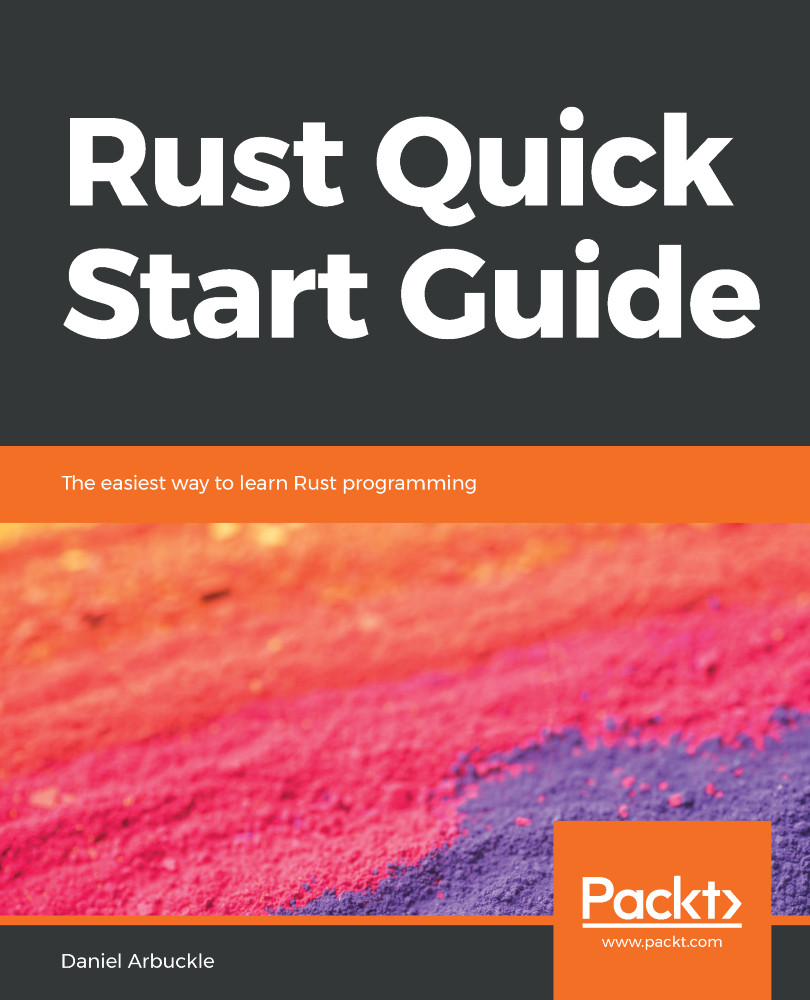
Rust Quick Start Guide

Rust Quick Start Guide

By : Daniel Arbuckle
3.7 (3)
close
close
Rust Quick Start Guide

Rust Quick Start Guide

3.7 (3)
By: Daniel Arbuckle

Overview of this book

Rust is an emerging programming language applicable to areas such as embedded programming, network programming, system programming, and web development. This book will take you from the basics of Rust to a point where your code compiles and does what you intend it to do! This book starts with an introduction to Rust and how to get set for programming, including the rustup and cargo tools for managing a Rust installation and development work?ow. Then you'll learn about the fundamentals of structuring a Rust program, such as functions, mutability, data structures, implementing behavior for types, and many more. You will also learn about concepts that Rust handles differently from most other languages. After understanding the Basics of Rust programming, you will learn about the core ideas, such as variable ownership, scope, lifetime, and borrowing. After these key ideas, you will explore making decisions in Rust based on data types by learning about match and if let expressions. After that, you'll work with different data types in Rust, and learn about memory management and smart pointers.
Table of Contents (10 chapters)
close
close

Making Decisions by Pattern Matching

We already saw Rust's if expressions, but those make decisions based on data values. Rust is a very type-conscious language, and so it's very important to be able to make decisions based on data types as well. Rust's match and if let expressions let us do that, comparing complex data types and allowing us to extract data values for further processing.

In this chapter, we're going to do the following:

  • Learn how to use pattern matching in the context of variable assignment using the let statement
  • Take what we've learned about pattern matching and apply it to decision making with the if let expression
  • Use the match expression to choose exactly one of many possible patterns
  • Use don't care values in pattern matching
  • See how borrowing interacts with pattern matching
  • Learn how to match complex, nested data structures...
Visually different images
CONTINUE READING
83
Tech Concepts
36
Programming languages
73
Tech Tools
Icon Unlimited access to the largest independent learning library in tech of over 8,000 expert-authored tech books and videos.
Icon Innovative learning tools, including AI book assistants, code context explainers, and text-to-speech.
Icon 50+ new titles added per month and exclusive early access to books as they are being written.
Rust Quick Start Guide
notes
bookmark Notes and Bookmarks search Search in title playlist Add to playlist download Download options font-size Font size

Change the font size

margin-width Margin width

Change margin width

day-mode Day/Sepia/Night Modes

Change background colour

Close icon Search
Country selected

Close icon Your notes and bookmarks

Confirmation

Modal Close icon
claim successful

Buy this book with your credits?

Modal Close icon
Are you sure you want to buy this book with one of your credits?
Close
YES, BUY

Submit Your Feedback

Modal Close icon
Modal Close icon
Modal Close icon