Sign In Start Free Trial
Account

Add to playlist

Create a Playlist

Modal Close icon
You need to login to use this feature.
  • Book Overview & Buying Designing React Hooks the Right Way
  • Table Of Contents Toc
  • Feedback & Rating feedback
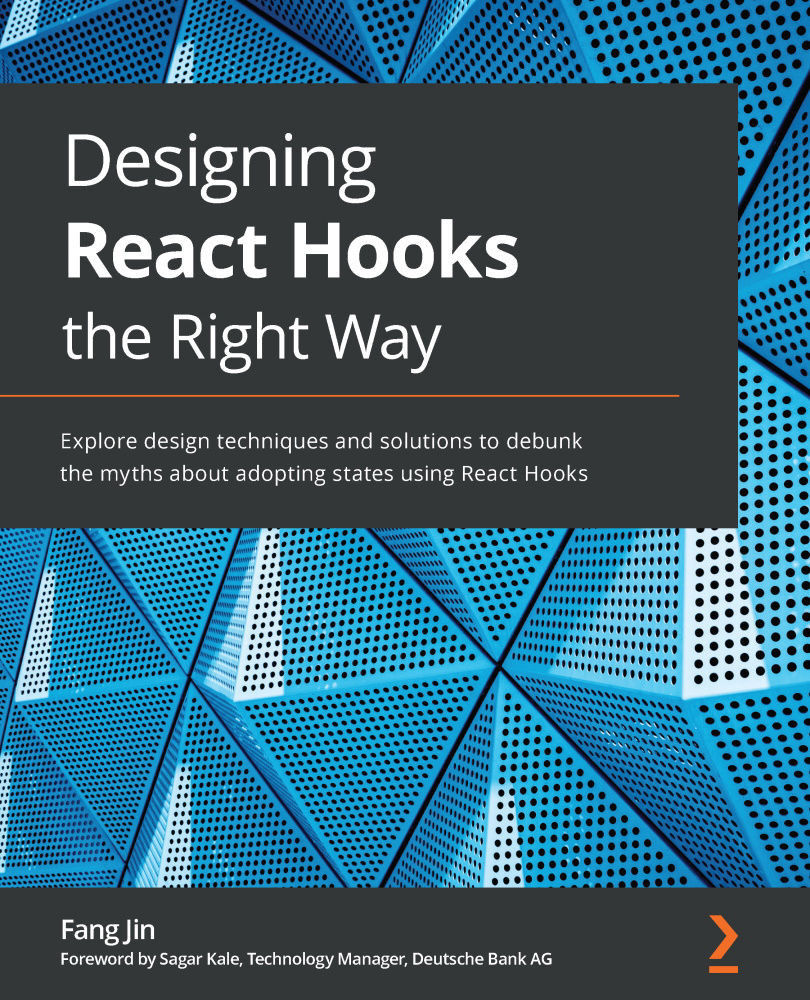
Designing React Hooks the Right Way

Designing React Hooks the Right Way

By : Jin
3.4 (7)
close
close
Designing React Hooks the Right Way

Designing React Hooks the Right Way

3.4 (7)
By: Jin

Overview of this book

React hook creates a unique solution for using states in function components to orchestrate UI communication. They provide you with an easy interface to write custom data management solutions with low development and maintenance costs. Understanding how Hooks are designed enables you to use them more effectively, and this book helps you to do just that. This book starts with a custom-crafted solution to reveal why Hooks are needed in the first place. You will learn about the React engine and discover how each built-in Hook can manage a persistent value by hooking into it. You will walk through the design and implementation of each hook with code so that you gain a solid understanding. Finally, you'll get to grips with each Hook's pitfalls and find out how to effectively overcome them. By the end of this React book, you'll have gained the confidence to build and write Hooks for developing functional and efficient web applications at scale.
Table of Contents (12 chapters)
close
close

Introducing a React Hook

The state is mostly local to a component, at least as far as this book is mostly concerned. The natural place for storage would be under a component instance because a component in React defines a piece of UI. So, where is the component instance of a function component in React stored?

It turns out that a component isn't the smallest unit in React. There's a more granular structure called fiber, which is used to represent a piece of element. A fiber performs all the tasks for this element. The element can be as simple as h1, div elements, or it can be an artificial element that does things differently. For instance, a "fragment" element can group other elements without displaying itself, or a "memo" element can remember all the elements from the last update.

Actually, a function component is one of the artificial elements that a fiber represents. What a function component does is allow us to define what elements it can display...

Visually different images
CONTINUE READING
83
Tech Concepts
36
Programming languages
73
Tech Tools
Icon Unlimited access to the largest independent learning library in tech of over 8,000 expert-authored tech books and videos.
Icon Innovative learning tools, including AI book assistants, code context explainers, and text-to-speech.
Icon 50+ new titles added per month and exclusive early access to books as they are being written.
Designing React Hooks the Right Way
notes
bookmark Notes and Bookmarks search Search in title playlist Add to playlist font-size Font size

Change the font size

margin-width Margin width

Change margin width

day-mode Day/Sepia/Night Modes

Change background colour

Close icon Search
Country selected

Close icon Your notes and bookmarks

Confirmation

Modal Close icon
claim successful

Buy this book with your credits?

Modal Close icon
Are you sure you want to buy this book with one of your credits?
Close
YES, BUY

Submit Your Feedback

Modal Close icon
Modal Close icon
Modal Close icon