Sign In Start Free Trial
Account

Add to playlist

Create a Playlist

Modal Close icon
You need to login to use this feature.
  • Book Overview & Buying Designing React Hooks the Right Way
  • Table Of Contents Toc
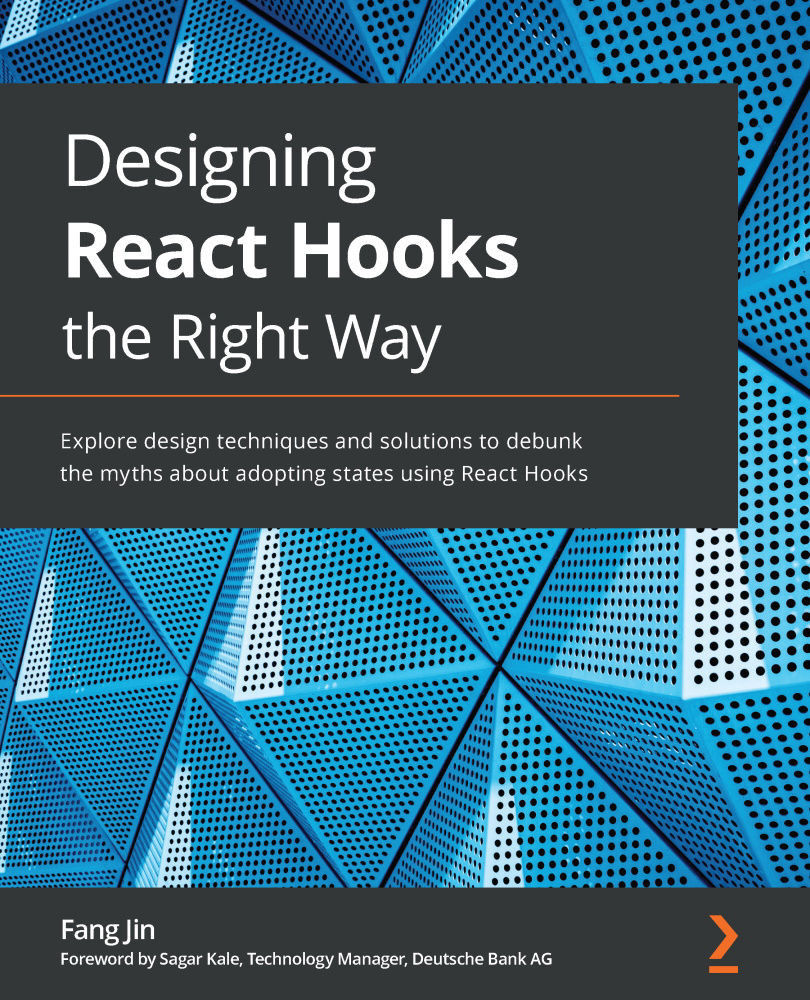
Designing React Hooks the Right Way

Designing React Hooks the Right Way

By : Jin
3.4 (7)
close
close
Designing React Hooks the Right Way

Designing React Hooks the Right Way

3.4 (7)
By: Jin

Overview of this book

React hook creates a unique solution for using states in function components to orchestrate UI communication. They provide you with an easy interface to write custom data management solutions with low development and maintenance costs. Understanding how Hooks are designed enables you to use them more effectively, and this book helps you to do just that. This book starts with a custom-crafted solution to reveal why Hooks are needed in the first place. You will learn about the React engine and discover how each built-in Hook can manage a persistent value by hooking into it. You will walk through the design and implementation of each hook with code so that you gain a solid understanding. Finally, you'll get to grips with each Hook's pitfalls and find out how to effectively overcome them. By the end of this React book, you'll have gained the confidence to build and write Hooks for developing functional and efficient web applications at scale.
Table of Contents (12 chapters)
close
close

useCurrent

Built-in hooks used in this custom hook: useState

When using the useState, we encountered quite a few issues that prevented a newcomer
from understanding how to use it properly, mainly from the inherited laggy behavior due to the fact that the state value does not change right after the dispatch.

const [state, dispatchState] = useState(0)

In the preceding line, if we understand the dispatchState function is to dispatch and request a change, then there's not much we need to do because that's how React designs the useState. However, most often we tend to think differently:

const [state, setState] = useState(0)

The preceding setState name is the main reason we push ourselves into trouble, because here we would expect the state to change right after the setState statement.

In Chapter 8, Use Ref to Hide Stuff, we used a useRef to locate the current value. There are two different ways to solve this problem: one is to design a container to keep...

CONTINUE READING
83
Tech Concepts
36
Programming languages
73
Tech Tools
Icon Unlimited access to the largest independent learning library in tech of over 8,000 expert-authored tech books and videos.
Icon Innovative learning tools, including AI book assistants, code context explainers, and text-to-speech.
Icon 50+ new titles added per month and exclusive early access to books as they are being written.
Designing React Hooks the Right Way
notes
bookmark Notes and Bookmarks search Search in title playlist Add to playlist font-size Font size

Change the font size

margin-width Margin width

Change margin width

day-mode Day/Sepia/Night Modes

Change background colour

Close icon Search
Country selected

Close icon Your notes and bookmarks

Confirmation

Modal Close icon
claim successful

Buy this book with your credits?

Modal Close icon
Are you sure you want to buy this book with one of your credits?
Close
YES, BUY

Submit Your Feedback

Modal Close icon
Modal Close icon
Modal Close icon