Sign In Start Free Trial
Account

Add to playlist

Create a Playlist

Modal Close icon
You need to login to use this feature.
  • Book Overview & Buying Clean Code with TypeScript
  • Table Of Contents Toc
Clean Code with TypeScript

Clean Code with TypeScript

By : Rukevwe Ojigbo, Dr. Sanjay Krishna Anbalagan
close
close
Clean Code with TypeScript

Clean Code with TypeScript

By: Rukevwe Ojigbo, Dr. Sanjay Krishna Anbalagan

Overview of this book

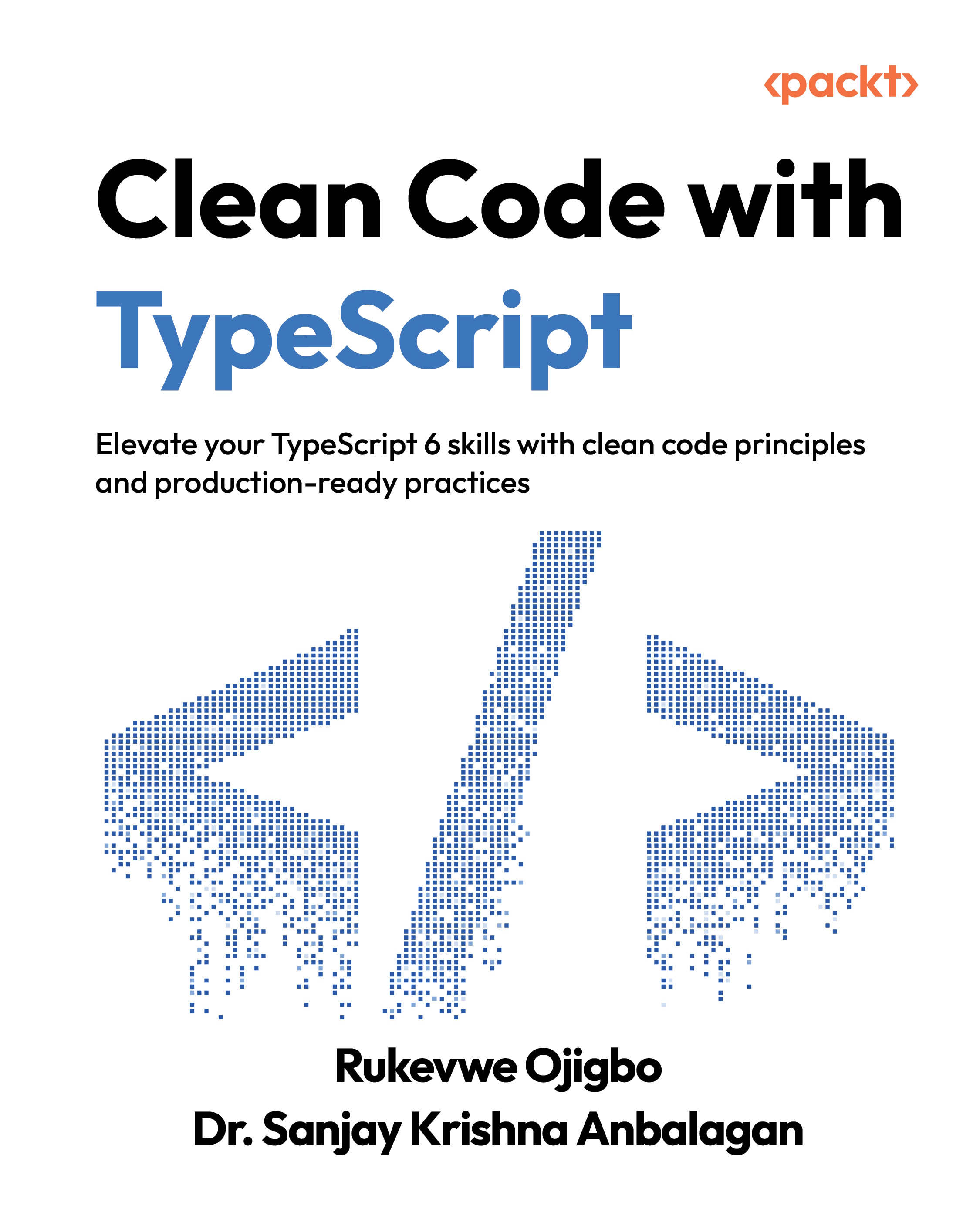
Clean Code with TypeScript is a practical guide to writing maintainable, efficient, and elegant TypeScript code. It equips developers with the essential principles and techniques to produce code that is both functional and easy to read and maintain. Written by Rukevwe Ojigbo and Dr. Sanjay Krishna Anbalagan, expert software engineers with extensive experience in building scalable, high-performance applications across industries, this book reflects practical lessons from their real-world projects. Throughout the book, you’ll work through hands-on implementations, including an LLM integration project and a full-stack TypeScript application, ensuring the concepts are grounded, relevant, and applicable to real development environments. What sets this book apart is its example-driven approach rooted in real-world scenarios. It goes beyond TypeScript best practices by developing your architectural thinking, enhancing team collaboration, and fostering long-term code quality. Whether you're new to TypeScript or an experienced developer, this guide will improve your TypeScript programming skills and help you deliver cleaner, more robust code. *Email sign-up and proof of purchase required
Table of Contents (16 chapters)
close
close
14
Other Books You May Enjoy
15
Index

Why TypeScript?

JavaScript was originally designed as a lightweight scripting language for small browser interactions such as handling button clicks, validating forms, or adding simple UI behavior. For many years, it was never intended to manage large, long-lived applications.

As web applications grew richer and more complex, more logic moved into the browser and server-side JavaScript environments. Code bases expanded from a few scripts into hundreds of interconnected files maintained by large teams. This growth exposed several challenges: runtime errors caused by unexpected data, difficulty understanding and refactoring code safely, and limited tooling support for reasoning about large systems.

At the core of these problems was a fundamental limitation: JavaScript provides no built-in way to verify correctness before code runs. Errors are often discovered only at runtime, sometimes long after deployment.

TypeScript was created to address this gap. By adding optional static typing and improved tooling to JavaScript, TypeScript enables developers to catch errors earlier, reason about code more effectively, and scale applications with greater confidence.

Advantages of using TypeScript

TypeScript's core feature is its static type system, which allows developers to define types for variables, function parameters, return values, classes, and namespaces. Not only do we benefit from enhanced code readability by being able to explicitly define these types, but runtime errors are reduced, and potential bugs are caught during the development phase itself. Real-world applications benefit from fewer unexpected runtime errors, leading to more reliable and stable software.

In collaborative development environments, TypeScript's type annotations serve as documentation for developers working on the same code base. Type definitions clarify the expected input and output of functions, reducing confusion and improving code comprehension. As projects grow, maintaining and extending code becomes more manageable due to the additional layer of information provided by TypeScript.

When refactoring or modifying existing code, TypeScript provides a safety net by identifying places in the code base that need to be updated due to changes in types or signatures. This minimizes the risk of introducing bugs during refactoring and encourages developers to make changes without fear of breaking existing functionality.

TypeScript's integration with modern development tools, such as VS Code, provides IntelliSense for code completion, intelligent suggestions, and real-time error checking. These features lead to faster coding, reduced cognitive load, and improved productivity for developers.

Real-world applications of TypeScript

TypeScript is widely adopted in popular frontend frameworks and libraries such as Angular, React, and Vue.js. By adding static type checking to these frameworks, TypeScript helps developers build more reliable and maintainable applications when creating complex user interfaces, managing state, and handling data flow. TypeScript's type system provides structure and catches errors early in the development process, making frontend applications more scalable and easier to maintain.

TypeScript is not limited to frontend development. It's also gaining traction in backend development using technologies such as Node.js and Deno. The ability to define types and interfaces makes working with APIs and databases more intuitive and error-resistant.

TypeScript's type annotations ensure that requests and responses adhere to defined structures when building middleware or RESTful APIs using frameworks such as Express.js, resulting in less error-prone code and improved API documentation. Third-party libraries and modules can also benefit from TypeScript's type system, with type definitions for popular libraries available on DefinitelyTyped. The DefinitelyTyped repository provides type definitions for popular libraries, bridging the gap between untyped JavaScript and type-safe TypeScript projects. You can find the repository here: https://github.com/DefinitelyTyped.

Now that we have explored TypeScript, its rationale, and the benefits it provides, the upcoming section will guide you through the process of setting up and configuring a TypeScript project, offering a step-by-step approach for seamless implementation.

CONTINUE READING
83
Tech Concepts
36
Programming languages
73
Tech Tools
Icon Unlimited access to the largest independent learning library in tech of over 8,000 expert-authored tech books and videos.
Icon Innovative learning tools, including AI book assistants, code context explainers, and text-to-speech.
Icon 50+ new titles added per month and exclusive early access to books as they are being written.
Clean Code with TypeScript
notes
bookmark Notes and Bookmarks search Search in title playlist Add to playlist download Download options font-size Font size

Change the font size

margin-width Margin width

Change margin width

day-mode Day/Sepia/Night Modes

Change background colour

Close icon Search
Country selected

Close icon Your notes and bookmarks

Confirmation

Modal Close icon
claim successful

Buy this book with your credits?

Modal Close icon
Are you sure you want to buy this book with one of your credits?
Close
YES, BUY

Submit Your Feedback

Modal Close icon
Modal Close icon
Modal Close icon