Sign In Start Free Trial
Account

Add to playlist

Create a Playlist

Modal Close icon
You need to login to use this feature.
  • Book Overview & Buying Clean Code with TypeScript
  • Table Of Contents Toc
Clean Code with TypeScript

Clean Code with TypeScript

By : Rukevwe Ojigbo, Dr. Sanjay Krishna Anbalagan
close
close
Clean Code with TypeScript

Clean Code with TypeScript

By: Rukevwe Ojigbo, Dr. Sanjay Krishna Anbalagan

Overview of this book

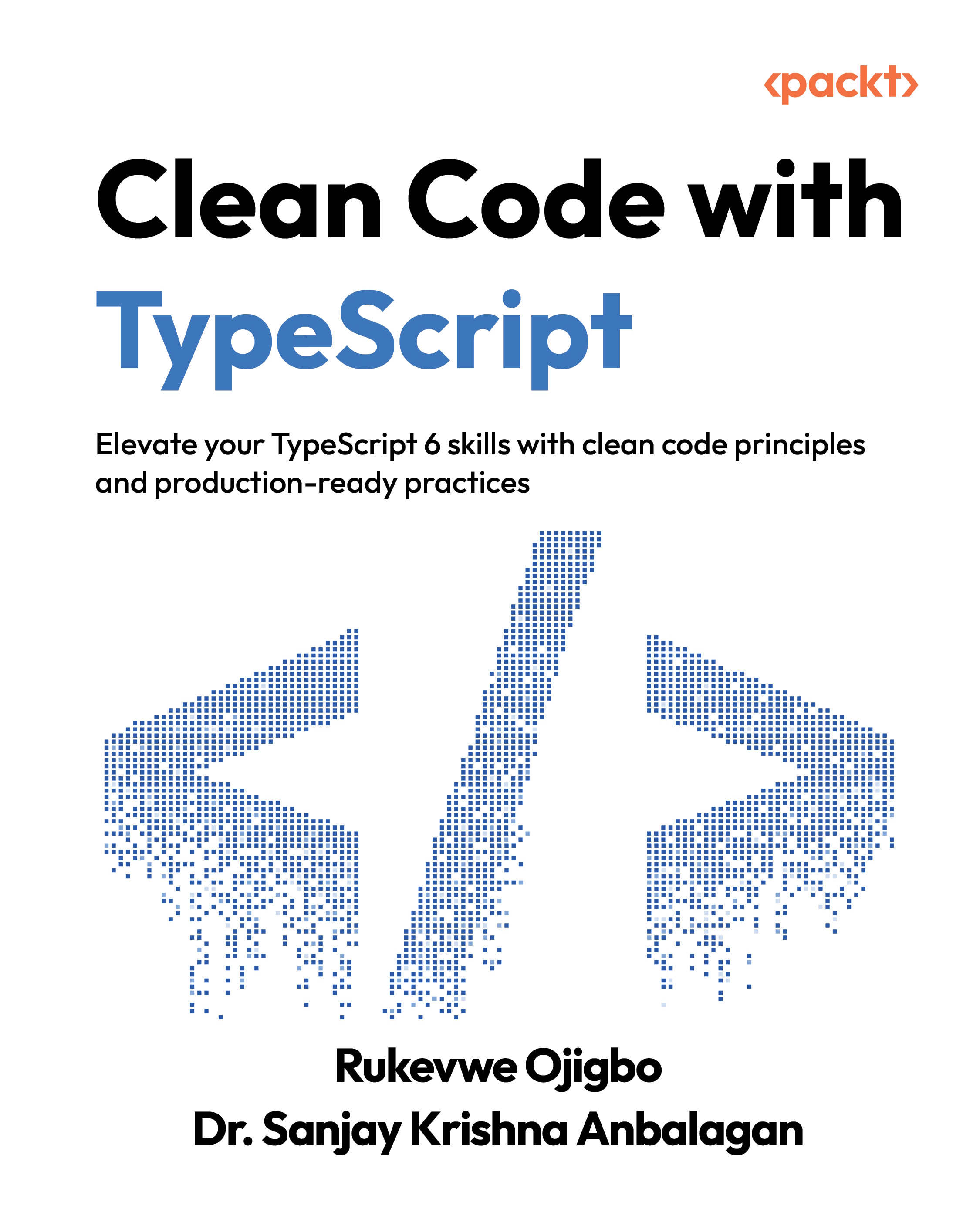
Clean Code with TypeScript is a practical guide to writing maintainable, efficient, and elegant TypeScript code. It equips developers with the essential principles and techniques to produce code that is both functional and easy to read and maintain. Written by Rukevwe Ojigbo and Dr. Sanjay Krishna Anbalagan, expert software engineers with extensive experience in building scalable, high-performance applications across industries, this book reflects practical lessons from their real-world projects. Throughout the book, you’ll work through hands-on implementations, including an LLM integration project and a full-stack TypeScript application, ensuring the concepts are grounded, relevant, and applicable to real development environments. What sets this book apart is its example-driven approach rooted in real-world scenarios. It goes beyond TypeScript best practices by developing your architectural thinking, enhancing team collaboration, and fostering long-term code quality. Whether you're new to TypeScript or an experienced developer, this guide will improve your TypeScript programming skills and help you deliver cleaner, more robust code. *Email sign-up and proof of purchase required
Table of Contents (16 chapters)
close
close
14
Other Books You May Enjoy
15
Index

Preface

TypeScript has become a cornerstone of modern web development, helping teams build applications that are safer, easier to maintain, and more scalable as requirements evolve. By adding strong typing and powerful tooling to JavaScript, TypeScript enables developers to catch errors earlier, communicate intent more clearly, and write code that remains reliable even as projects grow in complexity.

In this book, you will progress from TypeScript fundamentals to real-world development practices that reflect how professional teams build and maintain production systems. You will begin by learning how to set up TypeScript projects, understand essential and advanced types, and configure TypeScript effectively. From there, you will focus on writing clean functions, applying object-oriented programming principles, and organizing projects using modular, scalable structures supported by consistent tooling.

As you advance, you will learn how to test TypeScript applications with unit and integration tests, apply Test-Driven Development (TDD), and strengthen your applications through better error handling, debugging techniques, and security best practices. You will also explore performance optimization strategies and learn how design patterns can improve flexibility and maintainability in real-world code bases.

The later chapters take a hands-on, production-focused approach, guiding you through setting up scalable TypeScript environments using modern workflows such as Nx monorepos, pnpm dependency management, and automated code quality enforcement with Git hooks. You will then build a type-safe full stack application using NestJS and React, applying shared contracts to keep frontend and backend aligned. Finally, you will follow a realistic narrative where a working proof of concept evolves under changing requirements, learning how TypeScript helps prevent contract drift, protect runtime boundaries, and intentionally move failures earlier in the development lifecycle.

By the end of this book, you will have the skills to write clean, maintainable TypeScript code, architect scalable projects, and confidently apply TypeScript in real-world systems that grow, change, and evolve over time.

Who this book is for

The book is for JavaScript developers who want to master TypeScript to build scalable and maintainable applications. Frontend, backend, and full stack developers, as well as software architects looking to leverage TypeScript for robust application design, will find practical value in this book. A basic understanding of JavaScript, including ES6+ features, functions, and asynchronous programming, is assumed. Although not required, familiarity with TypeScript fundamentals, OOP principles, and Git is helpful.

What this book covers

Chapter 1, Introducing TypeScript, introduces TypeScript and explains why it has become essential for building reliable, maintainable web applications. It walks you through setting up a TypeScript project, understanding core and advanced types, and configuring tsconfig.json for an efficient development workflow.

Chapter 2, Writing Clean Functions, focuses on writing clean, maintainable TypeScript functions by applying best practices such as the single responsibility principle, avoiding side effects, and using clear function signatures. It also covers effective naming conventions and documentation techniques using TSDoc and TypeDoc to improve readability and long-term maintainability.

Chapter 3, Object-Oriented Programming with TypeScript, explores object-oriented programming in TypeScript, covering core concepts such as classes, inheritance, interfaces, abstract classes, and polymorphism for building scalable and reusable applications. It also highlights encapsulation and the principle of composition over inheritance to help you design cleaner, more flexible code bases.

Chapter 4, Clean Code in TypeScript Projects, brings together the clean code concepts from earlier chapters and applies them to building a complete TypeScript project. It focuses on structuring scalable code bases through effective folder organization, module systems, dependency management, and tooling such as linting and formatting for consistent code quality.

Chapter 5, Testing and Test-Driven Development, introduces a complete testing strategy for TypeScript projects, covering the fundamentals of testing along with unit and integration testing practices. It also explores Test-Driven Development (TDD) and how writing tests first can improve code quality, reliability, and overall application design.

Chapter 6, Error Handling, Debugging, and Security Best Practices, focuses on mastering error handling and debugging techniques to build reliable and secure TypeScript applications. It covers strategies for managing synchronous and asynchronous errors, using error types effectively, leveraging debugging tools, and applying essential security best practices.

Chapter 7, Maximizing Performance Optimization, explores practical techniques for optimizing the performance of TypeScript applications, from identifying bottlenecks and using profiling tools to applying proven optimization strategies. It covers approaches such as minification, tree shaking, lazy loading, and caching to help you build faster, more efficient, and cost-effective applications.

Chapter 8, Mastering Design Patterns in TypeScript, introduces design patterns in TypeScript and explains how they provide reusable, maintainable solutions to common software design challenges. It explores creational, structural, and behavioral patterns through practical examples, along with best practices to help you apply them effectively in real-world projects.

Chapter 9, Understanding Advanced TypeScript Features, explores advanced TypeScript features that help you write more flexible, scalable, and maintainable code for real-world applications. It covers generics, advanced and utility types, decorators, mapped types, and conditional types with practical examples to strengthen your expertise.

Chapter 10, Setting Up Scalable TypeScript Projects, shifts from TypeScript theory to real-world application by guiding you through building a production-ready development environment designed for scalability and team collaboration. It covers key architectural decisions such as monorepo versus polyrepo, setting up an Nx workspace with pnpm, and automating code quality using Git hooks for long-term maintainability.

Chapter 11, TypeScript in Action: Building Full Stack Applications, brings your Nx-based project to life by building a type-safe full stack application with a NestJS backend and a React frontend. It shows how shared DTOs and validated APIs help TypeScript enforce consistency across client and server, improving collaboration and reducing runtime errors.

Chapter 12, TypeScript in Evolving Systems, follows a real-world narrative of a full stack support chatbot that evolves from a working proof of concept into a growing system where assumptions drift and runtime failures emerge. It shows how TypeScript techniques—such as explicit contracts, runtime validation, and discriminated unions—help move errors earlier to build time, making changes safer and easier to maintain.

To get the most out of this book

This book is designed for developers who want to write clean, scalable, and production-ready TypeScript. To get the most value from the examples and hands-on chapters, you should be comfortable with basic JavaScript concepts such as variables, functions, arrays, objects, and asynchronous programming (promises and async/await). Familiarity with ES6+ syntax (arrow functions, destructuring, modules) will also help you follow along smoothly. While prior TypeScript experience is not required, having a basic understanding of web development workflows (using the terminal, installing packages, and running scripts) will make the learning process faster and more practical.

To follow along with this book, you will need the following:

  • Node.js (LTS version recommended) and npm (comes with Node.js)
  • A code editor such as Visual Studio Code (recommended)
  • A terminal (macOS Terminal, Windows PowerShell, or any modern shell)
  • TypeScript installed either globally or as a project dependency
  • A package manager such as npm, pnpm, or Yarn (pnpm is used in later chapters)

Some chapters include full stack and team-style workflows, so the following tools are also recommended:

  • Git (for version control and Git hooks)
  • A modern browser such as Chrome, Firefox, or Edge (for testing frontend behavior)

In the project chapters, you'll set up a production-ready workspace using Nx, configure dependencies using pnpm, and apply automated quality checks using tools such as linters, formatters, and Git hooks. Ensure you have the ability to install dependencies and run commands locally so you can experiment, break things safely, and learn by building.

Download the example code files

This book includes a complete downloadable code bundle containing all the example projects and files used throughout the chapters. We recommend downloading the bundle so you can follow along smoothly and experiment with the examples.

Use the bundle as a practical starting point. Modify it, extend it, and apply what you learn by creating your own variations as you progress through the chapters.

Get the code bundle

If you bought the book directly from Packt:

  1. Go to packtpub.com
  2. Click your profile picture and select Your Orders
  3. Find this book and click Download Code

If you bought this book from Amazon or any other channel partner:

  1. Go to packtpub.com/unlock or scan the following QR code:

    Image

  2. Search for this book
  3. Sign up or log in to your free Packt account
  4. Upload your proof of purchase and download the code bundle locally

Usage note: You're free to use and modify this code for personal learning and non-commercial projects.

Conventions used

There are a number of text conventions used throughout this book.

CodeInText: Indicates code words in text, database table names, folder names, filenames, file extensions, pathnames, dummy URLs, user input, and Twitter handles. For example: "For instance, a class named ShoppingCart provides much more context than simply Cart."

A block of code is set as follows:

  /**
   * Completes the checkout process.
   * @param discount The discount percentage to apply.
   * @returns The final total after applying the discount.
   */
  checkout(discount: number): number {
    const total = this.applyDiscount(discount);
    console.log('Your total is: $' + total.toFixed(2));
    console.log('Thank you for shopping with us!');
    return total;
  }

When we wish to draw your attention to a particular part of a code block, the relevant lines or items are set in bold:

  /**
   * Completes the checkout process.
   * @param discount The discount percentage to apply.
   * @returns The final total after applying the discount.
   */
  checkout(discount: number): number {
    const total = this.applyDiscount(discount);
    console.log('Your total is: $' + total.toFixed(2));
    console.log('Thank you for shopping with us!');
    return total;
  }

Any command-line input or output is written as follows:

npm install --save-dev typedoc

Bold: Indicates a new term, an important word, or words that you see on the screen. For instance, words in menus or dialog boxes appear in the text like this. For example: "To follow along with the examples in this chapter on testing and TDD, you will need Node.js version 20.0.0 or later and TypeScript version 5.0 or later installed on your machine."

Warnings or important notes appear like this.

Tips and tricks appear like this.

Get in touch

Feedback from our readers is always welcome.

General feedback: If you have questions about any aspect of this book or have any general feedback, please email us at customercare@packt.com and mention the book's title in the subject of your message.

Errata: Although we have taken every care to ensure the accuracy of our content, mistakes do happen. If you have found a mistake in this book, we would be grateful if you reported this to us. Please visit http://www.packt.com/submit-errata, click Submit Errata, and fill in the form.

Piracy: If you come across any illegal copies of our works in any form on the internet, we would be grateful if you would provide us with the location address or website name. Please contact us at [email protected] with a link to the material.

If you are interested in becoming an author: If there is a topic that you have expertise in and you are interested in either writing or contributing to a book, please visit http://authors.packt.com/.

CONTINUE READING
83
Tech Concepts
36
Programming languages
73
Tech Tools
Icon Unlimited access to the largest independent learning library in tech of over 8,000 expert-authored tech books and videos.
Icon Innovative learning tools, including AI book assistants, code context explainers, and text-to-speech.
Icon 50+ new titles added per month and exclusive early access to books as they are being written.
Clean Code with TypeScript
notes
bookmark Notes and Bookmarks search Search in title playlist Add to playlist download Download options font-size Font size

Change the font size

margin-width Margin width

Change margin width

day-mode Day/Sepia/Night Modes

Change background colour

Close icon Search
Country selected

Close icon Your notes and bookmarks

Confirmation

Modal Close icon
claim successful

Buy this book with your credits?

Modal Close icon
Are you sure you want to buy this book with one of your credits?
Close
YES, BUY

Submit Your Feedback

Modal Close icon
Modal Close icon
Modal Close icon