
Sign In Start Free Trial
Account

Add to playlist

Create a Playlist

Modal Close icon
You need to login to use this feature.
  • Book Overview & Buying Hands-On Design Patterns with C# and .NET Core
  • Table Of Contents Toc
Hands-On Design Patterns with C# and .NET Core

Hands-On Design Patterns with C# and .NET Core

By : Gaurav Aroraa, Chilberto
2.8 (5)
close
close
Hands-On Design Patterns with C# and .NET Core

Hands-On Design Patterns with C# and .NET Core

2.8 (5)
By: Gaurav Aroraa, Chilberto

Overview of this book

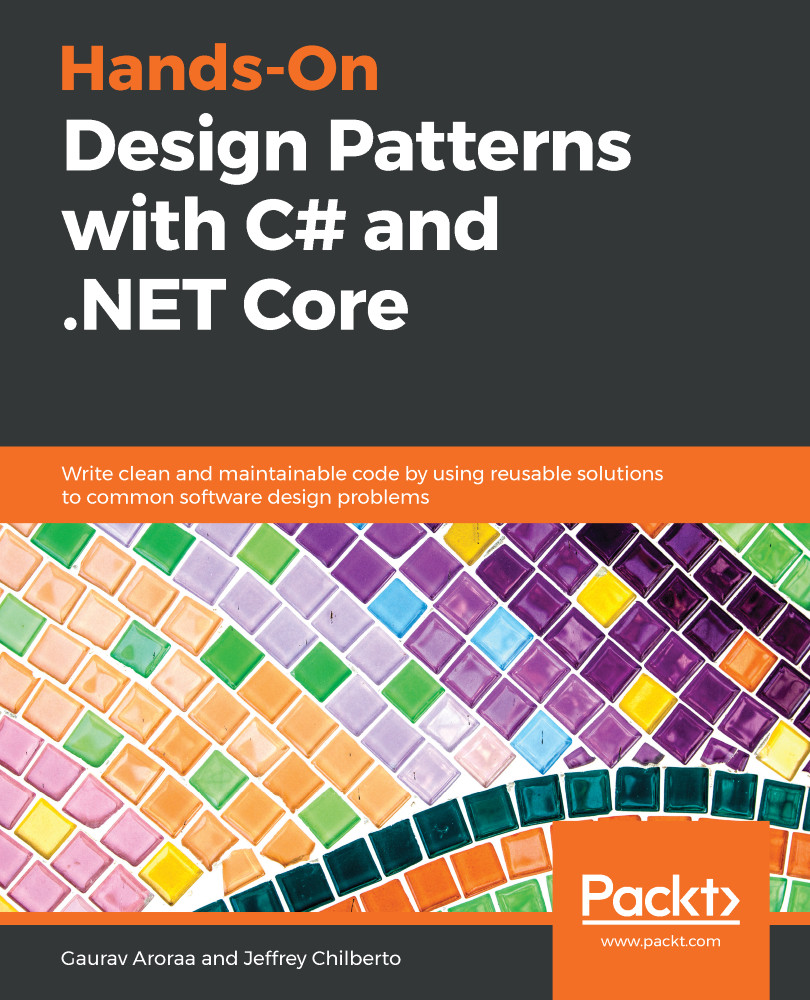
Design patterns are essentially reusable solutions to common programming problems. When used correctly, they meet crucial software requirements with ease and reduce costs. This book will uncover effective ways to use design patterns and demonstrate their implementation with executable code specific to both C# and .NET Core. Hands-On Design Patterns with C# and .NET Core begins with an overview of object-oriented programming (OOP) and SOLID principles. It provides an in-depth explanation of the Gang of Four (GoF) design patterns, including creational, structural, and behavioral. The book then takes you through functional, reactive, and concurrent patterns, helping you write better code with streams, threads, and coroutines. Toward the end of the book, you’ll learn about the latest trends in architecture, exploring design patterns for microservices, serverless, and cloud native applications. You’ll even understand the considerations that need to be taken into account when choosing between different architectures such as microservices and MVC. By the end of the book, you will be able to write efficient and clear code and be comfortable working on scalable and maintainable projects of any size.
Table of Contents (19 chapters)
close
close
Lock Free Chapter
1
Section 1: Essentials of Design Patterns in C# and .NET Core
4
Section 2: Deep Dive into Utilities and Patterns in .NET Core
10
Section 3: Functional Programming, Reactive Programming, and Coding for the Cloud

Advanced Database Design and Application Techniques

In the previous chapter, we learned about reactive programming by discussing its principles and models. We also discussed and looked at examples of how reactive programming is all about data streams.

Database designing is a complex task and needs a lot of patience. In this chapter, we will discuss advanced database and application techniques, including applying Command Query Responsibility Segregation (CQRS) and ledger-style databases.

Similar to previous chapters, a requirement gathering session will be illustrated in order to determine the Minimum Viable Product (MVP). In this chapter, several factors will be used to lead the design to CQRS. We will be using a ledger-style approach that consists of increased tracking of changes to inventory levels, as well as wanting to provide public APIs for retrieving inventory levels. This...

Visually different images
CONTINUE READING
83
Tech Concepts
36
Programming languages
73
Tech Tools
Icon Unlimited access to the largest independent learning library in tech of over 8,000 expert-authored tech books and videos.
Icon Innovative learning tools, including AI book assistants, code context explainers, and text-to-speech.
Icon 50+ new titles added per month and exclusive early access to books as they are being written.
Hands-On Design Patterns with C# and .NET Core
notes
bookmark Notes and Bookmarks search Search in title playlist Add to playlist download Download options font-size Font size

Change the font size

margin-width Margin width

Change margin width

day-mode Day/Sepia/Night Modes

Change background colour

Close icon Search
Country selected

Close icon Your notes and bookmarks

Confirmation

Modal Close icon
claim successful

Buy this book with your credits?

Modal Close icon
Are you sure you want to buy this book with one of your credits?
Close
YES, BUY

Submit Your Feedback

Modal Close icon
Modal Close icon
Modal Close icon