
Sign In Start Free Trial
Account

Add to playlist

Create a Playlist

Modal Close icon
You need to login to use this feature.
  • Book Overview & Buying Hands-On Exploratory Data Analysis with Python
  • Table Of Contents Toc
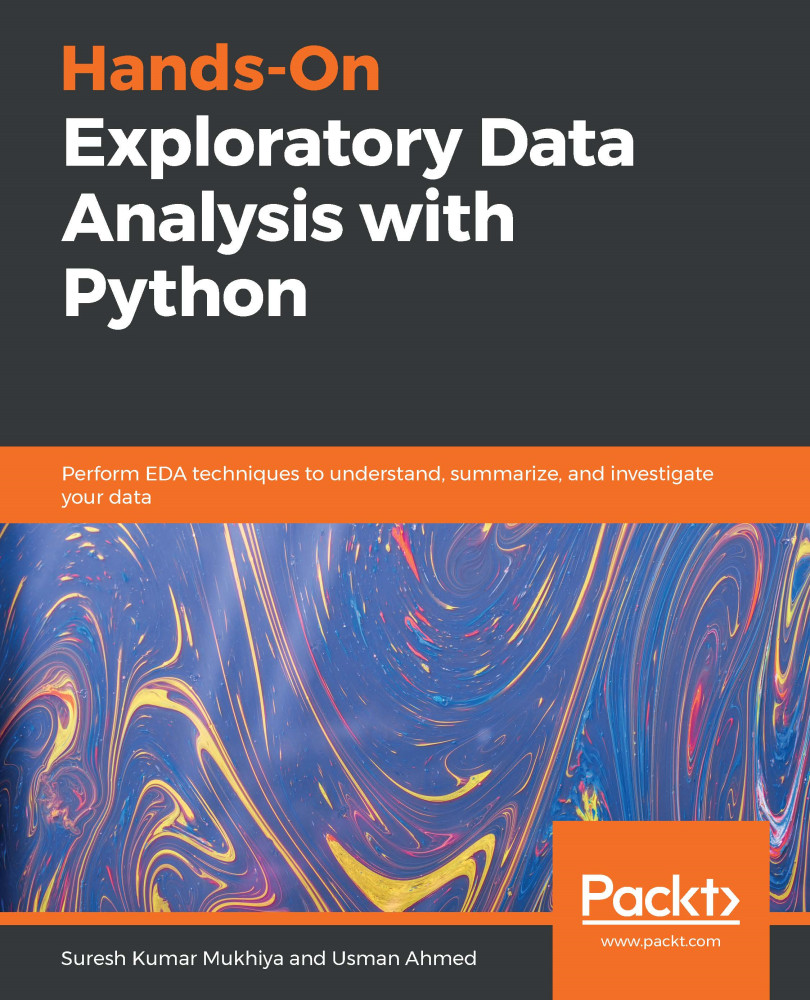
Hands-On Exploratory Data Analysis with Python

Hands-On Exploratory Data Analysis with Python

By : Kumar Mukhiya, Ahmed
2.5 (2)
close
close
Hands-On Exploratory Data Analysis with Python

Hands-On Exploratory Data Analysis with Python

2.5 (2)
By: Kumar Mukhiya, Ahmed

Overview of this book

Exploratory Data Analysis (EDA) is an approach to data analysis that involves the application of diverse techniques to gain insights into a dataset. This book will help you gain practical knowledge of the main pillars of EDA - data cleaning, data preparation, data exploration, and data visualization. You’ll start by performing EDA using open source datasets and perform simple to advanced analyses to turn data into meaningful insights. You’ll then learn various descriptive statistical techniques to describe the basic characteristics of data and progress to performing EDA on time-series data. As you advance, you’ll learn how to implement EDA techniques for model development and evaluation and build predictive models to visualize results. Using Python for data analysis, you’ll work with real-world datasets, understand data, summarize its characteristics, and visualize it for business intelligence. By the end of this EDA book, you’ll have developed the skills required to carry out a preliminary investigation on any dataset, yield insights into data, present your results with visual aids, and build a model that correctly predicts future outcomes.
Table of Contents (17 chapters)
close
close
1
Section 1: The Fundamentals of EDA
6
Section 2: Descriptive Statistics
11
Section 3: Model Development and Evaluation

Data aggregation

Aggregation is the process of implementing any mathematical operation on a dataset or a subset of it. Aggregation is one of the many techniques in pandas that's used to manipulate the data in the dataframe for data analysis.

The Dataframe.aggregate() function is used to apply aggregation across one or more columns. Some of the most frequently used aggregations are as follows:

  • sum: Returns the sum of the values for the requested axis
  • min: Returns the minimum of the values for the requested axis
  • max: Returns the maximum of the values for the requested axis

We can apply aggregation in a DataFrame, df, as df.aggregate() or df.agg().

Since aggregation only works with numeric type columns, let's take some of the numeric columns from the dataset and apply some aggregation functions to them:

# new dataframe that consist length,width,height,curb-weight and...
CONTINUE READING
83
Tech Concepts
36
Programming languages
73
Tech Tools
Icon Unlimited access to the largest independent learning library in tech of over 8,000 expert-authored tech books and videos.
Icon Innovative learning tools, including AI book assistants, code context explainers, and text-to-speech.
Icon 50+ new titles added per month and exclusive early access to books as they are being written.
Hands-On Exploratory Data Analysis with Python
notes
bookmark Notes and Bookmarks search Search in title playlist Add to playlist download Download options font-size Font size

Change the font size

margin-width Margin width

Change margin width

day-mode Day/Sepia/Night Modes

Change background colour

Close icon Search
Country selected

Close icon Your notes and bookmarks

Confirmation

Modal Close icon
claim successful

Buy this book with your credits?

Modal Close icon
Are you sure you want to buy this book with one of your credits?
Close
YES, BUY

Submit Your Feedback

Modal Close icon
Modal Close icon
Modal Close icon