
Sign In Start Free Trial
Account

Add to playlist

Create a Playlist

Modal Close icon
You need to login to use this feature.
  • Book Overview & Buying R Statistics Cookbook
  • Table Of Contents Toc
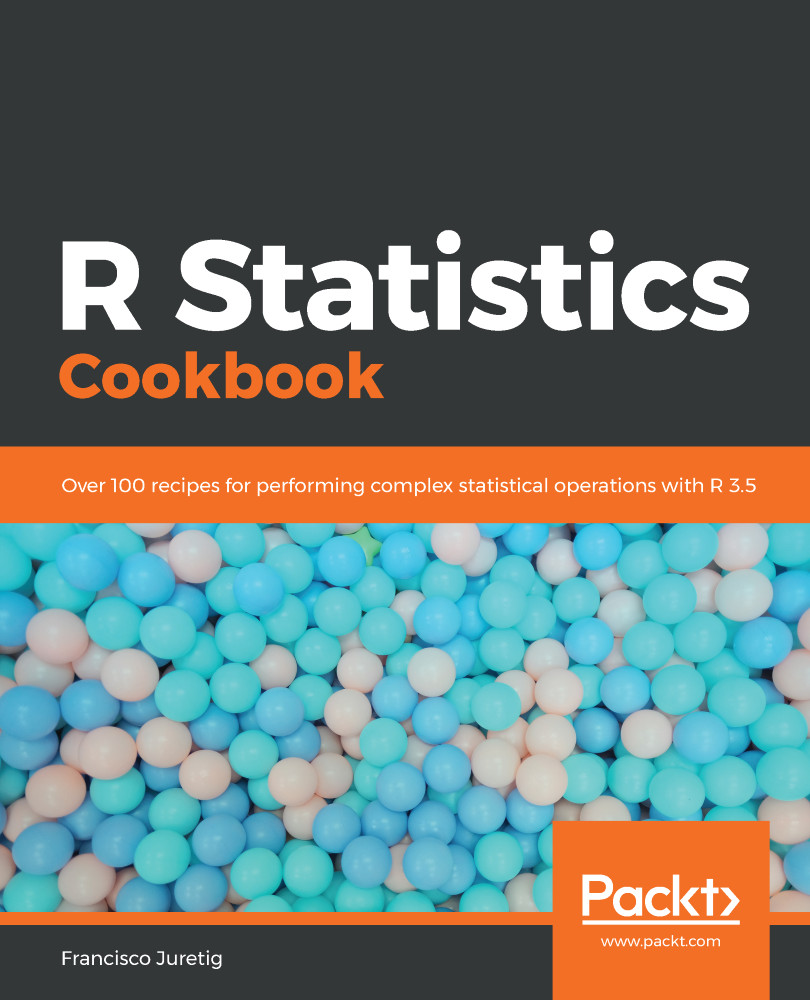
R Statistics Cookbook

R Statistics Cookbook

By : Juretig
4.3 (4)
close
close
R Statistics Cookbook

R Statistics Cookbook

4.3 (4)
By: Juretig

Overview of this book

R is a popular programming language for developing statistical software. This book will be a useful guide to solving common and not-so-common challenges in statistics. With this book, you'll be equipped to confidently perform essential statistical procedures across your organization with the help of cutting-edge statistical tools. You'll start by implementing data modeling, data analysis, and machine learning to solve real-world problems. You'll then understand how to work with nonparametric methods, mixed effects models, and hidden Markov models. This book contains recipes that will guide you in performing univariate and multivariate hypothesis tests, several regression techniques, and using robust techniques to minimize the impact of outliers in data.You'll also learn how to use the caret package for performing machine learning in R. Furthermore, this book will help you understand how to interpret charts and plots to get insights for better decision making. By the end of this book, you will be able to apply your skills to statistical computations using R 3.5. You will also become well-versed with a wide array of statistical techniques in R that are extensively used in the data science industry.
Table of Contents (12 chapters)
close
close

Bayesian variable selection

Bayesian variable selection within a classical context is usually simple. It really boils down to selecting an appropriate metric (such as the AIC or p-values) and evaluating the model in a greedy way; starting with either a simple (or complex) model, and seeing what happens when we add (or remove) terms.

In a Bayesian context, things are not that easy, since we are not treating parameters as fixed values. We are estimating a posterior density, but a density itself has no significance so we can no longer remove them based on p-values. The AIC way can't be used either, as we don't have an AIC value, but a distribution of possible AICs.

Clearly, we need a different way of doing variable selection that takes into consideration that we are dealing with densities. Kuo and Mallick (https://www.jstor.org/stable/25053023?seq=1#page_scan_tab_contents...

CONTINUE READING
83
Tech Concepts
36
Programming languages
73
Tech Tools
Icon Unlimited access to the largest independent learning library in tech of over 8,000 expert-authored tech books and videos.
Icon Innovative learning tools, including AI book assistants, code context explainers, and text-to-speech.
Icon 50+ new titles added per month and exclusive early access to books as they are being written.
R Statistics Cookbook
notes
bookmark Notes and Bookmarks search Search in title playlist Add to playlist download Download options font-size Font size

Change the font size

margin-width Margin width

Change margin width

day-mode Day/Sepia/Night Modes

Change background colour

Close icon Search
Country selected

Close icon Your notes and bookmarks

Confirmation

Modal Close icon
claim successful

Buy this book with your credits?

Modal Close icon
Are you sure you want to buy this book with one of your credits?
Close
YES, BUY

Submit Your Feedback

Modal Close icon
Modal Close icon
Modal Close icon