
Sign In Start Free Trial
Account

Add to playlist

Create a Playlist

Modal Close icon
You need to login to use this feature.
  • Book Overview & Buying Hands-On Neuroevolution with Python
  • Table Of Contents Toc
Hands-On Neuroevolution with Python

Hands-On Neuroevolution with Python

By : Omelianenko
3 (1)
close
close
Hands-On Neuroevolution with Python

Hands-On Neuroevolution with Python

3 (1)
By: Omelianenko

Overview of this book

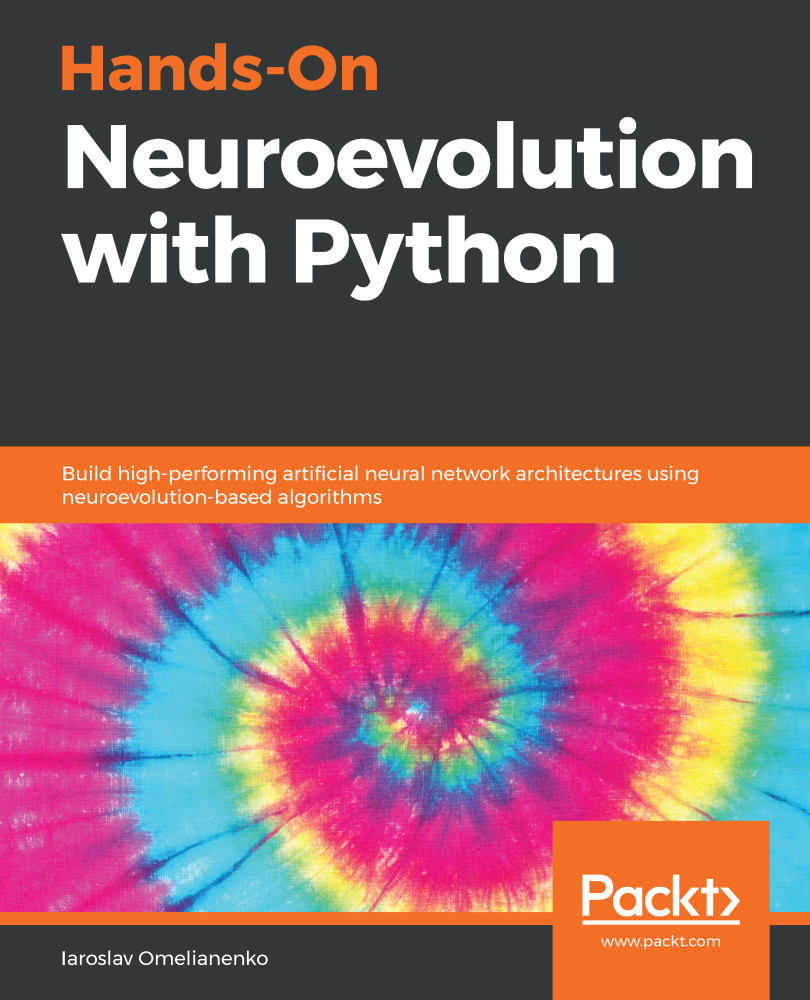
Neuroevolution is a form of artificial intelligence learning that uses evolutionary algorithms to simplify the process of solving complex tasks in domains such as games, robotics, and the simulation of natural processes. This book will give you comprehensive insights into essential neuroevolution concepts and equip you with the skills you need to apply neuroevolution-based algorithms to solve practical, real-world problems. You'll start with learning the key neuroevolution concepts and methods by writing code with Python. You'll also get hands-on experience with popular Python libraries and cover examples of classical reinforcement learning, path planning for autonomous agents, and developing agents to autonomously play Atari games. Next, you'll learn to solve common and not-so-common challenges in natural computing using neuroevolution-based algorithms. Later, you'll understand how to apply neuroevolution strategies to existing neural network designs to improve training and inference performance. Finally, you'll gain clear insights into the topology of neural networks and how neuroevolution allows you to develop complex networks, starting with simple ones. By the end of this book, you will not only have explored existing neuroevolution-based algorithms, but also have the skills you need to apply them in your research and work assignments.
Table of Contents (18 chapters)
close
close
Lock Free Chapter
1
Section 1: Fundamentals of Evolutionary Computation Algorithms and Neuroevolution Methods
4
Section 2: Applying Neuroevolution Methods to Solve Classic Computer Science Problems
9
Section 3: Advanced Neuroevolution Methods
14
Section 4: Discussion and Concluding Remarks

Summary

In this chapter, we learned how to implement control strategies for controllers that can maintain a stable state of a cart-pole apparatus with one or two poles mounted on top. We improved our Python skills and expanded our knowledge of the NEAT-Python library by implementing accurate simulations of physical apparatuses, which was used to define the objective functions for the experiments. Besides this, we learned about two methods for numerical approximations of differential equations, Euler's and Runge-Kutta, and implemented them in Python.

We found that the initial conditions that determine the neuroevolutionary process, such as a random seed number, have a significant impact on the performance of the algorithm. These values determine the entire sequence of numbers that will be generated by a random number generator. They serve as a random attractor that can amplify...

CONTINUE READING
83
Tech Concepts
36
Programming languages
73
Tech Tools
Icon Unlimited access to the largest independent learning library in tech of over 8,000 expert-authored tech books and videos.
Icon Innovative learning tools, including AI book assistants, code context explainers, and text-to-speech.
Icon 50+ new titles added per month and exclusive early access to books as they are being written.
Hands-On Neuroevolution with Python
notes
bookmark Notes and Bookmarks search Search in title playlist Add to playlist download Download options font-size Font size

Change the font size

margin-width Margin width

Change margin width

day-mode Day/Sepia/Night Modes

Change background colour

Close icon Search
Country selected

Close icon Your notes and bookmarks

Confirmation

Modal Close icon
claim successful

Buy this book with your credits?

Modal Close icon
Are you sure you want to buy this book with one of your credits?
Close
YES, BUY

Submit Your Feedback

Modal Close icon
Modal Close icon
Modal Close icon