Sign In Start Free Trial
Account

Add to playlist

Create a Playlist

Modal Close icon
You need to login to use this feature.
  • Book Overview & Buying Embedded Programming with Modern C++ Cookbook
  • Table Of Contents Toc
  • Feedback & Rating feedback
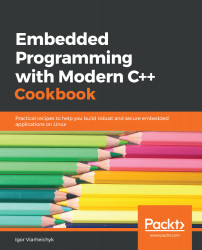
Embedded Programming with Modern C++ Cookbook

Embedded Programming with Modern C++ Cookbook

By : Viarheichyk
3.9 (7)
close
close
Embedded Programming with Modern C++ Cookbook

Embedded Programming with Modern C++ Cookbook

3.9 (7)
By: Viarheichyk

Overview of this book

Developing applications for embedded systems may seem like a daunting task as developers face challenges related to limited memory, high power consumption, and maintaining real-time responses. This book is a collection of practical examples to explain how to develop applications for embedded boards and overcome the challenges that you may encounter while developing. The book will start with an introduction to embedded systems and how to set up the development environment. By teaching you to build your first embedded application, the book will help you progress from the basics to more complex concepts, such as debugging, logging, and profiling. Moving ahead, you will learn how to use specialized memory and custom allocators. From here, you will delve into recipes that will teach you how to work with the C++ memory model, atomic variables, and synchronization. The book will then take you through recipes on inter-process communication, data serialization, and timers. Finally, you will cover topics such as error handling and guidelines for real-time systems and safety-critical systems. By the end of this book, you will have become proficient in building robust and secure embedded applications with C++.
Table of Contents (17 chapters)
close
close

Memory Management

Memory efficiency is one of the major requirements for embedded applications. Since target embedded platforms often have limited performance and memory capabilities, developers need to know how to use available memory in the most efficient way.

Surprisingly, the most efficient way does not necessarily mean that the least amount of memory is used. Since embedded systems are specialized, developers know in advance which applications or components will be executed on the system. Saving memory in one application does not result in any gain unless another application running in the same system can use the extra memory. That is why the most important characteristic of memory management in embedded systems is determinism, or predictability. It is much more important to know that an application can use two megabytes of memory under any load than knowing an application...

Visually different images
CONTINUE READING
83
Tech Concepts
36
Programming languages
73
Tech Tools
Icon Unlimited access to the largest independent learning library in tech of over 8,000 expert-authored tech books and videos.
Icon Innovative learning tools, including AI book assistants, code context explainers, and text-to-speech.
Icon 50+ new titles added per month and exclusive early access to books as they are being written.
Embedded Programming with Modern C++ Cookbook
notes
bookmark Notes and Bookmarks search Search in title playlist Add to playlist download Download options font-size Font size

Change the font size

margin-width Margin width

Change margin width

day-mode Day/Sepia/Night Modes

Change background colour

Close icon Search
Country selected

Close icon Your notes and bookmarks

Confirmation

Modal Close icon
claim successful

Buy this book with your credits?

Modal Close icon
Are you sure you want to buy this book with one of your credits?
Close
YES, BUY

Submit Your Feedback

Modal Close icon
Modal Close icon
Modal Close icon