Sign In Start Free Trial
Account

Add to playlist

Create a Playlist

Modal Close icon
You need to login to use this feature.
  • Book Overview & Buying Delphi High Performance
  • Table Of Contents Toc
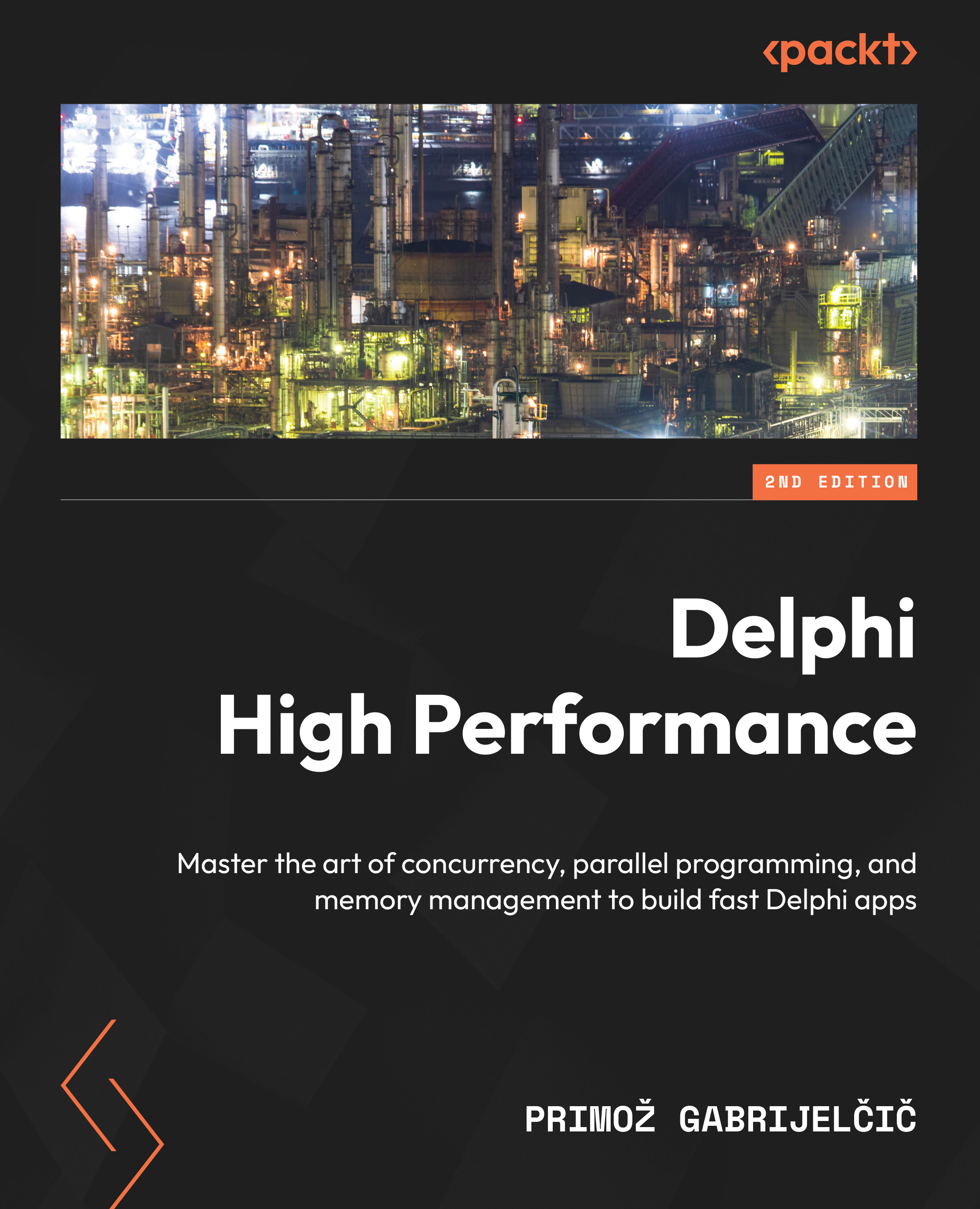
Delphi High Performance

Delphi High Performance - Second Edition

By : Primož Gabrijelčič
4.9 (11)
close
close
Delphi High Performance

Delphi High Performance

4.9 (11)
By: Primož Gabrijelčič

Overview of this book

Performance matters! Users hate to use programs that are not responsive to interactions or run too slow to be useful. While becoming a programmer is simple enough, you require dedication and hard work to achieve an advanced level of programming proficiency where you know how to write fast code. This book begins by helping you explore algorithms and algorithmic complexity and continues by describing tools that can help you find slow parts of your code. Subsequent chapters will provide you with practical ideas about optimizing code by doing less work or doing it in a smarter way. The book also teaches you how to use optimized data structures from the Spring4D library, along with exploring data structures that are not part of the standard Delphi runtime library. The second part of the book talks about parallel programming. You’ll learn about the problems that only occur in multithreaded code and explore various approaches to fixing them effectively. The concluding chapters provide instructions on writing parallel code in different ways – by using basic threading support or focusing on advanced concepts such as tasks and parallel patterns. By the end of this book, you’ll have learned to look at your programs from a totally different perspective and will be equipped to effortlessly make your code faster than it is now.
Table of Contents (15 chapters)
close
close

Profiling the Code

Now that we know what performance is and how to measure it, we can start speeding up our programs. This is, however, not an easy process. For starters, we must know which parts of the program are slowing us down, and that can sometimes be hard to determine.

We can, of course, start by guessing. This will sometimes work, but it will often just result in wasted time and frustration. It turns out that it is usually hard to tell what will be a slow part of a complex program. Even if we start by guessing, it is good if we can then confirm our assumption before we start rewriting the code.

We can do that by adding measurement code, which works great if a program is small or if we know which specific part we want to improve, but most of the time, it is better to use a specialized tool: a profiler.

In this chapter, we’ll look into both approaches, manual profiling and using an automated tool.

We will cover the following topics:

  • Why is it better to measure than to guess?
  • How to manually determine which part of the program is the slowest
  • What tools can we use to find the slow parts of a program?
Visually different images
CONTINUE READING
83
Tech Concepts
36
Programming languages
73
Tech Tools
Icon Unlimited access to the largest independent learning library in tech of over 8,000 expert-authored tech books and videos.
Icon Innovative learning tools, including AI book assistants, code context explainers, and text-to-speech.
Icon 50+ new titles added per month and exclusive early access to books as they are being written.
Delphi High Performance
notes
bookmark Notes and Bookmarks search Search in title playlist Add to playlist download Download options font-size Font size

Change the font size

margin-width Margin width

Change margin width

day-mode Day/Sepia/Night Modes

Change background colour

Close icon Search
Country selected

Close icon Your notes and bookmarks

Confirmation

Modal Close icon
claim successful

Buy this book with your credits?

Modal Close icon
Are you sure you want to buy this book with one of your credits?
Close
YES, BUY

Submit Your Feedback

Modal Close icon
Modal Close icon
Modal Close icon