Sign In Start Free Trial
Account

Add to playlist

Create a Playlist

Modal Close icon
You need to login to use this feature.
  • Book Overview & Buying Mastering Julia
  • Table Of Contents Toc
Mastering Julia

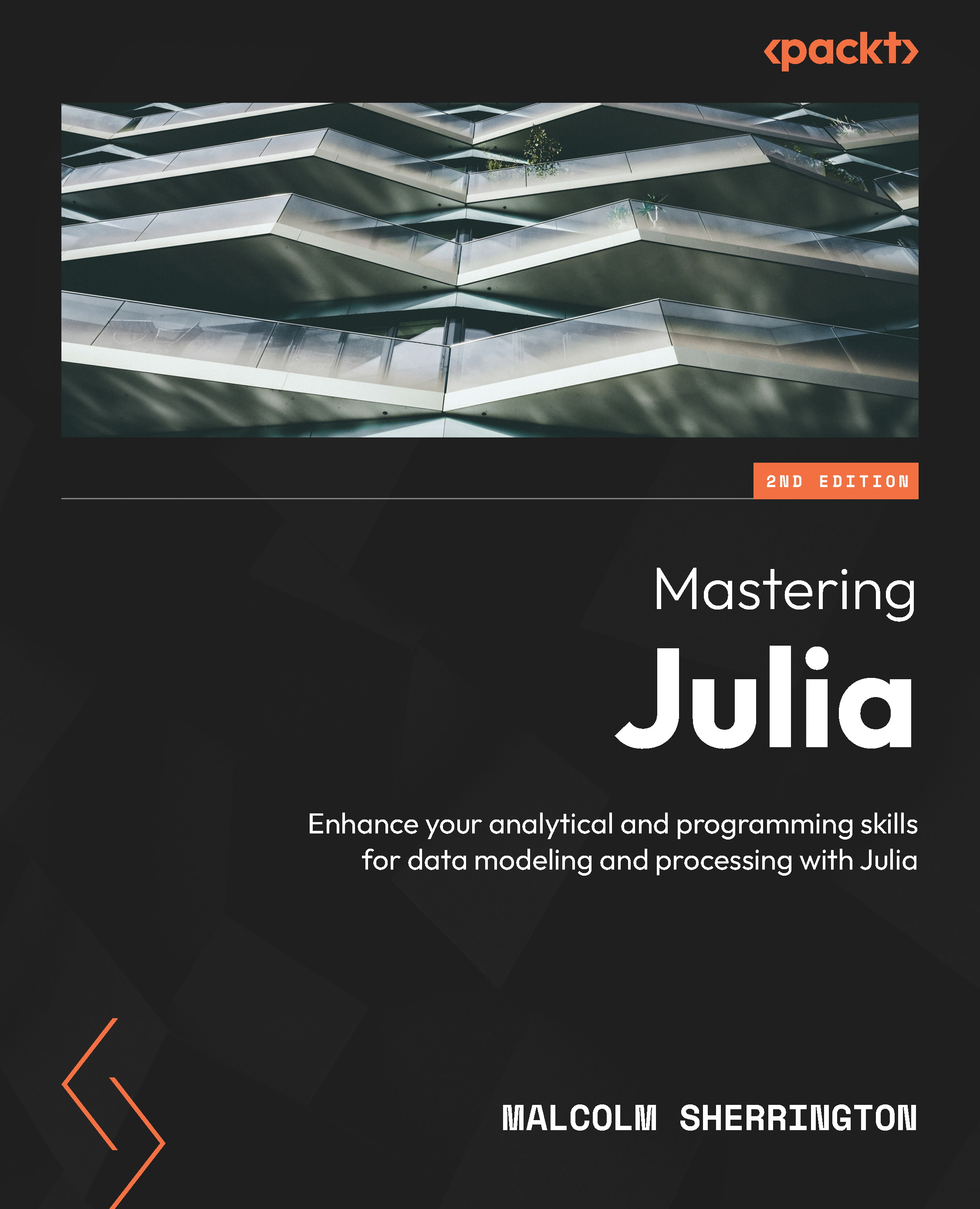
Mastering Julia - Second Edition

By : Malcolm Sherrington
4.3 (3)
close
close
Mastering Julia

Mastering Julia

4.3 (3)
By: Malcolm Sherrington

Overview of this book

Julia is a well-constructed programming language which was designed for fast execution speed by using just-in-time LLVM compilation techniques, thus eliminating the classic problem of performing analysis in one language and translating it for performance in a second. This book is a primer on Julia’s approach to a wide variety of topics such as scientific computing, statistics, machine learning, simulation, graphics, and distributed computing. Starting off with a refresher on installing and running Julia on different platforms, you’ll quickly get to grips with the core concepts and delve into a discussion on how to use Julia with various code editors and interactive development environments (IDEs). As you progress, you’ll see how data works through simple statistics and analytics and discover Julia's speed, its real strength, which makes it particularly useful in highly intensive computing tasks. You’ll also and observe how Julia can cooperate with external processes to enhance graphics and data visualization. Finally, you will explore metaprogramming and learn how it adds great power to the language and establish networking and distributed computing with Julia. By the end of this book, you’ll be confident in using Julia as part of your existing skill set.
Table of Contents (14 chapters)
close
close

Summary

In this chapter, we dipped our toes into the networking and distributed capabilities of Julia. I didn’t discuss its threading capabilities since this is purely experimental, but much effort is being directed to it and it should be a major feature in Julia v2.

We started with basic networking services available from UDP and TCP sockets and showed how a simple “Julia through the looking glass” echo sever could be written. Then, we moved on to web clients and servers prescribed by the HTTP.jl package. After, we discussed how, when working on the web, it is possible to implement socket-style systems using HTTP protocols.

The last section was somewhat different, in which we considered Julia’s approach to executing tasks in parallel over distributed and multiprocessor systems and dealing with datasets distributed over multiple data files. There is one separate topic that must be considered and that is using Julia in the cloud; we will cover this...

CONTINUE READING
83
Tech Concepts
36
Programming languages
73
Tech Tools
Icon Unlimited access to the largest independent learning library in tech of over 8,000 expert-authored tech books and videos.
Icon Innovative learning tools, including AI book assistants, code context explainers, and text-to-speech.
Icon 50+ new titles added per month and exclusive early access to books as they are being written.
Mastering Julia
notes
bookmark Notes and Bookmarks search Search in title playlist Add to playlist download Download options font-size Font size

Change the font size

margin-width Margin width

Change margin width

day-mode Day/Sepia/Night Modes

Change background colour

Close icon Search
Country selected

Close icon Your notes and bookmarks

Confirmation

Modal Close icon
claim successful

Buy this book with your credits?

Modal Close icon
Are you sure you want to buy this book with one of your credits?
Close
YES, BUY

Submit Your Feedback

Modal Close icon
Modal Close icon
Modal Close icon