Sign In Start Free Trial
Account

Add to playlist

Create a Playlist

Modal Close icon
You need to login to use this feature.
  • Book Overview & Buying Mastering Julia
  • Table Of Contents Toc
Mastering Julia

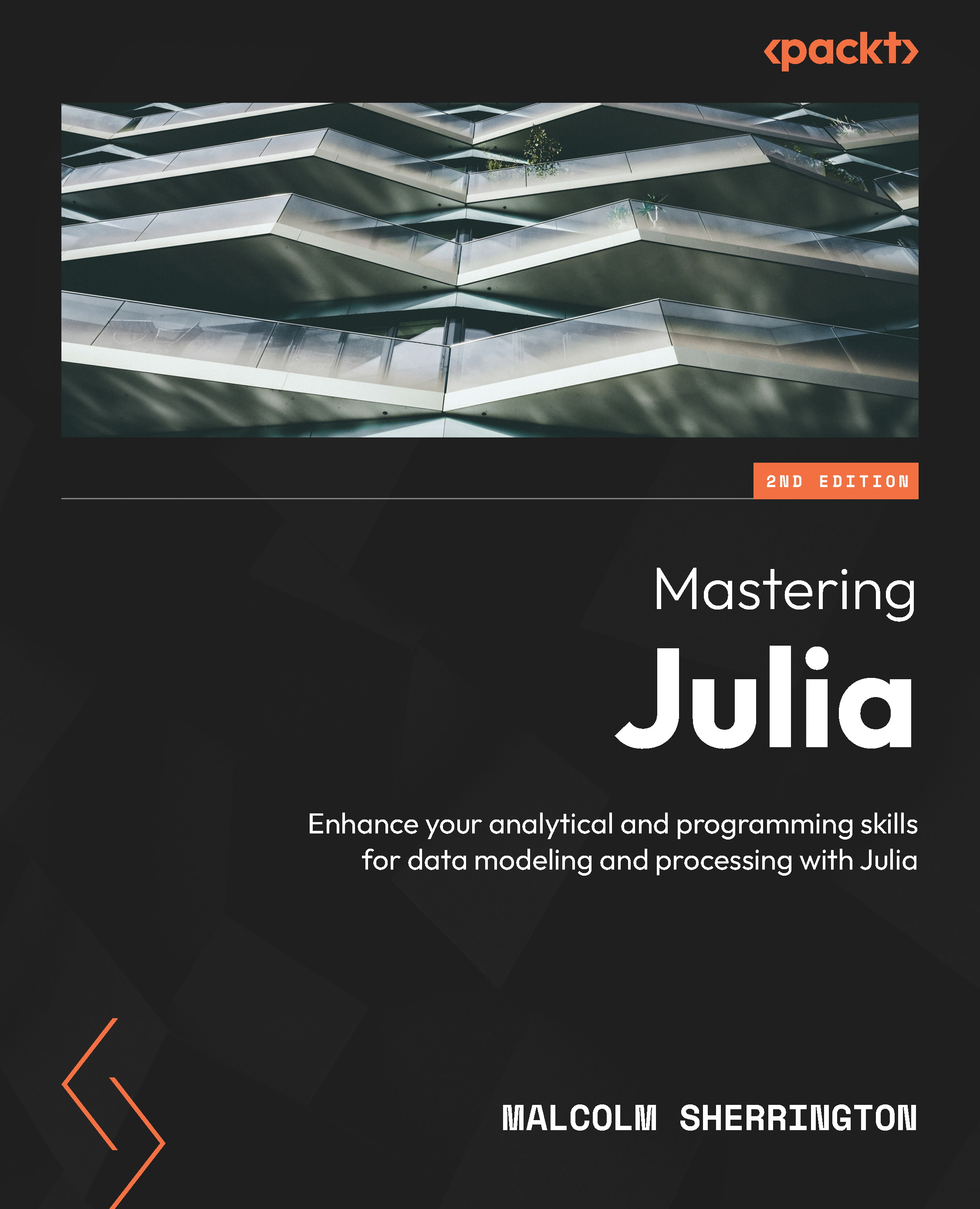
Mastering Julia - Second Edition

By : Malcolm Sherrington
4.3 (3)
close
close
Mastering Julia

Mastering Julia

4.3 (3)
By: Malcolm Sherrington

Overview of this book

Julia is a well-constructed programming language which was designed for fast execution speed by using just-in-time LLVM compilation techniques, thus eliminating the classic problem of performing analysis in one language and translating it for performance in a second. This book is a primer on Julia’s approach to a wide variety of topics such as scientific computing, statistics, machine learning, simulation, graphics, and distributed computing. Starting off with a refresher on installing and running Julia on different platforms, you’ll quickly get to grips with the core concepts and delve into a discussion on how to use Julia with various code editors and interactive development environments (IDEs). As you progress, you’ll see how data works through simple statistics and analytics and discover Julia's speed, its real strength, which makes it particularly useful in highly intensive computing tasks. You’ll also and observe how Julia can cooperate with external processes to enhance graphics and data visualization. Finally, you will explore metaprogramming and learn how it adds great power to the language and establish networking and distributed computing with Julia. By the end of this book, you’ll be confident in using Julia as part of your existing skill set.
Table of Contents (14 chapters)
close
close

Database preliminaries

A few years ago, discussing databases was simple. We spoke of relational databases such as Oracle, MySQL, and SQL Server and that was pretty much it. There were some exceptions, such as databases involved in Lightweight Directory Access Protocol (LDAP) and some configuration databases based on XML, when the whole world was relational. Even products that were not purely relational, such as Microsoft Access, tried to present a relational face to the user.

We usually use the terms relational and SQL database interchangeably, although the latter more correctly refers to the method of querying the database than to its architecture. What changed was the explosion of large databases from sources such as Google, Facebook, and Twitter, which could not be accommodated by scaling up the existing SQL databases of the time, and indeed such databases still cannot.

Relational databases consist of a set of tables, normally linked with a main (termed primary) key and related...

CONTINUE READING
83
Tech Concepts
36
Programming languages
73
Tech Tools
Icon Unlimited access to the largest independent learning library in tech of over 8,000 expert-authored tech books and videos.
Icon Innovative learning tools, including AI book assistants, code context explainers, and text-to-speech.
Icon 50+ new titles added per month and exclusive early access to books as they are being written.
Mastering Julia
notes
bookmark Notes and Bookmarks search Search in title playlist Add to playlist download Download options font-size Font size

Change the font size

margin-width Margin width

Change margin width

day-mode Day/Sepia/Night Modes

Change background colour

Close icon Search
Country selected

Close icon Your notes and bookmarks

Confirmation

Modal Close icon
claim successful

Buy this book with your credits?

Modal Close icon
Are you sure you want to buy this book with one of your credits?
Close
YES, BUY

Submit Your Feedback

Modal Close icon
Modal Close icon
Modal Close icon