


- One outcome of bad code is that you can end up with a really badly written piece of code that is hard to understand. This can often lead to programmer stress and software that is buggy, hard to maintain, and hard to test and extend.
- One outcome of good code is that it is easy to read and understand, as you know the programmer's intent. This leads to less stress for programmers who must debug the code, test it, and extend it.
- When you break a large project up into modular components and libraries, each module can be worked on by separate teams concurrently. Small modules are easy to test, code, document, deploy, extend, and maintain.
- DRY stands for Don't Repeat Yourself. Look for repeatable code, and refactor it so that you remove duplicate code. The advantage of this is smaller programs, because if such code contains bugs, you only have to change it in one place.
- KISS means simple code that will not confuse...
-
Book Overview & Buying
-
Table Of Contents

Clean Code in C#
By :


Clean Code in C#
By:
Overview of this book
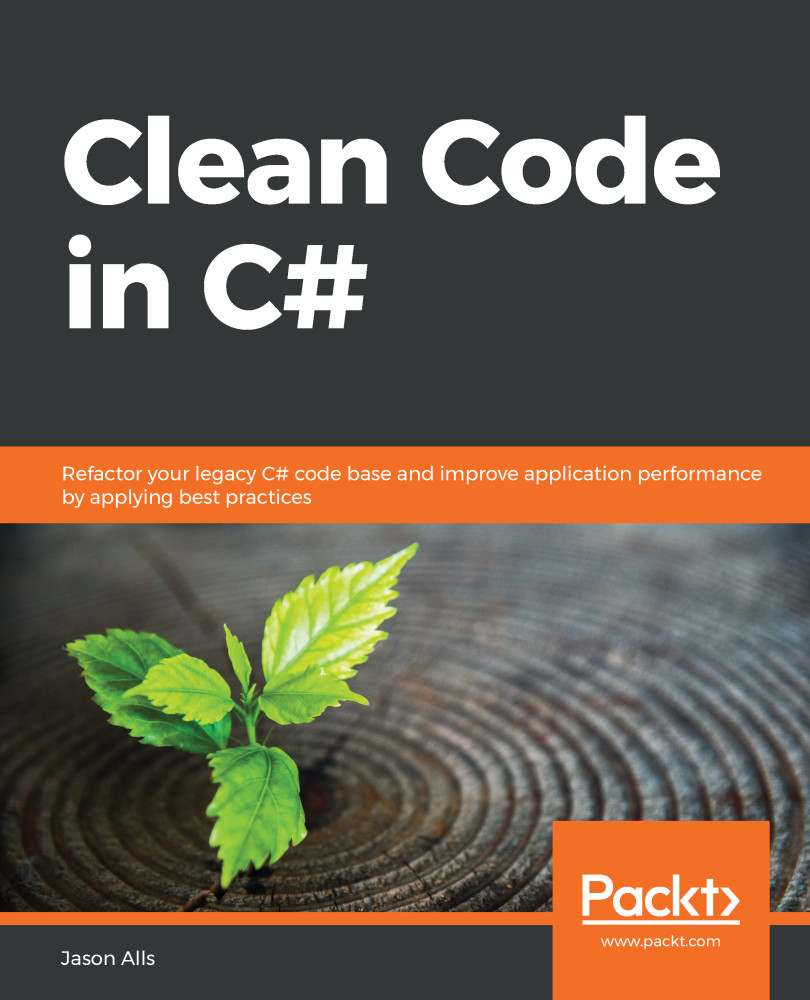
Traditionally associated with developing Windows desktop applications and games, C# is now used in a wide variety of domains, such as web and cloud apps, and has become increasingly popular for mobile development. Despite its extensive coding features, professionals experience problems related to efficiency, scalability, and maintainability because of bad code. Clean Code in C# will help you identify these problems and solve them using coding best practices.
The book starts with a comparison of good and bad code, helping you understand the importance of coding standards, principles, and methodologies. You’ll then get to grips with code reviews and their role in improving your code while ensuring that you adhere to industry-recognized coding standards. This C# book covers unit testing, delves into test-driven development, and addresses cross-cutting concerns. You’ll explore good programming practices for objects, data structures, exception handling, and other aspects of writing C# computer programs. Once you’ve studied API design and discovered tools for improving code quality, you’ll look at examples of bad code and understand which coding practices you should avoid.
By the end of this clean code book, you’ll have the developed skills you need in order to apply industry-approved coding practices to write clean, readable, extendable, and maintainable C# code.
Table of Contents (17 chapters)
Preface

Coding Standards and Principles in C#
 Free Chapter
Code Review – Process and Importance
Classes, Objects, and Data Structures
Writing Clean Functions
Exception Handling
Unit Testing
End-to-End System Testing
Threading and Concurrency
Designing and Developing APIs
Securing APIs with API Keys and Azure Key Vault
Addressing Cross-Cutting Concerns
Using Tools to Improve Code Quality
Refactoring C# Code – Identifying Code Smells
Refactoring C# Code – Implementing Design Patterns
Assessments

Other Books You May Enjoy



