
Sign In Start Free Trial
Account

Add to playlist

Create a Playlist

Modal Close icon
You need to login to use this feature.
  • Book Overview & Buying Clean Code in C#
  • Table Of Contents Toc
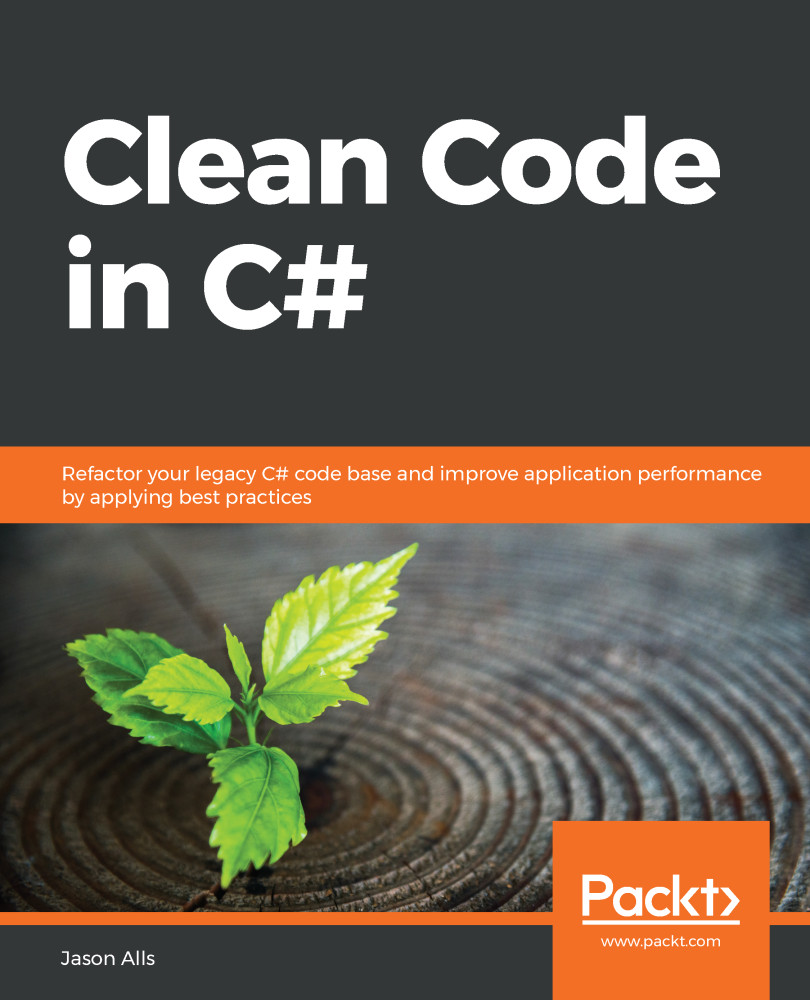
Clean Code in C#

Clean Code in C#

By : Jason Alls
4.1 (8)
close
close
Clean Code in C#

Clean Code in C#

4.1 (8)
By: Jason Alls

Overview of this book

Traditionally associated with developing Windows desktop applications and games, C# is now used in a wide variety of domains, such as web and cloud apps, and has become increasingly popular for mobile development. Despite its extensive coding features, professionals experience problems related to efficiency, scalability, and maintainability because of bad code. Clean Code in C# will help you identify these problems and solve them using coding best practices. The book starts with a comparison of good and bad code, helping you understand the importance of coding standards, principles, and methodologies. You’ll then get to grips with code reviews and their role in improving your code while ensuring that you adhere to industry-recognized coding standards. This C# book covers unit testing, delves into test-driven development, and addresses cross-cutting concerns. You’ll explore good programming practices for objects, data structures, exception handling, and other aspects of writing C# computer programs. Once you’ve studied API design and discovered tools for improving code quality, you’ll look at examples of bad code and understand which coding practices you should avoid. By the end of this clean code book, you’ll have the developed skills you need in order to apply industry-approved coding practices to write clean, readable, extendable, and maintainable C# code.
Table of Contents (17 chapters)
close
close

Summary

In this chapter, we covered what threading is and how to use it. We looked at the problems of deadlocks and race conditions in action, and we saw how to prevent these exceptional circumstances using a lock statement and the TPL library. We also discussed the thread safety of static constructors, static methods, immutable objects, and mutable objects. We saw why using immutable objects is a thread-safe way of transferring data between threads, and we reviewed some general recommendations for working with threads.

We also saw how making your code thread-safe can have a lot of benefits. In the next chapter, we will look at designing effective APIs. But for now, you can test your knowledge by answering the following questions and you can further your reading by referring to the links provided.

CONTINUE READING
83
Tech Concepts
36
Programming languages
73
Tech Tools
Icon Unlimited access to the largest independent learning library in tech of over 8,000 expert-authored tech books and videos.
Icon Innovative learning tools, including AI book assistants, code context explainers, and text-to-speech.
Icon 50+ new titles added per month and exclusive early access to books as they are being written.
Clean Code in C#
notes
bookmark Notes and Bookmarks search Search in title playlist Add to playlist download Download options font-size Font size

Change the font size

margin-width Margin width

Change margin width

day-mode Day/Sepia/Night Modes

Change background colour

Close icon Search
Country selected

Close icon Your notes and bookmarks

Confirmation

Modal Close icon
claim successful

Buy this book with your credits?

Modal Close icon
Are you sure you want to buy this book with one of your credits?
Close
YES, BUY

Submit Your Feedback

Modal Close icon
Modal Close icon
Modal Close icon