


- Cross-cutting concerns are those concerns that not part of the business requirements that form the core concerns, but that must be addressed in all areas of the code. AOP stands for Aspect-Oriented Programming.
- An aspect is an attribute that, when applied to a class, method, property, or parameter, injects code at compile time. You apply an aspect in square brackets before the item it is being applied to.
- An attribute gives semantic meaning to an item. You apply an attribute in square brackets before the item it is being applied to.
- Attributes give the code semantic meaning, while aspects remove the boilerplate code so that it is injected at compile time.
- When the code is being built, the compiler will insert the boilerplate code that the aspect hides from the programmer. This process is known as code weaving.
-
Book Overview & Buying
-
Table Of Contents

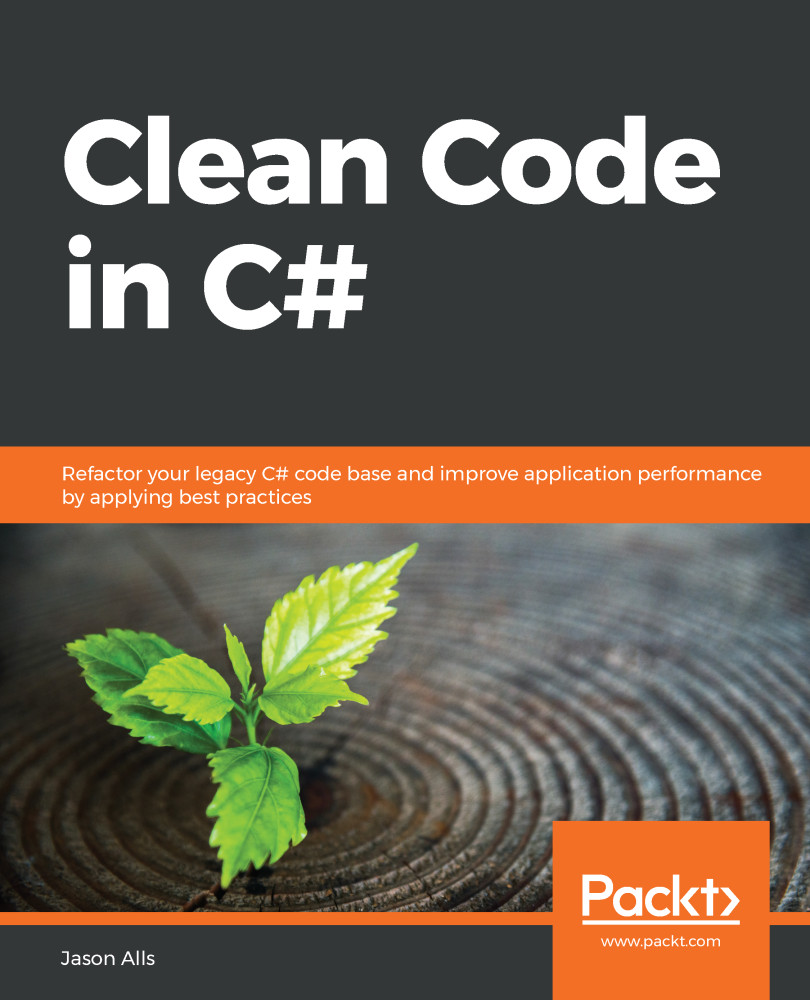
Clean Code in C#
By :


Clean Code in C#
By:
Overview of this book
Traditionally associated with developing Windows desktop applications and games, C# is now used in a wide variety of domains, such as web and cloud apps, and has become increasingly popular for mobile development. Despite its extensive coding features, professionals experience problems related to efficiency, scalability, and maintainability because of bad code. Clean Code in C# will help you identify these problems and solve them using coding best practices.
The book starts with a comparison of good and bad code, helping you understand the importance of coding standards, principles, and methodologies. You’ll then get to grips with code reviews and their role in improving your code while ensuring that you adhere to industry-recognized coding standards. This C# book covers unit testing, delves into test-driven development, and addresses cross-cutting concerns. You’ll explore good programming practices for objects, data structures, exception handling, and other aspects of writing C# computer programs. Once you’ve studied API design and discovered tools for improving code quality, you’ll look at examples of bad code and understand which coding practices you should avoid.
By the end of this clean code book, you’ll have the developed skills you need in order to apply industry-approved coding practices to write clean, readable, extendable, and maintainable C# code.
Table of Contents (17 chapters)
Preface

Coding Standards and Principles in C#
 Free Chapter
Code Review – Process and Importance
Classes, Objects, and Data Structures
Writing Clean Functions
Exception Handling
Unit Testing
End-to-End System Testing
Threading and Concurrency
Designing and Developing APIs
Securing APIs with API Keys and Azure Key Vault
Addressing Cross-Cutting Concerns
Using Tools to Improve Code Quality
Refactoring C# Code – Identifying Code Smells
Refactoring C# Code – Implementing Design Patterns
Assessments

Other Books You May Enjoy


