Sign In Start Free Trial
Account

Add to playlist

Create a Playlist

Modal Close icon
You need to login to use this feature.
  • Book Overview & Buying C++ High Performance
  • Table Of Contents Toc
  • Feedback & Rating feedback
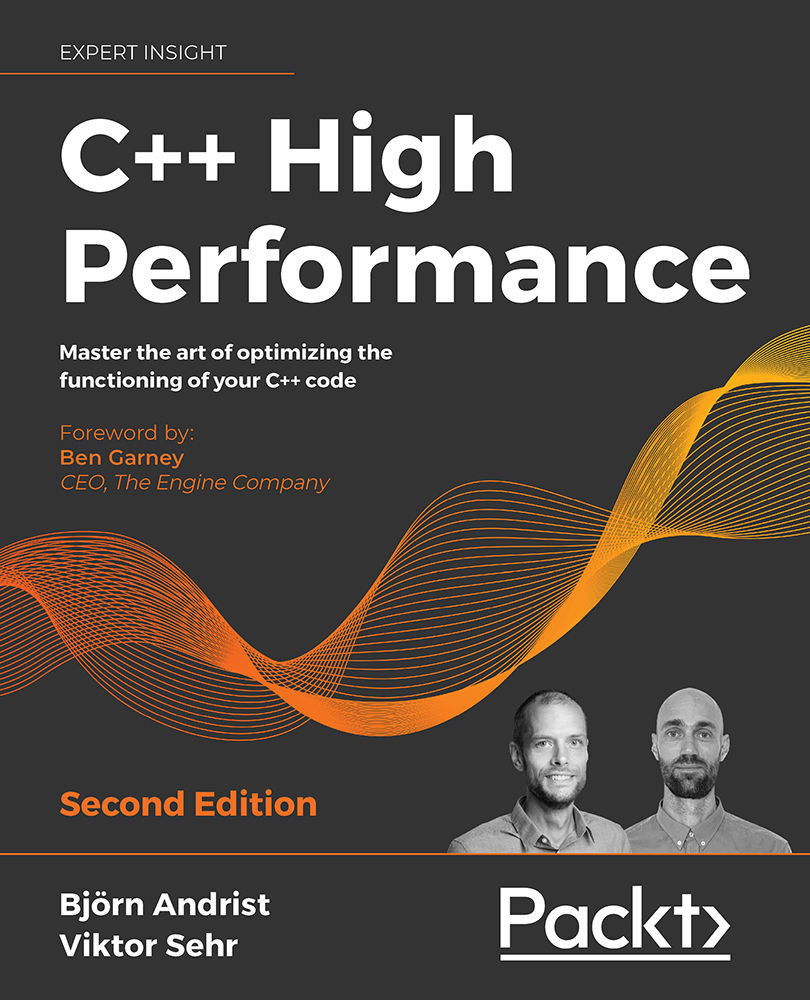
C++ High Performance

C++ High Performance - Second Edition

By : Björn Andrist, Sehr
4.4 (24)
close
close
C++ High Performance

C++ High Performance

4.4 (24)
By: Björn Andrist, Sehr

Overview of this book

C++ High Performance, Second Edition guides you through optimizing the performance of your C++ apps. This allows them to run faster and consume fewer resources on the device they're running on without compromising the readability of your codebase. The book begins by introducing the C++ language and some of its modern concepts in brief. Once you are familiar with the fundamentals, you will be ready to measure, identify, and eradicate bottlenecks in your C++ codebase. By following this process, you will gradually improve your style of writing code. The book then explores data structure optimization, memory management, and how it can be used efficiently concerning CPU caches. After laying the foundation, the book trains you to leverage algorithms, ranges, and containers from the standard library to achieve faster execution, write readable code, and use customized iterators. It provides hands-on examples of C++ metaprogramming, coroutines, reflection to reduce boilerplate code, proxy objects to perform optimizations under the hood, concurrent programming, and lock-free data structures. The book concludes with an overview of parallel algorithms. By the end of this book, you will have the ability to use every tool as needed to boost the efficiency of your C++ projects.
Table of Contents (17 chapters)
close
close
15
Other Books You May Enjoy
16
Index

Essential C++ Techniques

In this chapter, we will take an in-depth look at some fundamental C++ techniques, such as move semantics, error handling, and lambda expressions, that will be used throughout this book. Some of these concepts still confuse even experienced C++ programmers and therefore we will look into both their use cases and how they work under the hood.

This chapter will cover the following topics:

  • Automatic type deduction and how to use the auto keyword when declaring functions and variables.
  • Move semantics and the rule of five and rule of zero.
  • Error handling and contracts. Although these topics don't present anything that can be considered modern C++, both exceptions and contracts are highly debated areas within C++ today.
  • Creating function objects using lambda expressions, one of the most important features from C++11.

Let's begin by taking a look at automatic type deduction.

Visually different images
CONTINUE READING
83
Tech Concepts
36
Programming languages
73
Tech Tools
Icon Unlimited access to the largest independent learning library in tech of over 8,000 expert-authored tech books and videos.
Icon Innovative learning tools, including AI book assistants, code context explainers, and text-to-speech.
Icon 50+ new titles added per month and exclusive early access to books as they are being written.
C++ High Performance
notes
bookmark Notes and Bookmarks search Search in title playlist Add to playlist download Download options font-size Font size

Change the font size

margin-width Margin width

Change margin width

day-mode Day/Sepia/Night Modes

Change background colour

Close icon Search
Country selected

Close icon Your notes and bookmarks

Confirmation

Modal Close icon
claim successful

Buy this book with your credits?

Modal Close icon
Are you sure you want to buy this book with one of your credits?
Close
YES, BUY

Submit Your Feedback

Modal Close icon
Modal Close icon
Modal Close icon