Sign In Start Free Trial
Account

Add to playlist

Create a Playlist

Modal Close icon
You need to login to use this feature.
  • Book Overview & Buying Automotive Cybersecurity Engineering Handbook
  • Table Of Contents Toc
Automotive Cybersecurity Engineering Handbook

Automotive Cybersecurity Engineering Handbook

By : Dr. Ahmad MK Nasser
4.9 (20)
close
close
Automotive Cybersecurity Engineering Handbook

Automotive Cybersecurity Engineering Handbook

4.9 (20)
By: Dr. Ahmad MK Nasser

Overview of this book

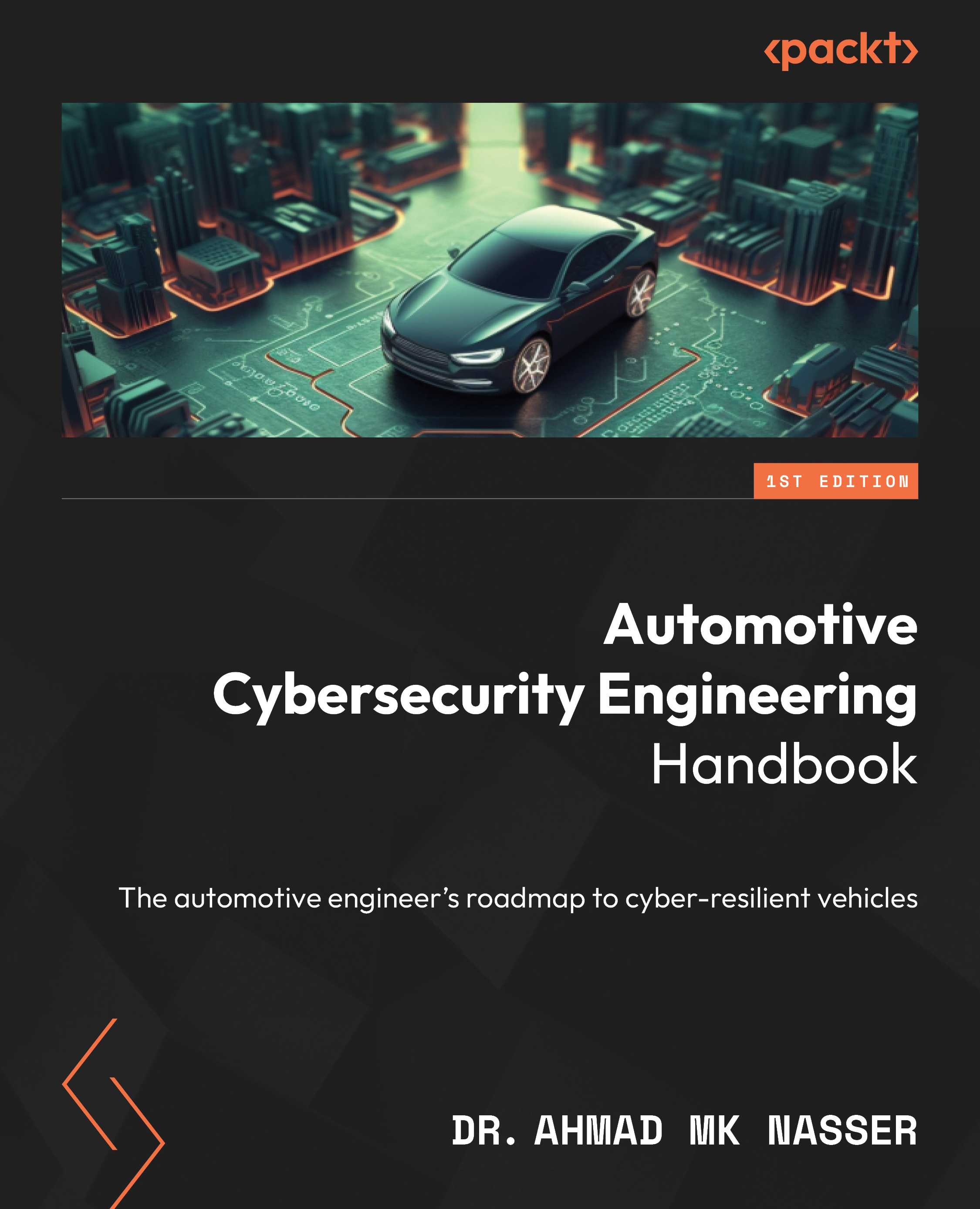
The Automotive Cybersecurity Engineering Handbook introduces the critical technology of securing automotive systems, with a focus on compliance with industry standards like ISO 21434 and UNECE REG 155-156. This book provides automotive engineers and security professionals with the practical knowledge needed to integrate cybersecurity into their development processes, ensuring vehicles remain resilient against cyber threats. Whether you're a functional safety engineer, a software developer, or a security expert transitioning to the automotive domain, this book serves as your roadmap to implementing effective cybersecurity practices within automotive systems. The purpose of this book is to demystify automotive cybersecurity and bridge the gap between safety-critical systems and cybersecurity requirements. It addresses the needs of professionals who are expected to make their systems secure without sacrificing time, quality, or safety. Unlike other resources, this book offers a practical, real-world approach, focusing on the integration of security into the engineering process, using existing frameworks and tools. By the end of this book, readers will understand the importance of automotive cybersecurity, how to perform threat modeling, and how to deploy robust security controls at various layers of a vehicle's architecture.
Table of Contents (15 chapters)
close
close
1
Part 1:Understanding the Cybersecurity Relevance of the Vehicle Electrical Architecture
5
Part 2: Understanding the Secure Engineering Development Process
9
Part 3: Executing the Process to Engineer a Secure Automotive Product

Preface

The subject of automotive cybersecurity involves many concepts, engineering methods, and technologies, some of which are unique to the automotive domain while others are shared with adjacent fields. The unique aspects are derived from the fact that the vehicle belongs to the family of cyber-physical systems. In such systems, embedded computers integrate with sensors and networking components to control physical processes, which then provide feedback to the computing environment. While sharing concepts with the domain of information security, breaches of cyber-physical systems result in physical impacts that can cause the unsafe operation of the system with the potential for injury and loss of life. When you choose to work in the field of automotive cybersecurity, you are not only responsible for protecting the security of the driver’s data, and the intellectual property and reputation of members in the supply chain, but more importantly, you are responsible for protecting the lives of those driving the vehicle or coming within its vicinity.

The complexity of producing vehicles that are secure by design goes beyond the technology challenges and spans several factors that are unique to the automotive industry. These include the complexity of the automotive supply chain, the legacy systems and practices that are hard to change, the limited allocated budgets for deploying security controls, the ever-shrinking program schedules, the limited computing resources, and the stringent power consumption requirements. All of these factors must be considered while meeting strict regulatory requirements and standards, which makes the job of automotive cybersecurity engineers both exciting and exhausting at the same time. To make matters worse, there is a severe shortage of automotive cybersecurity professionals, and all these while vehicles are becoming more connected, putting them at increased risk of cyber attacks. While software-defined vehicle transformation is underway, the trend of increased autonomy and connectivity will not be successful if vehicles are not developed on a secure foundation. Just like in adjacent domains, such as banking, cloud computing, and enterprise systems, when an opportunity for financial gain exists, hackers will find a way to penetrate even the most sophisticated defenses.

To ensure that the automotive industry does not go down the path of other industries in which the rate of fixing vulnerabilities is outpaced by the rate of creating them, there is a need for a systematic approach to cybersecurity engineering that is on par with the quality management and functional safety approaches that have an established record within this industry. You may have heard the phrases “secure by design” and “built-in security” versus “bolt-on security.” These are good mottos that we aim to put into practice throughout this book. Adopting cybersecurity within the engineering life cycle presents many challenges, which this book tries to tackle. The worst-case adoption scenario involves identifying threats but failing to act on risk reduction due to concerns about schedule and cost. Organizations that take this approach usually create a false sense of security by relying on a heavy-handed process that produces reams of paperwork to document risks and risk treatment decisions without investing in the technology needed to mitigate critical risks. Consequently, relying on processes that prioritize paper evidence over technical analysis and thorough argumentation of security risks creates a belief by engineering teams that the cybersecurity process is merely a checkbox exercise that adds no value. It is also possible to create an over-zealous security culture that produces security solutions that are too complicated to achieve in practice. In fact, security experts can lose credibility when they offer too many esoteric solutions that are impractical to implement or that cannot be defended when scrutinized for fulfilling an actual need. It is thus the job of the cybersecurity professionals to strike the right balance between security, technical feasibility, cost, effort, and overall impact on schedule. That is why one of the goals of this book is to define a practical approach for building secure systems that integrate seamlessly with existing engineering processes and tools while producing effective results.

There is no doubt that today, there exists a sizeable knowledge gap. To close this gap, the automotive industry either recruits security professionals with limited automotive knowledge or trains automotive engineers with limited security knowledge. This book aims to bridge the gap between the two groups of professionals by providing a balanced approach that reduces security risks to reasonable levels while working within the acceptable parameters of producing sellable automotive systems.

Throughout this book, you will notice that we do not dwell heavily on theory, and sometimes concepts may intentionally be over-simplified in favor of highlighting their practical aspects. It is the intent of this book to expose you to the widest set of cybersecurity topics that are relevant to this domain so you may later choose the level of depth you want to pursue in areas of interest. You might already be a practicing professional or someone who is just getting into the field. Either way, sooner or later, you will discover that what may be more challenging than producing technical security solutions is convincing people of the risks that need mitigation and why the pain they must endure now is justified in the long run. Having a formalized security engineering approach can help reduce the amount of subjectivity during these difficult conversations to avoid endless debates about what is considered a reasonable risk. That is why this book aims to reframe the security conversation through a common language that stresses objectivity while focusing on cybersecurity risk reduction.

Note

The views and opinions expressed in this book are solely those of the author and do not necessarily represent or reflect the views of current or past employers.

CONTINUE READING
83
Tech Concepts
36
Programming languages
73
Tech Tools
Icon Unlimited access to the largest independent learning library in tech of over 8,000 expert-authored tech books and videos.
Icon Innovative learning tools, including AI book assistants, code context explainers, and text-to-speech.
Icon 50+ new titles added per month and exclusive early access to books as they are being written.
Automotive Cybersecurity Engineering Handbook
notes
bookmark Notes and Bookmarks search Search in title playlist Add to playlist download Download options font-size Font size

Change the font size

margin-width Margin width

Change margin width

day-mode Day/Sepia/Night Modes

Change background colour

Close icon Search
Country selected

Close icon Your notes and bookmarks

Confirmation

Modal Close icon
claim successful

Buy this book with your credits?

Modal Close icon
Are you sure you want to buy this book with one of your credits?
Close
YES, BUY

Submit Your Feedback

Modal Close icon
Modal Close icon
Modal Close icon