
Sign In Start Free Trial
Account

Add to playlist

Create a Playlist

Modal Close icon
You need to login to use this feature.
  • Book Overview & Buying Crafting Test-Driven Software with Python
  • Table Of Contents Toc
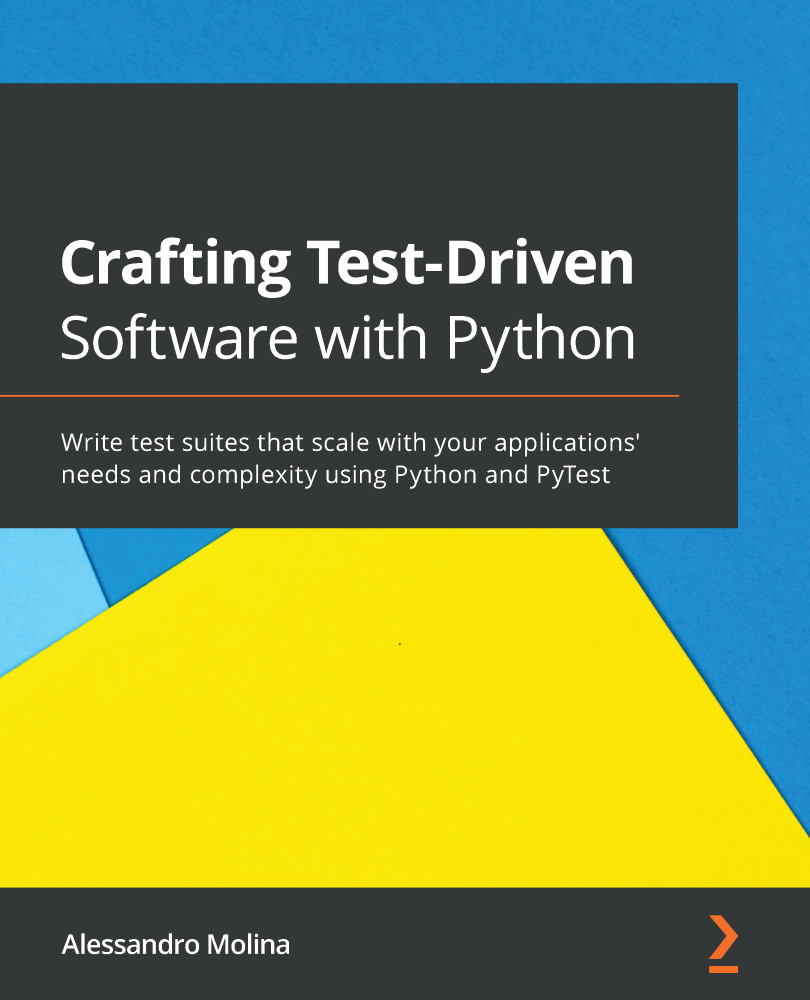
Crafting Test-Driven Software with Python

Crafting Test-Driven Software with Python

By : Molina
4.8 (11)
close
close
Crafting Test-Driven Software with Python

Crafting Test-Driven Software with Python

4.8 (11)
By: Molina

Overview of this book

Test-driven development (TDD) is a set of best practices that helps developers to build more scalable software and is used to increase the robustness of software by using automatic tests. This book shows you how to apply TDD practices effectively in Python projects. You’ll begin by learning about built-in unit tests and Mocks before covering rich frameworks like PyTest and web-based libraries such as WebTest and Robot Framework, discovering how Python allows you to embrace all modern testing practices with ease. Moving on, you’ll find out how to design tests and balance them with new feature development and learn how to create a complete test suite with PyTest. The book helps you adopt a hands-on approach to implementing TDD and associated methodologies that will have you up and running and make you more productive in no time. With the help of step-by-step explanations of essential concepts and practical examples, you’ll explore automatic tests and TDD best practices and get to grips with the methodologies and tools available in Python for creating effective and robust applications. By the end of this Python book, you will be able to write reliable test suites in Python to ensure the long-term resilience of your application using the range of libraries offered by Python for testing and development.
Table of Contents (18 chapters)
close
close
1
Section 1: Software Testing and Test-Driven Development
6
Section 2: PyTest for Python Testing
13
Section 3: Testing for the Web
16
About Packt
End-to-End Testing with the Robot Framework

In the previous chapter, we saw how to test web applications and, in general, applications that rely on the HTTP protocol, both client and server side, but we were unable to test how they perform in a real browser. With their complex layouts, the fact that CSS and JavaScript are heavily involved in testing your application with WebTest or a similar solution might not be sufficient to guarantee users that they are actually able to work with it. What if a button is created by JavaScript or it's disabled by CSS? Those conditions are hard to test using WebTest and we might easily end up with a test that clicks that button even though the button wasn't actually usable by users.

To guarantee that our applications behave properly, it is a good idea to have a few tests that verify at least the more important areas of the application...

Visually different images
CONTINUE READING
83
Tech Concepts
36
Programming languages
73
Tech Tools
Icon Unlimited access to the largest independent learning library in tech of over 8,000 expert-authored tech books and videos.
Icon Innovative learning tools, including AI book assistants, code context explainers, and text-to-speech.
Icon 50+ new titles added per month and exclusive early access to books as they are being written.
Crafting Test-Driven Software with Python
notes
bookmark Notes and Bookmarks search Search in title playlist Add to playlist download Download options font-size Font size

Change the font size

margin-width Margin width

Change margin width

day-mode Day/Sepia/Night Modes

Change background colour

Close icon Search
Country selected

Close icon Your notes and bookmarks

Confirmation

Modal Close icon
claim successful

Buy this book with your credits?

Modal Close icon
Are you sure you want to buy this book with one of your credits?
Close
YES, BUY

Submit Your Feedback

Modal Close icon
Modal Close icon
Modal Close icon