
Sign In Start Free Trial
Account

Add to playlist

Create a Playlist

Modal Close icon
You need to login to use this feature.
  • Book Overview & Buying Crafting Test-Driven Software with Python
  • Table Of Contents Toc
Crafting Test-Driven Software with Python

Crafting Test-Driven Software with Python

By : Alessandro Molina
4.8 (11)
close
close
Crafting Test-Driven Software with Python

Crafting Test-Driven Software with Python

4.8 (11)
By: Alessandro Molina

Overview of this book

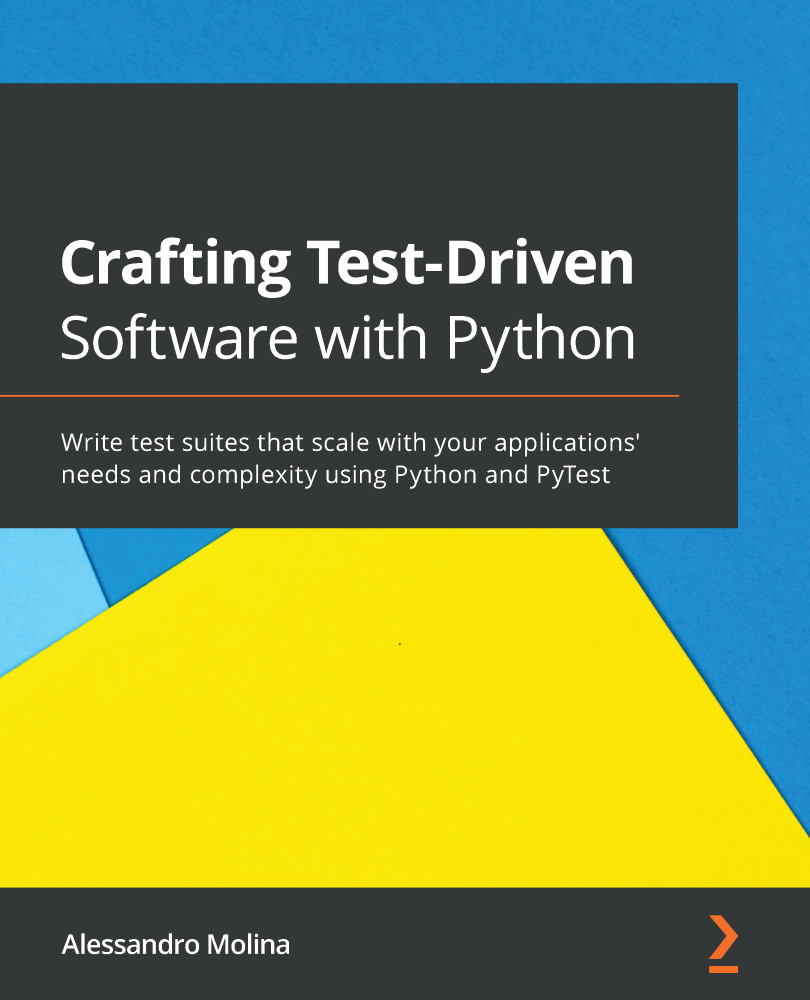
Test-driven development (TDD) is a set of best practices that helps developers to build more scalable software and is used to increase the robustness of software by using automatic tests. This book shows you how to apply TDD practices effectively in Python projects. You’ll begin by learning about built-in unit tests and Mocks before covering rich frameworks like PyTest and web-based libraries such as WebTest and Robot Framework, discovering how Python allows you to embrace all modern testing practices with ease. Moving on, you’ll find out how to design tests and balance them with new feature development and learn how to create a complete test suite with PyTest. The book helps you adopt a hands-on approach to implementing TDD and associated methodologies that will have you up and running and make you more productive in no time. With the help of step-by-step explanations of essential concepts and practical examples, you’ll explore automatic tests and TDD best practices and get to grips with the methodologies and tools available in Python for creating effective and robust applications. By the end of this Python book, you will be able to write reliable test suites in Python to ensure the long-term resilience of your application using the range of libraries offered by Python for testing and development.
Table of Contents (18 chapters)
close
close
1
Section 1: Software Testing and Test-Driven Development
6
Section 2: PyTest for Python Testing
13
Section 3: Testing for the Web
16
About Packt

Summary

We saw how acceptance tests can be used to make clear what we want to build and guide us step by step through what we have to build next, while lower-level tests, such as unit and integration tests, can be used to tell us how we want to build it and how we want the various pieces to work together.

In this case, our application was fairly small, so we used the acceptance test to verify the integration of our pieces. However, in the real world, as we grow the various parts of our infrastructure, we will have to introduce tests to confirm they are able to work together and the reason is their intercommunication protocol.

Once we found a bug, we also saw how regression tests can help us design fixes and how they can prevent the same bug from happening again in the long term.

During any stage of software development, the Design, Implementation, and Maintenance workflow helps us better understand what we are trying to do and thus get the right software, code, and bug fixes in place...

CONTINUE READING
83
Tech Concepts
36
Programming languages
73
Tech Tools
Icon Unlimited access to the largest independent learning library in tech of over 8,000 expert-authored tech books and videos.
Icon Innovative learning tools, including AI book assistants, code context explainers, and text-to-speech.
Icon 50+ new titles added per month and exclusive early access to books as they are being written.
Crafting Test-Driven Software with Python
notes
bookmark Notes and Bookmarks search Search in title playlist Add to playlist download Download options font-size Font size

Change the font size

margin-width Margin width

Change margin width

day-mode Day/Sepia/Night Modes

Change background colour

Close icon Search
Country selected

Close icon Your notes and bookmarks

Confirmation

Modal Close icon
claim successful

Buy this book with your credits?

Modal Close icon
Are you sure you want to buy this book with one of your credits?
Close
YES, BUY

Submit Your Feedback

Modal Close icon
Modal Close icon
Modal Close icon