
Sign In Start Free Trial
Account

Add to playlist

Create a Playlist

Modal Close icon
You need to login to use this feature.
  • Book Overview & Buying Crafting Test-Driven Software with Python
  • Table Of Contents Toc
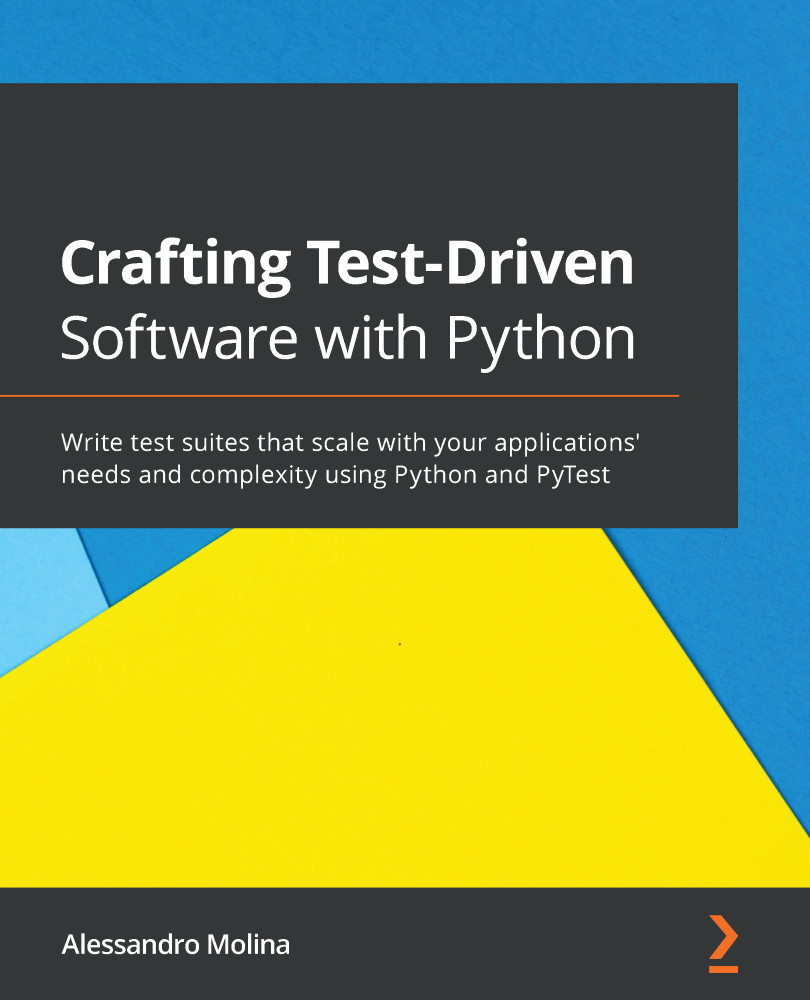
Crafting Test-Driven Software with Python

Crafting Test-Driven Software with Python

By : Molina
4.8 (11)
close
close
Crafting Test-Driven Software with Python

Crafting Test-Driven Software with Python

4.8 (11)
By: Molina

Overview of this book

Test-driven development (TDD) is a set of best practices that helps developers to build more scalable software and is used to increase the robustness of software by using automatic tests. This book shows you how to apply TDD practices effectively in Python projects. You’ll begin by learning about built-in unit tests and Mocks before covering rich frameworks like PyTest and web-based libraries such as WebTest and Robot Framework, discovering how Python allows you to embrace all modern testing practices with ease. Moving on, you’ll find out how to design tests and balance them with new feature development and learn how to create a complete test suite with PyTest. The book helps you adopt a hands-on approach to implementing TDD and associated methodologies that will have you up and running and make you more productive in no time. With the help of step-by-step explanations of essential concepts and practical examples, you’ll explore automatic tests and TDD best practices and get to grips with the methodologies and tools available in Python for creating effective and robust applications. By the end of this Python book, you will be able to write reliable test suites in Python to ensure the long-term resilience of your application using the range of libraries offered by Python for testing and development.
Table of Contents (18 chapters)
close
close
1
Section 1: Software Testing and Test-Driven Development
6
Section 2: PyTest for Python Testing
13
Section 3: Testing for the Web
16
About Packt
Getting Started with Software Testing

Many think that the big step from "coding" to "software engineering" is made by having elegant architectures, well-defined execution plans, and software that moves big companies' processes. This mostly comes from our vision of the classic industrial product development world, where planning mostly mattered more than execution, because the execution was moved forward by an assembly line and software was an expensive internal utility that only big companies could afford

As software development science moved forward and matured, it became clear that classic industrial best practices weren't always a great fit for it. The reason being that every software product was very different, due to the technologies involved, the speed at which those technologies evolve, and in the end the fact that different software had to do totally different things. Thus the idea developed that software development was more similar to craftsmanship than to industry.

If you embrace that it's very hard, and not very effective, to try to eliminate uncertainty and issues with tons of preparation work due to the very nature of software itself, it becomes evident that the most important part of software development is detecting defects and ensuring it achieves the expected goals. Those two things are usually mostly done by having tests and a fitness function that can verify the software does what we really mean it to – founding pieces of the whole Software Quality Control discipline, which is what this chapter will introduce and, in practice, what this book is all about.

In this chapter, we will go through testing software products and the best practices in quality control. We will also introduce automatic tests and how they are superseding manual testing. We will take a look at what Test-Driven Development (TDD) is and how to apply it in Python, giving some guidance on how to distinguish between the various categories of tests, how to implement them, and how to get the right balance between test efficacy and test cost.

In this chapter, we will cover the following:

  • Introducing software testing and quality control
  • Introducing automatic tests and test suites
  • Introducing test-driven development and unit tests
  • Understanding integration and functional tests
  • Understanding the testing pyramid and trophy

Visually different images
CONTINUE READING
83
Tech Concepts
36
Programming languages
73
Tech Tools
Icon Unlimited access to the largest independent learning library in tech of over 8,000 expert-authored tech books and videos.
Icon Innovative learning tools, including AI book assistants, code context explainers, and text-to-speech.
Icon 50+ new titles added per month and exclusive early access to books as they are being written.
Crafting Test-Driven Software with Python
notes
bookmark Notes and Bookmarks search Search in title playlist Add to playlist download Download options font-size Font size

Change the font size

margin-width Margin width

Change margin width

day-mode Day/Sepia/Night Modes

Change background colour

Close icon Search
Country selected

Close icon Your notes and bookmarks

Confirmation

Modal Close icon
claim successful

Buy this book with your credits?

Modal Close icon
Are you sure you want to buy this book with one of your credits?
Close
YES, BUY

Submit Your Feedback

Modal Close icon
Modal Close icon
Modal Close icon