Sign In Start Free Trial
Account

Add to playlist

Create a Playlist

Modal Close icon
You need to login to use this feature.
  • Book Overview & Buying SQL for Data Analytics
  • Table Of Contents Toc
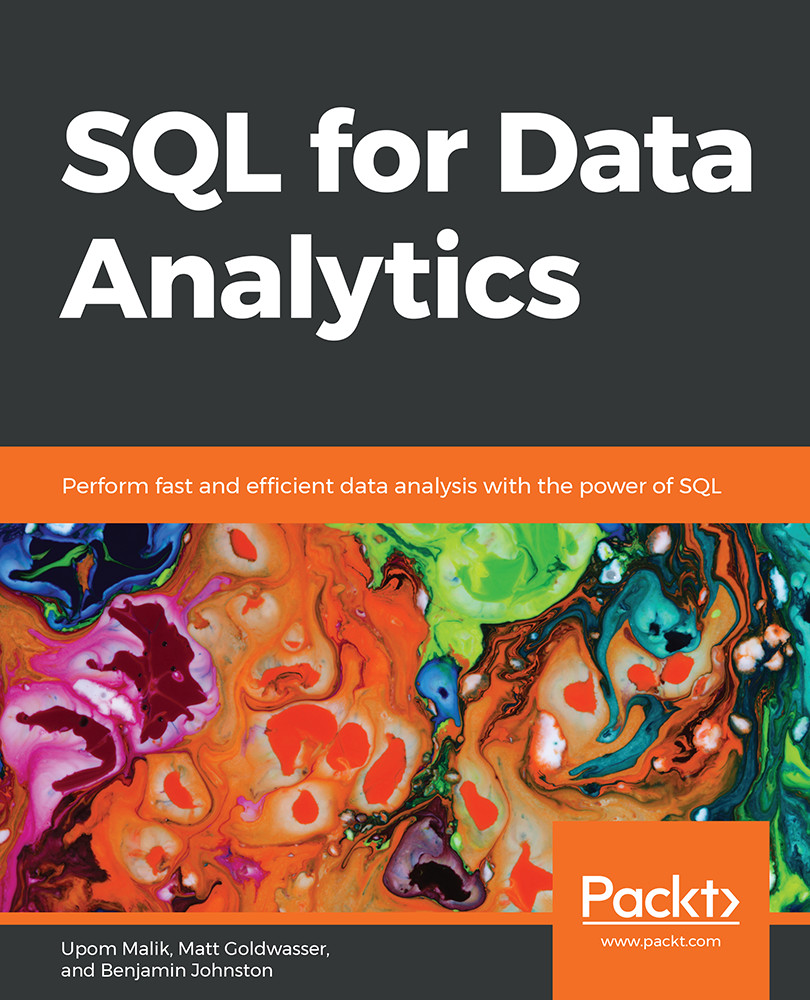
SQL for Data Analytics

SQL for Data Analytics

By : Upom Malik, Matt Goldwasser, Benjamin Johnston
3.5 (35)
close
close
SQL for Data Analytics

SQL for Data Analytics

3.5 (35)
By: Upom Malik, Matt Goldwasser, Benjamin Johnston

Overview of this book

Understanding and finding patterns in data has become one of the most important ways to improve business decisions. If you know the basics of SQL, but don't know how to use it to gain the most effective business insights from data, this book is for you. SQL for Data Analytics helps you build the skills to move beyond basic SQL and instead learn to spot patterns and explain the logic hidden in data. You'll discover how to explore and understand data by identifying trends and unlocking deeper insights. You'll also gain experience working with different types of data in SQL, including time-series, geospatial, and text data. Finally, you'll learn how to increase your productivity with the help of profiling and automation. By the end of this book, you'll be able to use SQL in everyday business scenarios efficiently and look at data with the critical eye of an analytics professional. Please note: if you are having difficulty loading the sample datasets, there are new instructions uploaded to the GitHub repository. The link to the GitHub repository can be found in the book's preface.
Table of Contents (11 chapters)
close
close
9
9. Using SQL to Uncover the Truth – a Case Study

Introduction

In Chapter 1, Understanding and Describing Data, we discussed analytics and how we can use data to obtain valuable information. While we could, in theory, analyze all data by hand, computers are far better at the task and are certainly the preferred tool for storing, organizing, and processing data. Among the most critical of these data tools is the relational database and the language used to access it, Structured Query Language (SQL). These two technologies have been cornerstones of data processing and continue to be the data backbone of most companies that deal with substantial amounts of data.

Companies use SQL as the primary method for storing much of their data. Furthermore, companies now take much of this data and put it into specialized databases called data warehouses and data lakes so that they can perform advanced analytics on their data. Virtually all of these data warehouses and data lakes are accessed using SQL. We'll be looking at working with SQL...

CONTINUE READING
83
Tech Concepts
36
Programming languages
73
Tech Tools
Icon Unlimited access to the largest independent learning library in tech of over 8,000 expert-authored tech books and videos.
Icon Innovative learning tools, including AI book assistants, code context explainers, and text-to-speech.
Icon 50+ new titles added per month and exclusive early access to books as they are being written.
SQL for Data Analytics
notes
bookmark Notes and Bookmarks search Search in title playlist Add to playlist font-size Font size

Change the font size

margin-width Margin width

Change margin width

day-mode Day/Sepia/Night Modes

Change background colour

Close icon Search
Country selected

Close icon Your notes and bookmarks

Confirmation

Modal Close icon
claim successful

Buy this book with your credits?

Modal Close icon
Are you sure you want to buy this book with one of your credits?
Close
YES, BUY

Submit Your Feedback

Modal Close icon
Modal Close icon
Modal Close icon