Sign In Start Free Trial
Account

Add to playlist

Create a Playlist

Modal Close icon
You need to login to use this feature.
  • Book Overview & Buying The Unsupervised Learning Workshop
  • Table Of Contents Toc
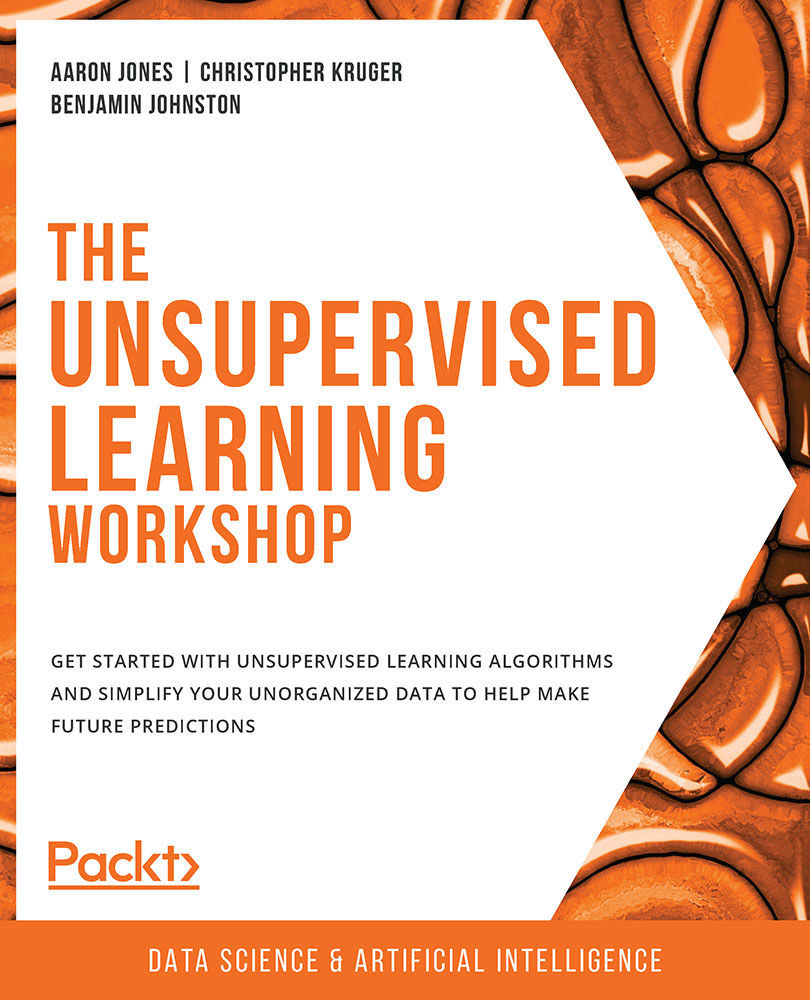
The Unsupervised Learning Workshop

The Unsupervised Learning Workshop

By : Aaron Jones , Richard Brooker, John Wesley Doyle , Priyanjit Ghosh, Sani Kamal, Ashish Pratik Patil , Philip Solomon, Geetank Raipuria, Christopher Kruger , Benjamin Johnston
4.3 (6)
close
close
The Unsupervised Learning Workshop

The Unsupervised Learning Workshop

4.3 (6)
By: Aaron Jones , Richard Brooker, John Wesley Doyle , Priyanjit Ghosh, Sani Kamal, Ashish Pratik Patil , Philip Solomon, Geetank Raipuria, Christopher Kruger , Benjamin Johnston

Overview of this book

Do you find it difficult to understand how popular companies like WhatsApp and Amazon find valuable insights from large amounts of unorganized data? The Unsupervised Learning Workshop will give you the confidence to deal with cluttered and unlabeled datasets, using unsupervised algorithms in an easy and interactive manner. The book starts by introducing the most popular clustering algorithms of unsupervised learning. You'll find out how hierarchical clustering differs from k-means, along with understanding how to apply DBSCAN to highly complex and noisy data. Moving ahead, you'll use autoencoders for efficient data encoding. As you progress, you’ll use t-SNE models to extract high-dimensional information into a lower dimension for better visualization, in addition to working with topic modeling for implementing natural language processing (NLP). In later chapters, you’ll find key relationships between customers and businesses using Market Basket Analysis, before going on to use Hotspot Analysis for estimating the population density of an area. By the end of this book, you’ll be equipped with the skills you need to apply unsupervised algorithms on cluttered datasets to find useful patterns and insights.
Table of Contents (11 chapters)
close
close
Preface

Summary

In this chapter, we started with an introduction to artificial neural networks, how they are structured, and the processes by which they learn to complete a particular task. Starting with a supervised learning example, we built an artificial neural network classifier to identify objects within the CIFAR-10 dataset. We then progressed to the autoencoder architecture of neural networks and learned how we can use these networks to prepare a dataset for use in an unsupervised learning problem. Finally, we completed this investigation with autoencoders, looking at convolutional neural networks and the benefits that these additional layers can provide. This chapter prepared us well for the final installment of dimensionality reduction, when we will look at using and visualizing the encoded data with t-distributed nearest neighbors (t-SNE). T-distributed nearest neighbors provides an extremely effective method for visualizing high-dimensional data even after applying reduction techniques...

CONTINUE READING
83
Tech Concepts
36
Programming languages
73
Tech Tools
Icon Unlimited access to the largest independent learning library in tech of over 8,000 expert-authored tech books and videos.
Icon Innovative learning tools, including AI book assistants, code context explainers, and text-to-speech.
Icon 50+ new titles added per month and exclusive early access to books as they are being written.
The Unsupervised Learning Workshop
notes
bookmark Notes and Bookmarks search Search in title playlist Add to playlist download Download options font-size Font size

Change the font size

margin-width Margin width

Change margin width

day-mode Day/Sepia/Night Modes

Change background colour

Close icon Search
Country selected

Close icon Your notes and bookmarks

Confirmation

Modal Close icon
claim successful

Buy this book with your credits?

Modal Close icon
Are you sure you want to buy this book with one of your credits?
Close
YES, BUY

Submit Your Feedback

Modal Close icon
Modal Close icon
Modal Close icon