
Sign In Start Free Trial
Account

Add to playlist

Create a Playlist

Modal Close icon
You need to login to use this feature.
  • Book Overview & Buying Deep Learning for Beginners
  • Table Of Contents Toc
Deep Learning for Beginners

Deep Learning for Beginners

By : Dr. Pablo Rivas
4.3 (3)
close
close
Deep Learning for Beginners

Deep Learning for Beginners

4.3 (3)
By: Dr. Pablo Rivas

Overview of this book

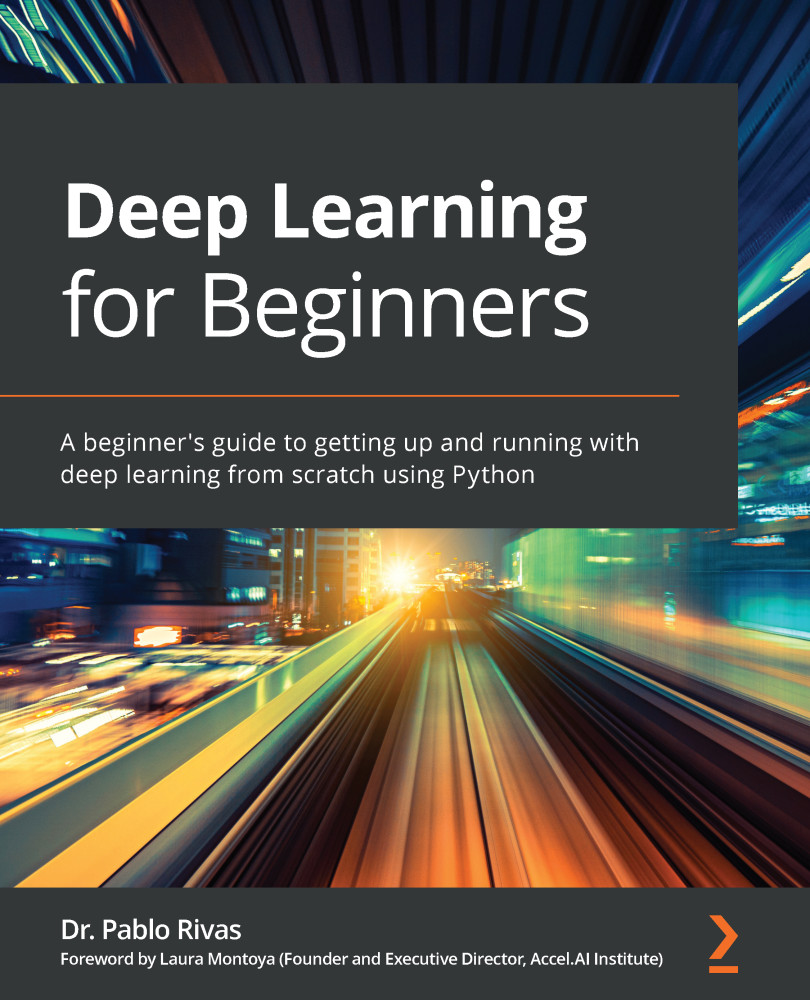
With information on the web exponentially increasing, it has become more difficult than ever to navigate through everything to find reliable content that will help you get started with deep learning. This book is designed to help you if you're a beginner looking to work on deep learning and build deep learning models from scratch, and you already have the basic mathematical and programming knowledge required to get started. The book begins with a basic overview of machine learning, guiding you through setting up popular Python frameworks. You will also understand how to prepare data by cleaning and preprocessing it for deep learning, and gradually go on to explore neural networks. A dedicated section will give you insights into the working of neural networks by helping you get hands-on with training single and multiple layers of neurons. Later, you will cover popular neural network architectures such as CNNs, RNNs, AEs, VAEs, and GANs with the help of simple examples, and learn how to build models from scratch. At the end of each chapter, you will find a question and answer section to help you test what you've learned through the course of the book. By the end of this book, you'll be well-versed with deep learning concepts and have the knowledge you need to use specific algorithms with various tools for different tasks.
Table of Contents (20 chapters)
close
close
1
Section 1: Getting Up to Speed
8
Section 2: Unsupervised Deep Learning
13
Section 3: Supervised Deep Learning

Introducing deep generative models

Deep learning has very interesting contributions to the general machine learning community, particularly when it comes to deep discriminative and generative models. We are familiar with what a discriminative model is—for example, a Multilayer Perceptron (MLP) is one. In a discriminative model, we are tasked with guessing, predicting, or approximating a desired target, , given input data . In statistical theory terms, we are modeling the conditional probability density function, . On the other hand, by a generative model, this is what most people mean:

A model that can generate data that follows a particular distribution based on an input or stimulus .

In deep learning, we can build a neural network that can model this generative process very well. In statistical terms, the neural model approximates the conditional probability density function, . While there are several generative models today, in this book, we will talk about three in particular...

CONTINUE READING
83
Tech Concepts
36
Programming languages
73
Tech Tools
Icon Unlimited access to the largest independent learning library in tech of over 8,000 expert-authored tech books and videos.
Icon Innovative learning tools, including AI book assistants, code context explainers, and text-to-speech.
Icon 50+ new titles added per month and exclusive early access to books as they are being written.
Deep Learning for Beginners
notes
bookmark Notes and Bookmarks search Search in title playlist Add to playlist download Download options font-size Font size

Change the font size

margin-width Margin width

Change margin width

day-mode Day/Sepia/Night Modes

Change background colour

Close icon Search
Country selected

Close icon Your notes and bookmarks

Confirmation

Modal Close icon
claim successful

Buy this book with your credits?

Modal Close icon
Are you sure you want to buy this book with one of your credits?
Close
YES, BUY

Submit Your Feedback

Modal Close icon
Modal Close icon
Modal Close icon