Sign In Start Free Trial
Account

Add to playlist

Create a Playlist

Modal Close icon
You need to login to use this feature.
  • Book Overview & Buying Deep Learning with TensorFlow 2 and Keras
  • Table Of Contents Toc
Deep Learning with TensorFlow 2 and Keras

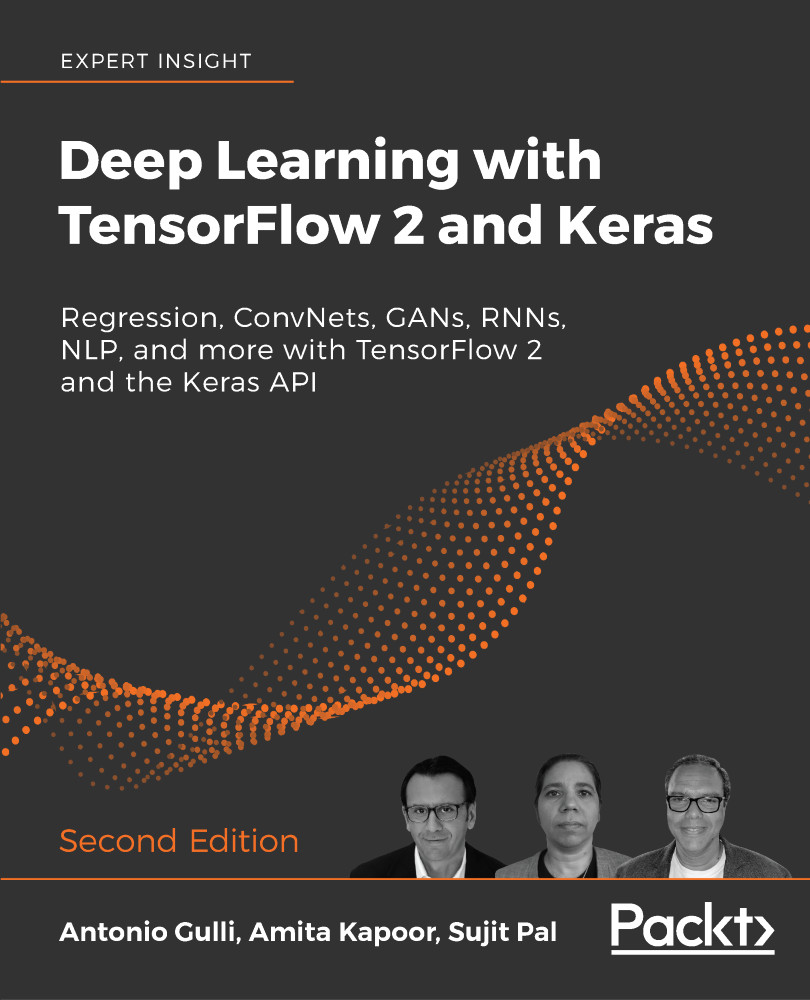
Deep Learning with TensorFlow 2 and Keras - Second Edition

By : Antonio Gulli, Dr. Amita Kapoor, Sujit Pal
4.3 (26)
close
close
Deep Learning with TensorFlow 2 and Keras

Deep Learning with TensorFlow 2 and Keras

4.3 (26)
By: Antonio Gulli, Dr. Amita Kapoor, Sujit Pal

Overview of this book

Deep Learning with TensorFlow 2 and Keras, Second Edition teaches neural networks and deep learning techniques alongside TensorFlow (TF) and Keras. You’ll learn how to write deep learning applications in the most powerful, popular, and scalable machine learning stack available. TensorFlow is the machine learning library of choice for professional applications, while Keras offers a simple and powerful Python API for accessing TensorFlow. TensorFlow 2 provides full Keras integration, making advanced machine learning easier and more convenient than ever before. This book also introduces neural networks with TensorFlow, runs through the main applications (regression, ConvNets (CNNs), GANs, RNNs, NLP), covers two working example apps, and then dives into TF in production, TF mobile, and using TensorFlow with AutoML.
Table of Contents (19 chapters)
close
close
17
Other Books You May Enjoy
18
Index

Prediction using linear regression

Linear regression is one of the most widely known modeling techniques. Existing for more than 200 years, it has been explored from almost all possible angles. Linear regression assumes a linear relationship between the input variable (X) and the output variable (Y). It involves finding a linear equation for predicted value Y of the form:

Yhat = WTX + b

Where X = {x1, x2, ..., xn} are the n input variables, and W = { w1, w2, ...wn} are the linear coefficients, with b as the bias term. The bias term allows our regression model to provide an output even in the absence of any input; it provides us with an option to shift our data left or right to better fit the data. The error between the observed values (Y) and predicted values (Yhat) for an input sample i is:

ei = Yi - Yhati

The goal is to find the best estimates for the coefficients W and bias b, such that the error between the observed values Y and the predicted values Yhat is minimized...

CONTINUE READING
83
Tech Concepts
36
Programming languages
73
Tech Tools
Icon Unlimited access to the largest independent learning library in tech of over 8,000 expert-authored tech books and videos.
Icon Innovative learning tools, including AI book assistants, code context explainers, and text-to-speech.
Icon 50+ new titles added per month and exclusive early access to books as they are being written.
Deep Learning with TensorFlow 2 and Keras
notes
bookmark Notes and Bookmarks search Search in title playlist Add to playlist download Download options font-size Font size

Change the font size

margin-width Margin width

Change margin width

day-mode Day/Sepia/Night Modes

Change background colour

Close icon Search
Country selected

Close icon Your notes and bookmarks

Confirmation

Modal Close icon
claim successful

Buy this book with your credits?

Modal Close icon
Are you sure you want to buy this book with one of your credits?
Close
YES, BUY

Submit Your Feedback

Modal Close icon
Modal Close icon
Modal Close icon