

Sign In Start Free Trial
Account

Add to playlist

Create a Playlist

Modal Close icon
You need to login to use this feature.
  • Book Overview & Buying Learn Swift by Building Applications
  • Table Of Contents Toc
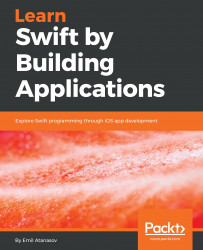
Learn Swift by Building Applications

Learn Swift by Building Applications

By : Giordano Scalzo, Emil Atanasov
3.5 (2)
close
close
Learn Swift by Building Applications

Learn Swift by Building Applications

3.5 (2)
By: Giordano Scalzo, Emil Atanasov

Overview of this book

Swift Language is now more powerful than ever; it has introduced new ways to solve old problems and has gone on to become one of the fastest growing popular languages. It is now a de-facto choice for iOS developers and it powers most of the newly released and popular apps. This practical guide will help you to begin your journey with Swift programming through learning how to build iOS apps. You will learn all about basic variables, if clauses, functions, loops, and other core concepts; then structures, classes, and inheritance will be discussed. Next, you’ll dive into developing a weather app that consumes data from the internet and presents information to the user. The final project is more complex, involving creating an Instagram like app that integrates different external libraries. The app also uses CocoaPods as its package dependency manager, to give you a cutting-edge tool to add to your skillset. By the end of the book, you will have learned how to model real-world apps in Swift.
Table of Contents (14 chapters)
close
close
5
Adding Interactivity to Your First App

Table view in iOS app

First, let's create a new single view Xcode project with the default language Swift and target OS—iOS. We already know how to do this from previous chapters:

Open the storyboard and add a new table view controller. (Use the Utilities panel and the object library. If you filter the controls, you will find the Table View Controller in no time.) You should see two view controllers on the screen:

Two view controllers on the screen
Use a different scale level so that you can see more scenes at once.

Drag the gray/blue arrow (the one on the left) from the default view controller to the new view controller. This arrow defines which scene (screen) is the app's initial view controller. You can remove the other view controller, which we won't use.

Before defining the table cells, which should be used to render each item in the table, we need...

CONTINUE READING
83
Tech Concepts
36
Programming languages
73
Tech Tools
Icon Unlimited access to the largest independent learning library in tech of over 8,000 expert-authored tech books and videos.
Icon Innovative learning tools, including AI book assistants, code context explainers, and text-to-speech.
Icon 50+ new titles added per month and exclusive early access to books as they are being written.
Learn Swift by Building Applications
notes
bookmark Notes and Bookmarks search Search in title playlist Add to playlist download Download options font-size Font size

Change the font size

margin-width Margin width

Change margin width

day-mode Day/Sepia/Night Modes

Change background colour

Close icon Search
Country selected

Close icon Your notes and bookmarks

Confirmation

Modal Close icon
claim successful

Buy this book with your credits?

Modal Close icon
Are you sure you want to buy this book with one of your credits?
Close
YES, BUY

Submit Your Feedback

Modal Close icon
Modal Close icon
Modal Close icon