
Sign In Start Free Trial
Account

Add to playlist

Create a Playlist

Modal Close icon
You need to login to use this feature.
  • Book Overview & Buying Rust Standard Library Cookbook
  • Table Of Contents Toc
Rust Standard Library Cookbook

Rust Standard Library Cookbook

By : Jan Hohenheim, Daniel Durante
5 (1)
close
close
Rust Standard Library Cookbook

Rust Standard Library Cookbook

5 (1)
By: Jan Hohenheim, Daniel Durante

Overview of this book

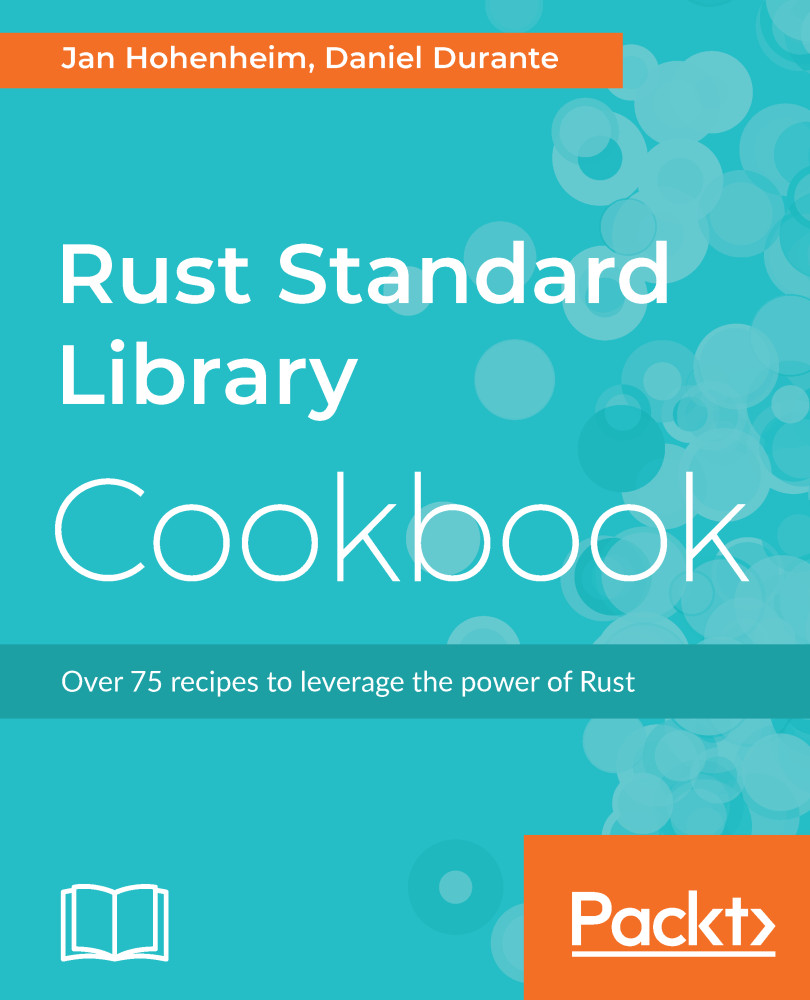
Mozilla’s Rust is gaining much attention with amazing features and a powerful library. This book will take you through varied recipes to teach you how to leverage the Standard library to implement efficient solutions. The book begins with a brief look at the basic modules of the Standard library and collections. From here, the recipes will cover packages that support file/directory handling and interaction through parsing. You will learn about packages related to advanced data structures, error handling, and networking. You will also learn to work with futures and experimental nightly features. The book also covers the most relevant external crates in Rust. By the end of the book, you will be proficient at using the Rust Standard library.
Table of Contents (12 chapters)
close
close

How it works...

As of the time of writing, there are four atomic types in the standard library under the std::sync::atomic module: AtomicBool, AtomicIsize, AtomicUsize, and AtomicPtr. Each one of them represents a primitive type, namely bool, isize, usize, and *mut. We are not going to look at the last, which, being a pointer, you will probably only have to deal with when interfacing with programs written in other languages anyways.

In case you haven't encountered isize and usize before, they are representations of the smallest amount of bytes needed to address any part of the memory of your machine. On 32-bit targets this is 4 bytes, while 64-bit systems will need 8 bytes. isize uses those bytes to represent a signed number, as in an integer that can be negative. usize instead represents an unsigned number, which can only be positive but has a lot more capacity for huge numbers in that direction. They are usually used when dealing with collections capacities. For example, Vec...
CONTINUE READING
83
Tech Concepts
36
Programming languages
73
Tech Tools
Icon Unlimited access to the largest independent learning library in tech of over 8,000 expert-authored tech books and videos.
Icon Innovative learning tools, including AI book assistants, code context explainers, and text-to-speech.
Icon 50+ new titles added per month and exclusive early access to books as they are being written.
Rust Standard Library Cookbook
notes
bookmark Notes and Bookmarks search Search in title playlist Add to playlist download Download options font-size Font size

Change the font size

margin-width Margin width

Change margin width

day-mode Day/Sepia/Night Modes

Change background colour

Close icon Search
Country selected

Close icon Your notes and bookmarks

Confirmation

Modal Close icon
claim successful

Buy this book with your credits?

Modal Close icon
Are you sure you want to buy this book with one of your credits?
Close
YES, BUY

Submit Your Feedback

Modal Close icon
Modal Close icon
Modal Close icon