
Sign In Start Free Trial
Account

Add to playlist

Create a Playlist

Modal Close icon
You need to login to use this feature.
  • Book Overview & Buying Mastering Rust
  • Table Of Contents Toc
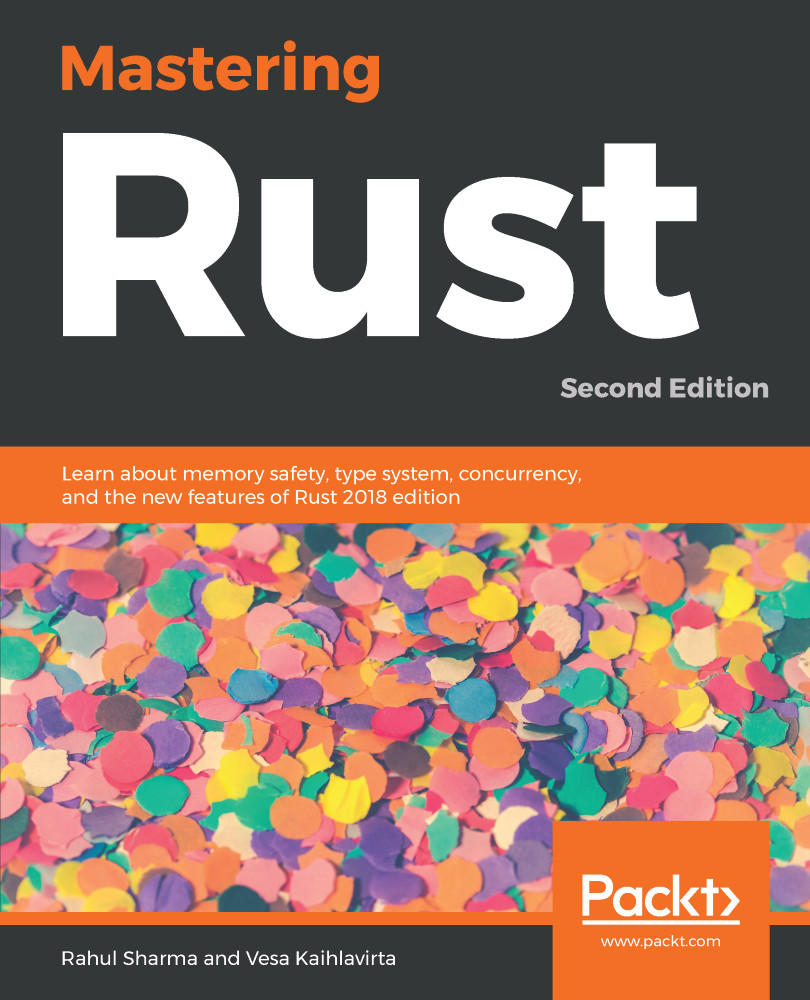
Mastering Rust

Mastering Rust - Second Edition

By : Sharma, Vesa Kaihlavirta
2.6 (5)
close
close
Mastering Rust

Mastering Rust

2.6 (5)
By: Sharma, Vesa Kaihlavirta

Overview of this book

Rust is an empowering language that provides a rare combination of safety, speed, and zero-cost abstractions. Mastering Rust – Second Edition is filled with clear and simple explanations of the language features along with real-world examples, showing you how you can build robust, scalable, and reliable programs. This second edition of the book improves upon the previous one and touches on all aspects that make Rust a great language. We have included the features from latest Rust 2018 edition such as the new module system, the smarter compiler, helpful error messages, and the stable procedural macros. You’ll learn how Rust can be used for systems programming, network programming, and even on the web. You’ll also learn techniques such as writing memory-safe code, building idiomatic Rust libraries, writing efficient asynchronous networking code, and advanced macros. The book contains a mix of theory and hands-on tasks so you acquire the skills as well as the knowledge, and it also provides exercises to hammer the concepts in. After reading this book, you will be able to implement Rust for your enterprise projects, write better tests and documentation, design for performance, and write idiomatic Rust code.
Table of Contents (19 chapters)
close
close

Iterators

We glimpsed iterators in Chapter 1, Getting Started with Rust. To recap, an iterator is any ordinary type that can walk over elements of a collection type in one of three ways: via self, &self, or &mut self. They are not a new concept and mainstream language such as C++ and Python have them already though that in Rust, they can appear surprising at first due to their form as an associated type trait. Iterators are used quite frequently in idiomatic Rust code when dealing with collection types.

To understand how they work, let's look at the definition of the Iterator trait from the std::iter module:

pub trait Iterator {
type Item;
fn next(&mut self) -> Option<Self::Item>;
// other default methods omitted
}

The Iterator trait is an associated type trait which mandates the two items, to be defined for any implementing type. First is the...

CONTINUE READING
83
Tech Concepts
36
Programming languages
73
Tech Tools
Icon Unlimited access to the largest independent learning library in tech of over 8,000 expert-authored tech books and videos.
Icon Innovative learning tools, including AI book assistants, code context explainers, and text-to-speech.
Icon 50+ new titles added per month and exclusive early access to books as they are being written.
Mastering Rust
notes
bookmark Notes and Bookmarks search Search in title playlist Add to playlist download Download options font-size Font size

Change the font size

margin-width Margin width

Change margin width

day-mode Day/Sepia/Night Modes

Change background colour

Close icon Search
Country selected

Close icon Your notes and bookmarks

Confirmation

Modal Close icon
claim successful

Buy this book with your credits?

Modal Close icon
Are you sure you want to buy this book with one of your credits?
Close
YES, BUY

Submit Your Feedback

Modal Close icon
Modal Close icon
Modal Close icon