
Sign In Start Free Trial
Account

Add to playlist

Create a Playlist

Modal Close icon
You need to login to use this feature.
  • Book Overview & Buying Mastering Object-Oriented Python
  • Table Of Contents Toc
  • Feedback & Rating feedback
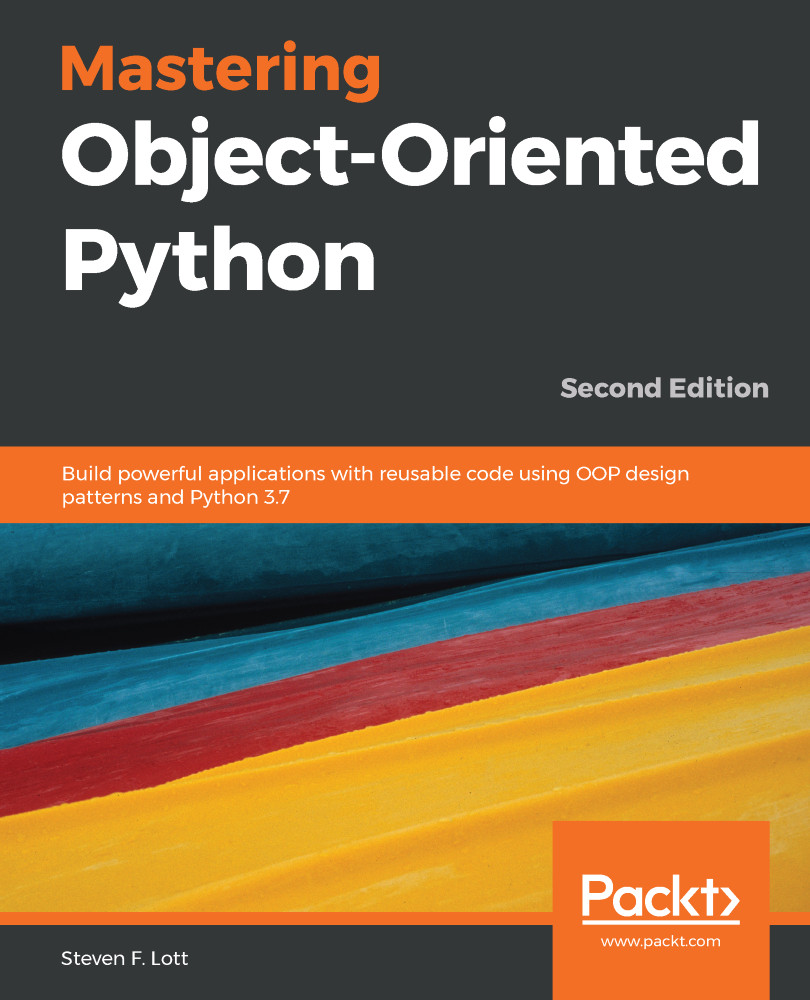
Mastering Object-Oriented Python

Mastering Object-Oriented Python - Second Edition

By : Steven F. Lott
3.8 (4)
close
close
Mastering Object-Oriented Python

Mastering Object-Oriented Python

3.8 (4)
By: Steven F. Lott

Overview of this book

Object-oriented programming (OOP) is a relatively complex discipline to master, and it can be difficult to see how general principles apply to each language's unique features. With the help of the latest edition of Mastering Objected-Oriented Python, you'll be shown how to effectively implement OOP in Python, and even explore Python 3.x. Complete with practical examples, the book guides you through the advanced concepts of OOP in Python, and demonstrates how you can apply them to solve complex problems in OOP. You will learn how to create high-quality Python programs by exploring design alternatives and determining which design offers the best performance. Next, you'll work through special methods for handling simple object conversions and also learn about hashing and comparison of objects. As you cover later chapters, you'll discover how essential it is to locate the best algorithms and optimal data structures for developing robust solutions to programming problems with minimal computer processing. Finally, the book will assist you in leveraging various Python features by implementing object-oriented designs in your programs. By the end of this book, you will have learned a number of alternate approaches with different attributes to confidently solve programming problems in Python.
Table of Contents (25 chapters)
close
close
Lock Free Chapter
1
Section 1: Tighter Integration Via Special Methods
11
Section 2: Object Serialization and Persistence
17
Section 3: Object-Oriented Testing and Debugging

Configuration Files and Persistence

A configuration file is a form of object persistence. It contains a serialized, plain-text, editable representation of some default state for an application program. We'll expand on the serialization techniques shown in Chapter 10, Serializing and Saving – JSON, YAML, Pickle, CSV, and XML to create files that are specifically used for application configuration. The focus on plain text means that pickle representation will be excluded. Due to the relative complexity of application configurations, CSV files aren't often used for this purpose, either.

Before a user can make use of an editable plain-text configuration file, we must design our application to be configurable. This can often require careful consideration of dependencies and limitations. Additionally, we must define some kind of configuration object that our application...

Visually different images
CONTINUE READING
83
Tech Concepts
36
Programming languages
73
Tech Tools
Icon Unlimited access to the largest independent learning library in tech of over 8,000 expert-authored tech books and videos.
Icon Innovative learning tools, including AI book assistants, code context explainers, and text-to-speech.
Icon 50+ new titles added per month and exclusive early access to books as they are being written.
Mastering Object-Oriented Python
notes
bookmark Notes and Bookmarks search Search in title playlist Add to playlist download Download options font-size Font size

Change the font size

margin-width Margin width

Change margin width

day-mode Day/Sepia/Night Modes

Change background colour

Close icon Search
Country selected

Close icon Your notes and bookmarks

Confirmation

Modal Close icon
claim successful

Buy this book with your credits?

Modal Close icon
Are you sure you want to buy this book with one of your credits?
Close
YES, BUY

Submit Your Feedback

Modal Close icon
Modal Close icon
Modal Close icon