Sign In Start Free Trial
Account

Add to playlist

Create a Playlist

Modal Close icon
You need to login to use this feature.
  • Book Overview & Buying The C# Workshop
  • Table Of Contents Toc
The C# Workshop

The C# Workshop

By : Jason Hales, Almantas Karpavicius, Mateus Viegas
4.5 (14)
close
close
The C# Workshop

The C# Workshop

4.5 (14)
By: Jason Hales, Almantas Karpavicius, Mateus Viegas

Overview of this book

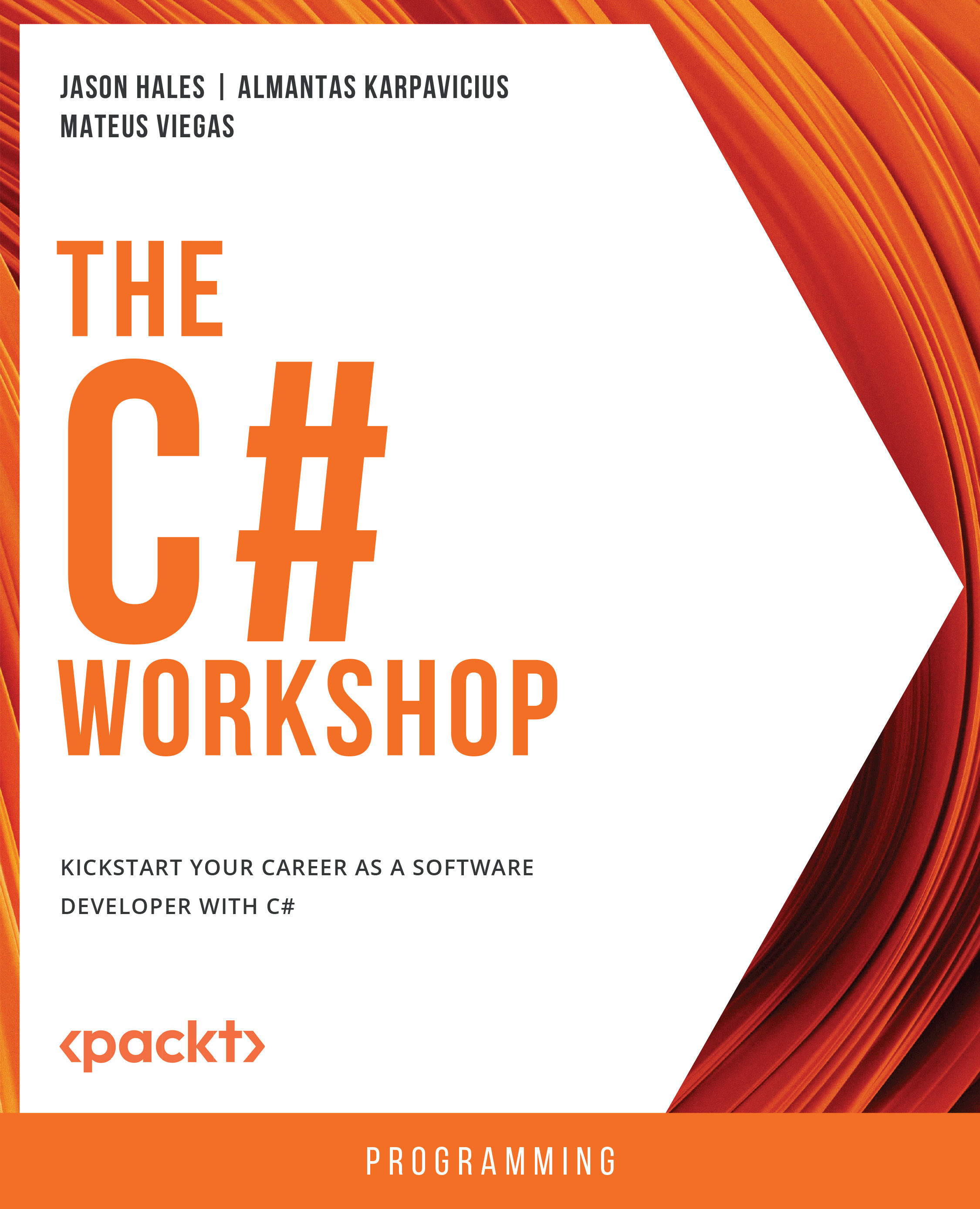
C# is a powerful, versatile language that can unlock a variety of career paths. But, as with any programming language, learning C# can be a challenging process. With a wide range of different resources available, it’s difficult to know where to start. That's where The C# Workshop comes in. Written and reviewed by industry experts, it provides a fast-paced, supportive learning experience that will quickly get you writing C# code and building applications. Unlike other software development books that focus on dry, technical explanations of the underlying theory, this Workshop cuts through the noise and uses engaging examples to help you understand how each concept is applied in the real world. As you work through the book, you'll tackle realistic exercises that simulate the type of problems that software developers work on every day. These mini-projects include building a random-number guessing game, using the publisher-subscriber model to design a web file downloader, creating a to-do list using Razor Pages, generating images from the Fibonacci sequence using async/await tasks, and developing a temperature unit conversion app which you will then deploy to a production server. By the end of this book, you'll have the knowledge, skills, and confidence to advance your career and tackle your own ambitious projects with C#.
Table of Contents (10 chapters)
close
close

Introduction

In the previous chapter, you learned some of the key aspects of Object Oriented Programming (OOP). In this chapter, you will build on this by looking at the common patterns used specifically in C# that enable classes to interact.

Have you found yourself working with a code that has to listen to certain signals and act on them, but you cannot be sure until runtime what those actions should be? Maybe you have a block of code that you need to reuse or pass to other methods for them to call when they are ready. Or, you may want to filter a list of objects, but need to base how you would do that on a combination of user preferences. Much of this can be achieved using interfaces, but it is often more efficient to create chunks of code that you can then pass to other classes in a type-safe way. Such blocks are referred to as delegates and form the backbone of many .NET libraries, allowing methods or pieces of code to be passed as parameters.

The natural extension to a delegate...

Visually different images
CONTINUE READING
83
Tech Concepts
36
Programming languages
73
Tech Tools
Icon Unlimited access to the largest independent learning library in tech of over 8,000 expert-authored tech books and videos.
Icon Innovative learning tools, including AI book assistants, code context explainers, and text-to-speech.
Icon 50+ new titles added per month and exclusive early access to books as they are being written.
The C# Workshop
notes
bookmark Notes and Bookmarks search Search in title playlist Add to playlist download Download options font-size Font size

Change the font size

margin-width Margin width

Change margin width

day-mode Day/Sepia/Night Modes

Change background colour

Close icon Search
Country selected

Close icon Your notes and bookmarks

Confirmation

Modal Close icon
claim successful

Buy this book with your credits?

Modal Close icon
Are you sure you want to buy this book with one of your credits?
Close
YES, BUY

Submit Your Feedback

Modal Close icon
Modal Close icon
Modal Close icon