Sign In Start Free Trial
Account

Add to playlist

Create a Playlist

Modal Close icon
You need to login to use this feature.
  • Book Overview & Buying Functional Programming in Go
  • Table Of Contents Toc
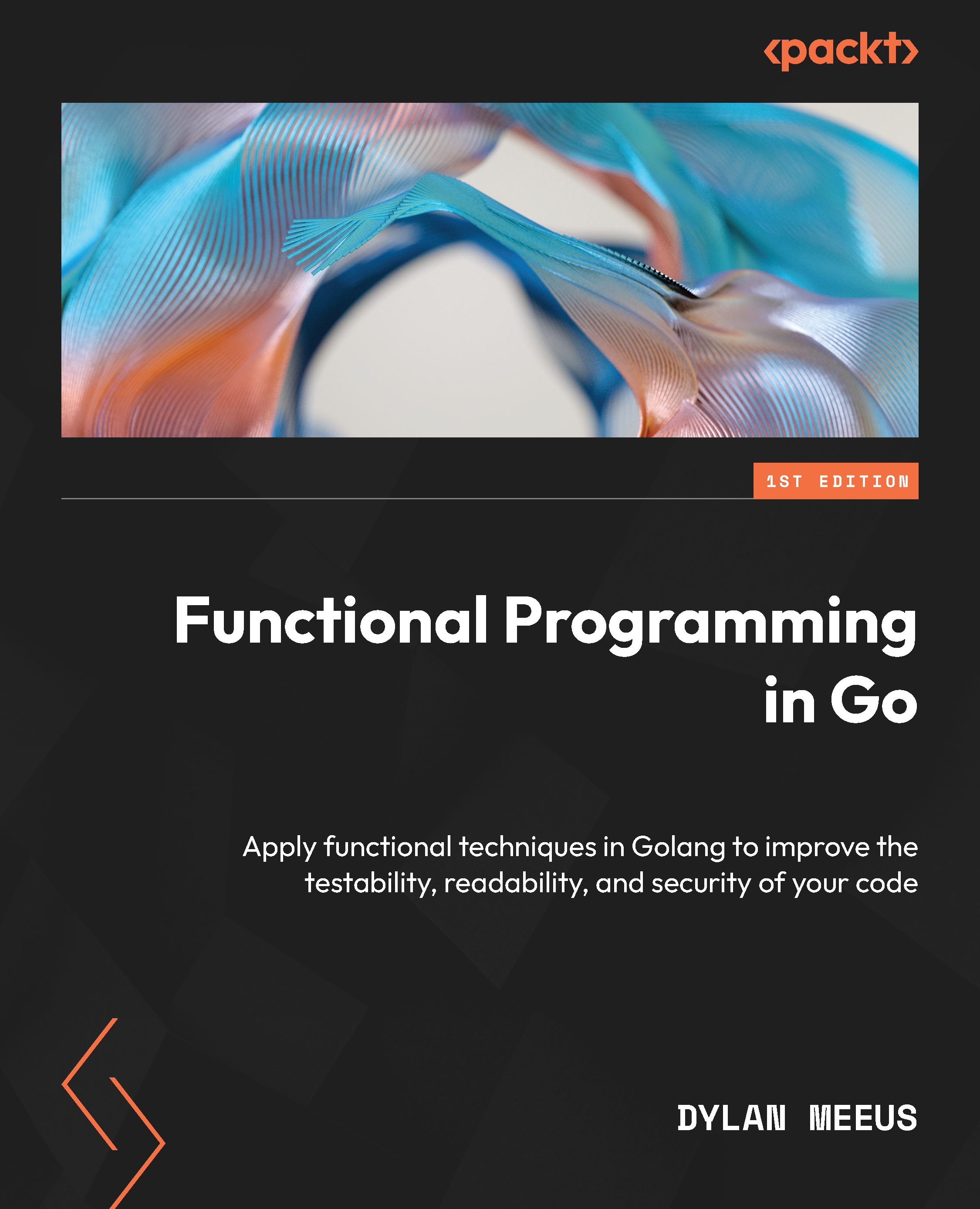
Functional Programming in Go

Functional Programming in Go

By : Dylan Meeus
4.9 (12)
close
close
Functional Programming in Go

Functional Programming in Go

4.9 (12)
By: Dylan Meeus

Overview of this book

While Go is a multi-paradigm language that gives you the option to choose whichever paradigm works best for the particular problem you aim to solve, it supports features that enable you to apply functional principles in your code. In this book, you’ll learn about concepts central to the functional programming paradigm and how and when to apply functional programming techniques in Go. Starting with the basic concepts of functional programming, this Golang book will help you develop a deeper understanding of first-class functions. In the subsequent chapters, you’ll gain a more comprehensive view of the techniques and methods used in functional languages, such as function currying, partial application, and higher-order functions. You’ll then be able to apply functional design patterns for solving common programming challenges and explore how to apply concurrency mechanisms to functional programming. By the end of this book, you’ll be ready to improve your code bases by applying functional programming techniques in Go to write cleaner, safer, and bug-free code.
Table of Contents (17 chapters)
close
close
1
Part 1: Functional Programming Paradigm Essentials
7
Part 2: Using Functional Programming Techniques
11
Part 3: Design Patterns and Functional Programming Libraries

The Go programming paradigm

Unless this is your first introduction to Go, you probably know that Go is a statically typed programming language. You also know that it has structs and that we can instantiate objects out of these. You likely also know that Go optionally binds functions to a struct, but that is not required. It would be possible to write an entire Go program without creating an object, something that the stricter object-oriented languages rarely allow.

In fact, the simplest Hello World program in Go has no sense of structs or objects:

package main
import “fmt”
func main() {
     fmt.Println(“Hello Reader!”)    
}

As you can see, the introductory Go program that many of us wrote when starting to learn Go has no notion of structs or objects to do something useful. Println is a function defined in the fmt package, but it’s not bound to an object.

The term for a language such as Go is multi-paradigm. Go does not force us to write code in the object-oriented paradigm or in the functional paradigm. We, the programmers, have complete freedom to use the language however we want. This is why the book you are reading right now exists.

Go offers several features that enable us to write functional Go code with (relative) ease:

  • Functions as first-class citizens
  • Higher-order functions
  • Immutability guarantees
  • Generics (not needed per se, but make life easier)
  • Recursion

These are explored in more detail later in the book. I also want to point out some features that Go lacks (as of 1.18) that would improve our quality of life:

  • Tail-call optimization
  • Lazy evaluation
  • Purity guarantee

These are not deal-breakers. The focus of this book is leveraging FP in Go to write better code. Even if we don’t have a purely statically typed system to work with, we can work with what we do have.

By no means do I want to posit FP as the superior way to write Go code. Nor do I want to frame it as the “right” paradigm to choose. Go is multi-paradigm, and just as programmers choose the right language for any problem, we also have to choose the right paradigm for each problem. We can even opt to stick to functional concepts 90% of the time and still end up with cleaner code than if we had stuck to it 100%. For example, writing purely functional code would prevent the use of any side effects. Yet, many side effects do serve a purpose. Any time we want to show a user output or get input from a user, we are technically dealing with a side effect.

CONTINUE READING
83
Tech Concepts
36
Programming languages
73
Tech Tools
Icon Unlimited access to the largest independent learning library in tech of over 8,000 expert-authored tech books and videos.
Icon Innovative learning tools, including AI book assistants, code context explainers, and text-to-speech.
Icon 50+ new titles added per month and exclusive early access to books as they are being written.
Functional Programming in Go
notes
bookmark Notes and Bookmarks search Search in title playlist Add to playlist download Download options font-size Font size

Change the font size

margin-width Margin width

Change margin width

day-mode Day/Sepia/Night Modes

Change background colour

Close icon Search
Country selected

Close icon Your notes and bookmarks

Confirmation

Modal Close icon
claim successful

Buy this book with your credits?

Modal Close icon
Are you sure you want to buy this book with one of your credits?
Close
YES, BUY

Submit Your Feedback

Modal Close icon
Modal Close icon
Modal Close icon