Sign In Start Free Trial
Account

Add to playlist

Create a Playlist

Modal Close icon
You need to login to use this feature.
  • Book Overview & Buying Functional Programming in Go
  • Table Of Contents Toc
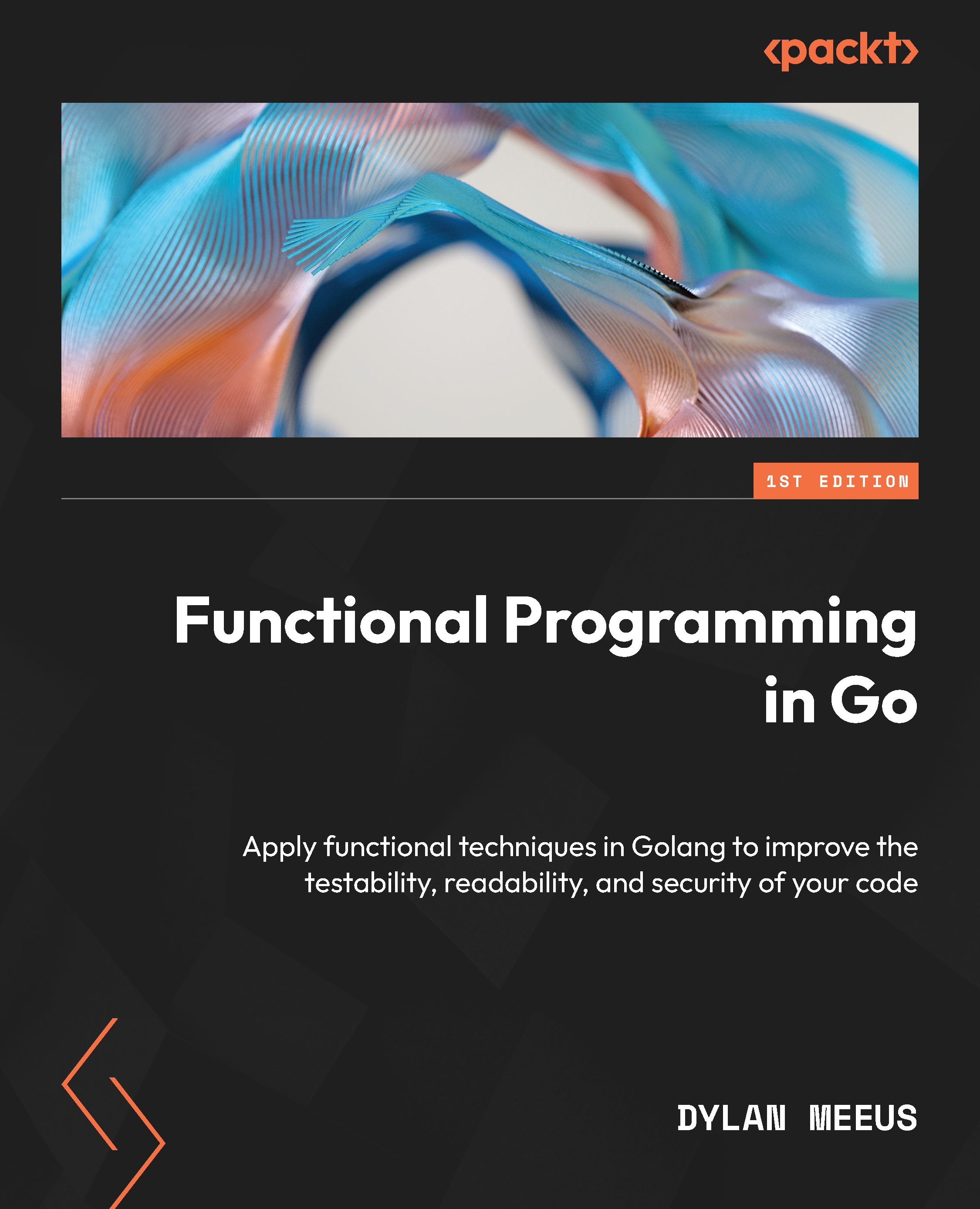
Functional Programming in Go

Functional Programming in Go

By : Dylan Meeus
4.9 (12)
close
close
Functional Programming in Go

Functional Programming in Go

4.9 (12)
By: Dylan Meeus

Overview of this book

While Go is a multi-paradigm language that gives you the option to choose whichever paradigm works best for the particular problem you aim to solve, it supports features that enable you to apply functional principles in your code. In this book, you’ll learn about concepts central to the functional programming paradigm and how and when to apply functional programming techniques in Go. Starting with the basic concepts of functional programming, this Golang book will help you develop a deeper understanding of first-class functions. In the subsequent chapters, you’ll gain a more comprehensive view of the techniques and methods used in functional languages, such as function currying, partial application, and higher-order functions. You’ll then be able to apply functional design patterns for solving common programming challenges and explore how to apply concurrency mechanisms to functional programming. By the end of this book, you’ll be ready to improve your code bases by applying functional programming techniques in Go to write cleaner, safer, and bug-free code.
Table of Contents (17 chapters)
close
close
1
Part 1: Functional Programming Paradigm Essentials
7
Part 2: Using Functional Programming Techniques
11
Part 3: Design Patterns and Functional Programming Libraries

Why not functional programming in Go?

To provide a holistic view of how FP can help us, as Go programmers, we should also consider when not to use FP. I view FP as a tool in my toolbox and when a problem lends itself to it, I will gladly use it – but just as importantly, we have to recognize when this does not work.

One of the concerns around FP is performance – while there is a lot to say on this topic, as we’ll see in later chapters, performance concerns could mean we throw out some functional concepts such as immutability in favor of executing with speed. This is more complex than it might sound at first, as Go pointers are not guaranteed to be faster than Go’s pass-by-value functions. We’ll expand more on the performance concerns in later chapters.

Another reason not to choose FP is Go’s lack of tail-call optimization. In theory, every loop you write in your program could be replaced by a recursive call, but as of Go 1.18, Go does not have the necessary tools to do this efficiently and you’d risk running into stack overflows. There are ways around this, as we will see, but if it starts sacrificing performance or readability significantly, my advice would be to just write a loop. This is not to say recursion is never the right approach. If you’ve worked with trees or graphs extensively, you’ve probably written some recursive algorithms and found them to work just fine.

Finally, if you are working on an existing code base with many other contributors, the best thing to do is follow the style of the code base. While some concepts of FP can be introduced quite easily, it is harder to enforce them in a team that’s not on board with the whole idea. Luckily, many programmers today see benefits in key concepts of FP. Even in Java or C#, the idea of immutable code is embraced. Side effects similarly are more and more seen as unwanted.

Let’s embrace Go as a fully multi-paradigm language and leverage each paradigm where it makes sense.

CONTINUE READING
83
Tech Concepts
36
Programming languages
73
Tech Tools
Icon Unlimited access to the largest independent learning library in tech of over 8,000 expert-authored tech books and videos.
Icon Innovative learning tools, including AI book assistants, code context explainers, and text-to-speech.
Icon 50+ new titles added per month and exclusive early access to books as they are being written.
Functional Programming in Go
notes
bookmark Notes and Bookmarks search Search in title playlist Add to playlist download Download options font-size Font size

Change the font size

margin-width Margin width

Change margin width

day-mode Day/Sepia/Night Modes

Change background colour

Close icon Search
Country selected

Close icon Your notes and bookmarks

Confirmation

Modal Close icon
claim successful

Buy this book with your credits?

Modal Close icon
Are you sure you want to buy this book with one of your credits?
Close
YES, BUY

Submit Your Feedback

Modal Close icon
Modal Close icon
Modal Close icon