Sign In Start Free Trial
Account

Add to playlist

Create a Playlist

Modal Close icon
You need to login to use this feature.
  • Book Overview & Buying C# Data Structures and Algorithms
  • Table Of Contents Toc
C# Data Structures and Algorithms

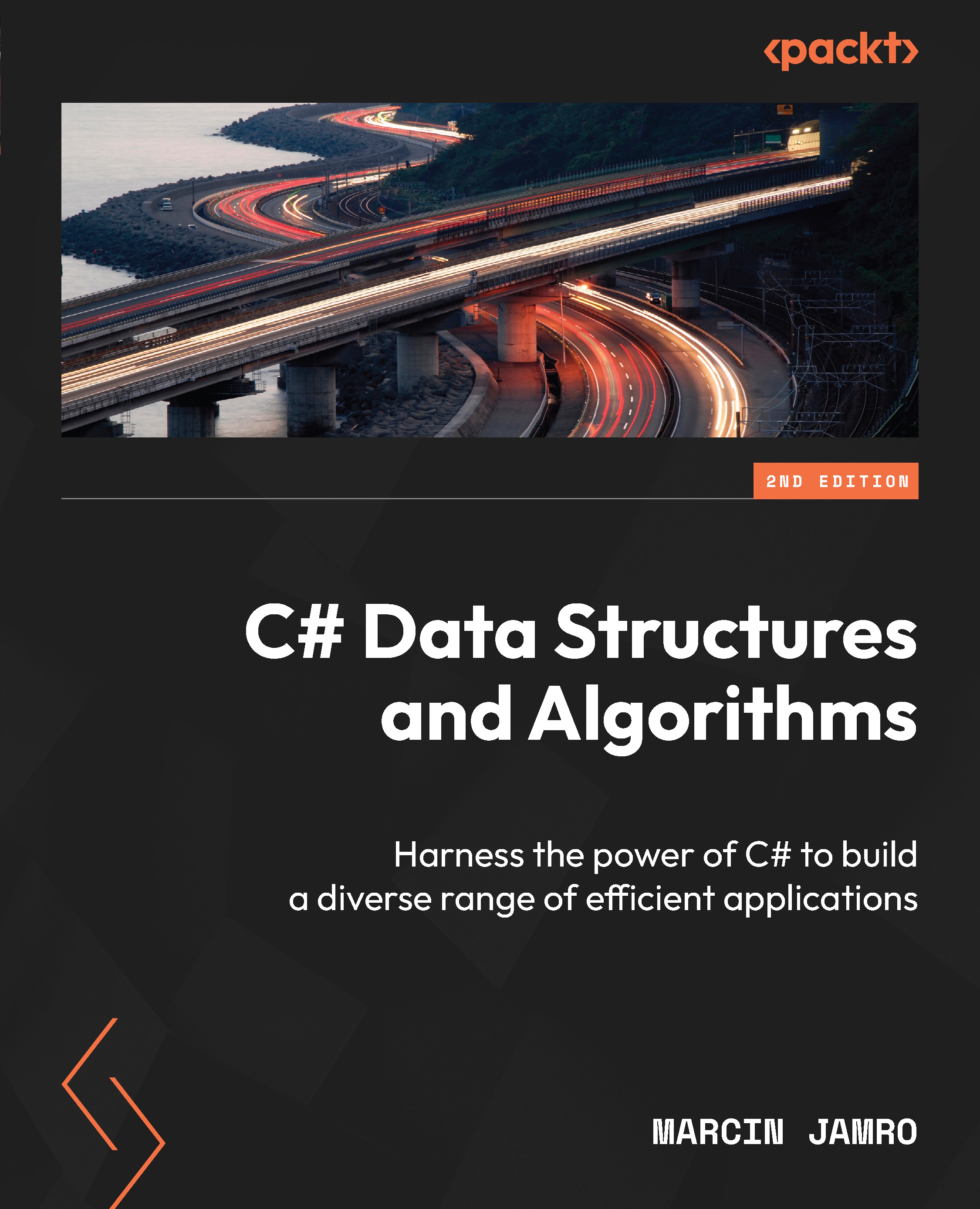
C# Data Structures and Algorithms - Second Edition

By : Marcin Jamro
4.1 (25)
close
close
C# Data Structures and Algorithms

C# Data Structures and Algorithms

4.1 (25)
By: Marcin Jamro

Overview of this book

Building your own applications is exciting but challenging, especially when tackling complex problems tied to advanced data structures and algorithms. This endeavor demands profound knowledge of the programming language as well as data structures and algorithms. C# Data Structures and Algorithms, armed with critical knowledge from an entrepreneur, author, industry expert, and seasoned developer with significant international experience, offers just that to C# developers. Starting with an introduction to algorithms, this book gradually immerses you in the world of arrays, lists, stacks, queues, dictionaries, and sets. Real-world examples, enriched with code snippets and illustrations, provide a practical understanding of these concepts. You’ll also learn how to sort arrays using various algorithms, setting a solid foundation for your programming expertise. As you progress, you’ll venture into more complex data structures – trees and graphs – and discover algorithms for tasks such as determining the shortest path in a graph before advancing to see various algorithms in action, such as solving Sudoku. By the end of this book, you’ll be able to use the C# language to build algorithmic components that are not only easy to understand and debug but also seamlessly applicable in various apps, spanning web and mobile platforms.
Table of Contents (13 chapters)
close
close

Summary

The current chapter was the longest so far in the book. However, it contained a lot of information about variants of trees. Such data structures perform a very important role in many algorithms, and it is good to learn more about them, as well as to know how to use them in your applications. For this reason, this chapter contained not only short theoretical introductions but also diagrams, explanations, and code samples.

At the beginning, the concept of a tree was described. As a reminder, a tree consists of nodes, including one root. The root does not contain a parent node, while all other nodes do. Each node can have any number of child nodes. The child nodes of the same node can be named siblings, while a node without children is named a leaf.

Various variants of trees follow this structure. The first one described in the chapter is a binary tree. In this case, a node can contain at most two children. However, the rules for binary search trees are even more strict...

CONTINUE READING
83
Tech Concepts
36
Programming languages
73
Tech Tools
Icon Unlimited access to the largest independent learning library in tech of over 8,000 expert-authored tech books and videos.
Icon Innovative learning tools, including AI book assistants, code context explainers, and text-to-speech.
Icon 50+ new titles added per month and exclusive early access to books as they are being written.
C# Data Structures and Algorithms
notes
bookmark Notes and Bookmarks search Search in title playlist Add to playlist download Download options font-size Font size

Change the font size

margin-width Margin width

Change margin width

day-mode Day/Sepia/Night Modes

Change background colour

Close icon Search
Country selected

Close icon Your notes and bookmarks

Confirmation

Modal Close icon
claim successful

Buy this book with your credits?

Modal Close icon
Are you sure you want to buy this book with one of your credits?
Close
YES, BUY

Submit Your Feedback

Modal Close icon
Modal Close icon
Modal Close icon