
Sign In Start Free Trial
Account

Add to playlist

Create a Playlist

Modal Close icon
You need to login to use this feature.
  • Book Overview & Buying Practical C Programming
  • Table Of Contents Toc
  • Feedback & Rating feedback
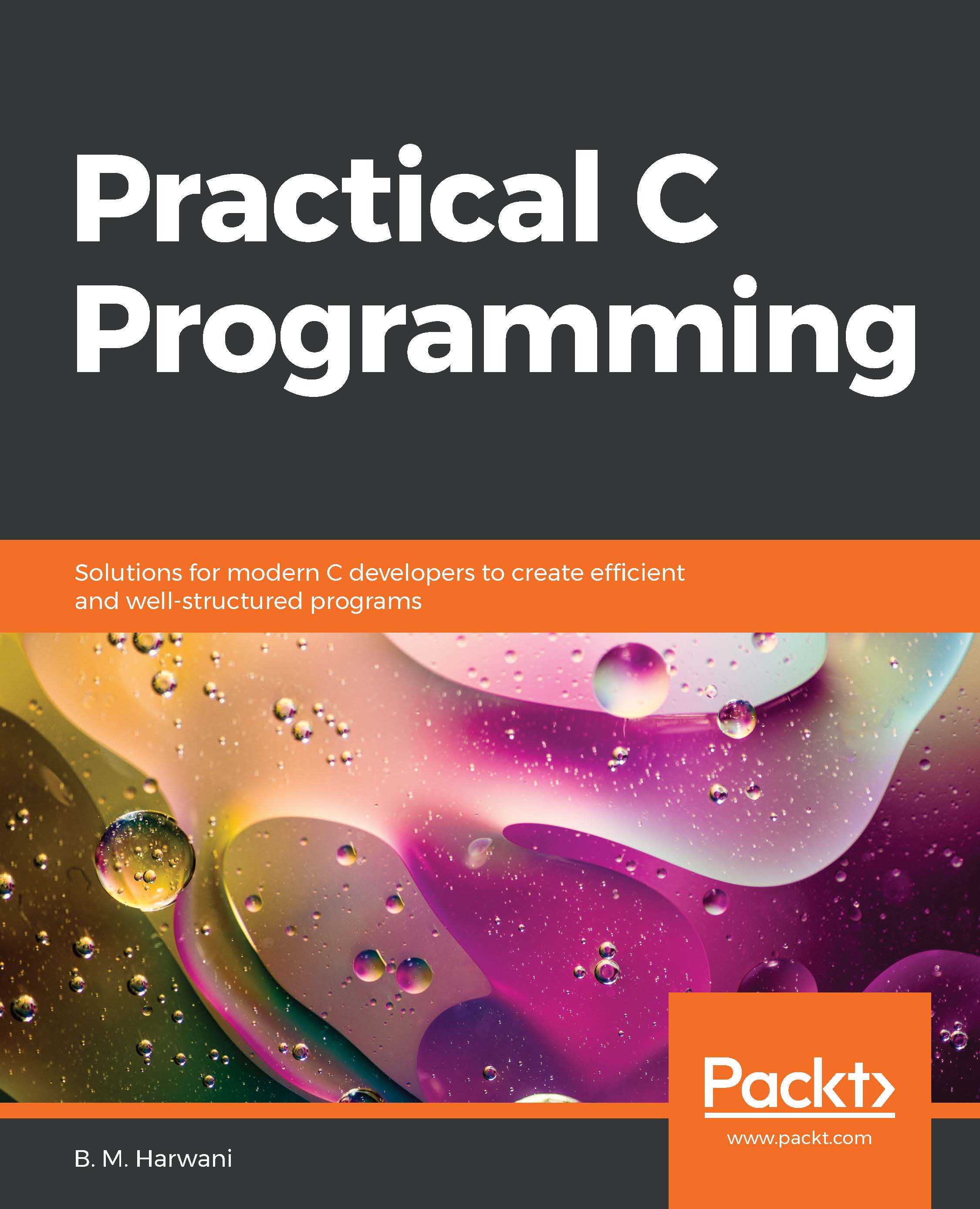
Practical C Programming

Practical C Programming

By : Harwani
3.3 (3)
close
close
Practical C Programming

Practical C Programming

3.3 (3)
By: Harwani

Overview of this book

Used in everything from microcontrollers to operating systems, C is a popular programming language among developers because of its flexibility and versatility. This book helps you get hands-on with various tasks, covering the fundamental as well as complex C programming concepts that are essential for making real-life applications. You’ll start with recipes for arrays, strings, user-defined functions, and pre-processing directives. Once you’re familiar with the basic features, you’ll gradually move on to learning pointers, file handling, concurrency, networking, and inter-process communication (IPC). The book then illustrates how to carry out searching and arrange data using different sorting techniques, before demonstrating the implementation of data structures such as stacks and queues. Later, you’ll learn interesting programming features such as using graphics for drawing and animation, and the application of general-purpose utilities. Finally, the book will take you through advanced concepts such as low-level programming, embedded software, IoT, and security in coding, as well as techniques for improving code performance. By the end of this book, you'll have a clear understanding of C programming, and have the skills you need to develop robust apps.
Table of Contents (20 chapters)
close
close

Preprocessing and Compilation

There are several preprocessor statements that can help you determine which source code needs to be compiled and which needs to be excluded from being compiled. That is, a condition can be applied and the desired statements will be compiled only if the specified condition is true. These directives can be nested for more precise branching. There are numerous preprocessor statements, such as #if, #ifdef, #ifndef, #else, #elif, and #endif, that can be used to collect statements into blocks that we want to be compiled when the specified condition is true.

Some of the advantages of using macros are as follows:

  • The execution speed of the program increases as the value or code of the macro is substituted by the name of the macro. So, the time involved in invoking or calling the functions by the compiler is saved.
  • Macros reduce the length of the...
Visually different images
CONTINUE READING
83
Tech Concepts
36
Programming languages
73
Tech Tools
Icon Unlimited access to the largest independent learning library in tech of over 8,000 expert-authored tech books and videos.
Icon Innovative learning tools, including AI book assistants, code context explainers, and text-to-speech.
Icon 50+ new titles added per month and exclusive early access to books as they are being written.
Practical C Programming
notes
bookmark Notes and Bookmarks search Search in title playlist Add to playlist download Download options font-size Font size

Change the font size

margin-width Margin width

Change margin width

day-mode Day/Sepia/Night Modes

Change background colour

Close icon Search
Country selected

Close icon Your notes and bookmarks

Confirmation

Modal Close icon
claim successful

Buy this book with your credits?

Modal Close icon
Are you sure you want to buy this book with one of your credits?
Close
YES, BUY

Submit Your Feedback

Modal Close icon
Modal Close icon
Modal Close icon