Sign In Start Free Trial
Account

Add to playlist

Create a Playlist

Modal Close icon
You need to login to use this feature.
  • Book Overview & Buying DWR Java AJAX Applications
  • Table Of Contents Toc
  • Feedback & Rating feedback

Chapter 1. Introduction

Learning by doing is a key if you want to benefit from this book. Since the target audience is the developer community, much of this book consists of examples using DWR in action. Chapters 1 to 3 introduce the main features of DWR, and discuss how to get the development work started. Chapters 4 to 7 are full of sample code, and focus on the source code samples and applications.

This chapter introduces AJAX technology and a widely used Java framework for building AJAX applications: Direct Web Remoting, commonly known as DWR. The introductory sections on both AJAX and DWR are brief since AJAX is already a well-known technology and most of us have at least heard about it and know what it stands for. The introduction to DWR is presented in a short "executive summary" before we dive into more details and examples on DWR in the later chapters.

The following sections are discussed in this chapter:

  • What is AJAX?

  • DWR: AJAX for Java Developers

  • The DWR Community

What is AJAX?

AJAX is the abbreviation for Asynchronous JavaScript and XML. This gives an almost comprehensive explanation of the technology, except that XML is not required. The term AJAX surfaced around February 2005 and was first used by Jesse James Garrett (http://www.adaptivepath.com/ideas/essays/archives/000385.php), long after the building blocks of AJAX, JavaScript and XML, were available and in wide use.

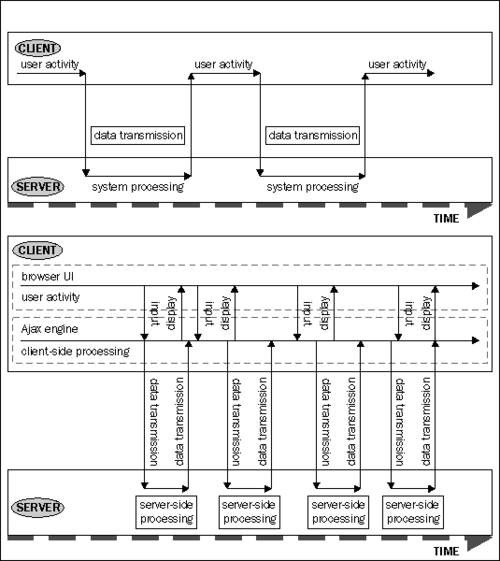
The principle idea of AJAX is in the word "Asynchronous". This feature enables rich a desktop-like user interface in the browser and enables interactive interfaces that can even replace traditional user interfaces. Communication between browser and server is done in the background. Moreover, as only the data is transferred between the browser and the server, AJAX applications are actually fast and responsive to users. The following figures display how a typical request-response application works (upper diagram), and how AJAX applications work compared to the request-response application (lower diagram).

The main component of AJAX technology is XmlHttpRequest, which is a JavaScript object, first supported by Mozilla in 2002. The concept was originally developed by Microsoft in 1999 for Internet Explorer 5.0 and it was then called XMLHTTP. The following link provides the details and history of XmlHttpRequest: http://en.wikipedia.org/wiki/XMLHttpRequest.

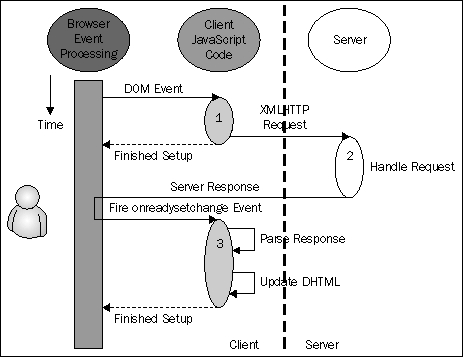
XmlHttpRequest is used to transfer data between client and server asynchronously. The following figure shows the AJAX sequence diagram and how XmlHttpRequest is used:

AJAX is dealt with in detail in many books such as Head Rush Ajax, a "brain friendly guide" to AJAX and also on Internet sites. Further, the assumption is that most of you already know AJAX and you are reading this book for reasons other than just learning AJAX basics.

Visually different images
CONTINUE READING
83
Tech Concepts
36
Programming languages
73
Tech Tools
Icon Unlimited access to the largest independent learning library in tech of over 8,000 expert-authored tech books and videos.
Icon Innovative learning tools, including AI book assistants, code context explainers, and text-to-speech.
Icon 50+ new titles added per month and exclusive early access to books as they are being written.
DWR Java AJAX Applications
notes
bookmark Notes and Bookmarks search Search in title playlist Add to playlist font-size Font size

Change the font size

margin-width Margin width

Change margin width

day-mode Day/Sepia/Night Modes

Change background colour

Close icon Search
Country selected

Close icon Your notes and bookmarks

Confirmation

Modal Close icon
claim successful

Buy this book with your credits?

Modal Close icon
Are you sure you want to buy this book with one of your credits?
Close
YES, BUY

Submit Your Feedback

Modal Close icon
Modal Close icon
Modal Close icon