
Sign In Start Free Trial
Account

Add to playlist

Create a Playlist

Modal Close icon
You need to login to use this feature.
  • Book Overview & Buying Python Data Science Essentials
  • Table Of Contents Toc
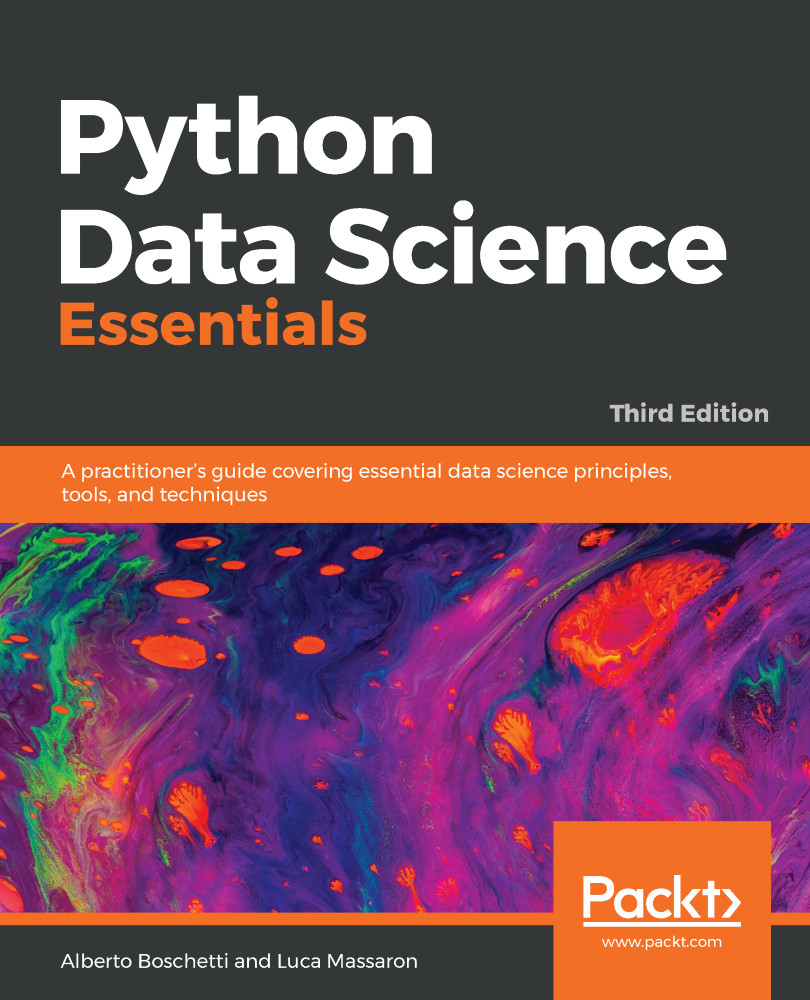
Python Data Science Essentials

Python Data Science Essentials - Third Edition

By : Alberto Boschetti, Luca Massaron, Pietro Marinelli, Matteo Malosetti
5 (2)
close
close
Python Data Science Essentials

Python Data Science Essentials

5 (2)
By: Alberto Boschetti, Luca Massaron, Pietro Marinelli, Matteo Malosetti

Overview of this book

Fully expanded and upgraded, the latest edition of Python Data Science Essentials will help you succeed in data science operations using the most common Python libraries. This book offers up-to-date insight into the core of Python, including the latest versions of the Jupyter Notebook, NumPy, pandas, and scikit-learn. The book covers detailed examples and large hybrid datasets to help you grasp essential statistical techniques for data collection, data munging and analysis, visualization, and reporting activities. You will also gain an understanding of advanced data science topics such as machine learning algorithms, distributed computing, tuning predictive models, and natural language processing. Furthermore, You’ll also be introduced to deep learning and gradient boosting solutions such as XGBoost, LightGBM, and CatBoost. By the end of the book, you will have gained a complete overview of the principal machine learning algorithms, graph analysis techniques, and all the visualization and deployment instruments that make it easier to present your results to an audience of both data science experts and business users
Table of Contents (11 chapters)
close
close

Dealing with big data

Big data puts data science projects under four points of view: volume (data quantity), velocity, variety, and veracity (is your data really representing what it should be or is it affected by some bias, distortion, or error?). The Scikit-learn package offers a range of classes and functions that will help you effectively work with data so large that it cannot entirely fit in the memory of a standard computer.

Before providing you with an overview of big data solutions, we have to create or import some datasets in order to give you a better idea of the scalability and performances of different algorithms. This will require about 1.5 gigabytes of your hard disk, which will be let free after the experiment.
(Not big data in itself—nowadays, it is hard to find computers with less than 4 GB of memory—yet, not even a toy dataset, it should provide...

CONTINUE READING
83
Tech Concepts
36
Programming languages
73
Tech Tools
Icon Unlimited access to the largest independent learning library in tech of over 8,000 expert-authored tech books and videos.
Icon Innovative learning tools, including AI book assistants, code context explainers, and text-to-speech.
Icon 50+ new titles added per month and exclusive early access to books as they are being written.
Python Data Science Essentials
notes
bookmark Notes and Bookmarks search Search in title playlist Add to playlist download Download options font-size Font size

Change the font size

margin-width Margin width

Change margin width

day-mode Day/Sepia/Night Modes

Change background colour

Close icon Search
Country selected

Close icon Your notes and bookmarks

Confirmation

Modal Close icon
claim successful

Buy this book with your credits?

Modal Close icon
Are you sure you want to buy this book with one of your credits?
Close
YES, BUY

Submit Your Feedback

Modal Close icon
Modal Close icon
Modal Close icon