
Sign In Start Free Trial
Account

Add to playlist

Create a Playlist

Modal Close icon
You need to login to use this feature.
  • Book Overview & Buying Python Feature Engineering Cookbook
  • Table Of Contents Toc
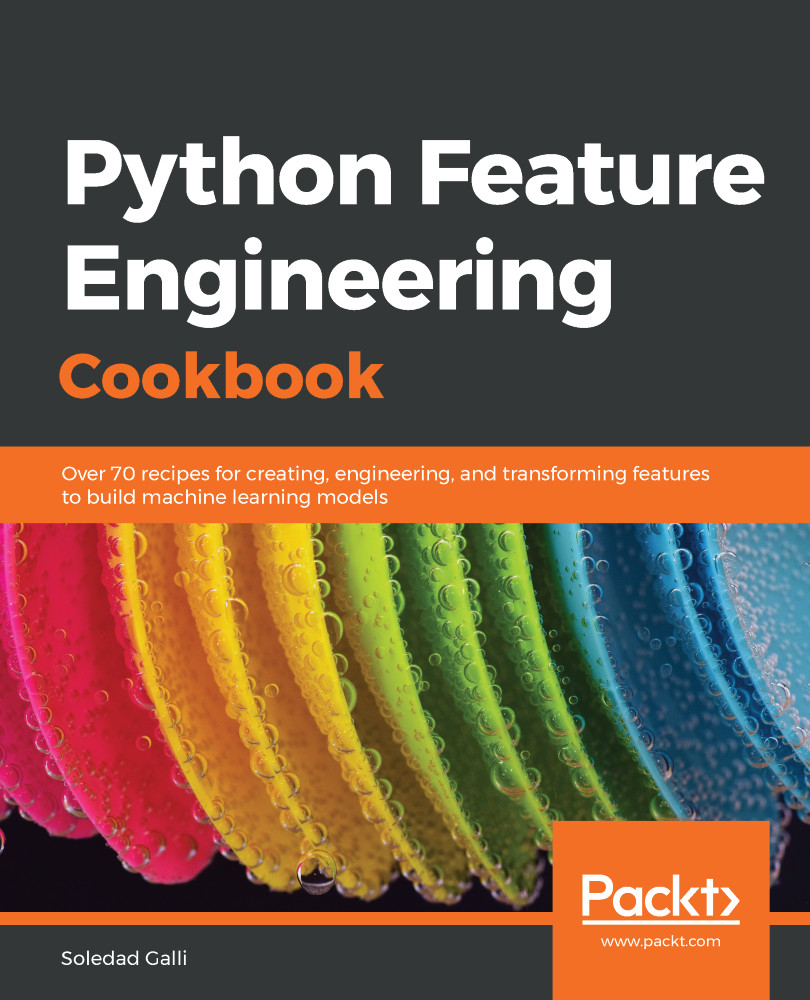
Python Feature Engineering Cookbook

Python Feature Engineering Cookbook

By : Soledad Galli
3.6 (9)
close
close
Python Feature Engineering Cookbook

Python Feature Engineering Cookbook

3.6 (9)
By: Soledad Galli

Overview of this book

Feature engineering is invaluable for developing and enriching your machine learning models. In this cookbook, you will work with the best tools to streamline your feature engineering pipelines and techniques and simplify and improve the quality of your code. Using Python libraries such as pandas, scikit-learn, Featuretools, and Feature-engine, you’ll learn how to work with both continuous and discrete datasets and be able to transform features from unstructured datasets. You will develop the skills necessary to select the best features as well as the most suitable extraction techniques. This book will cover Python recipes that will help you automate feature engineering to simplify complex processes. You’ll also get to grips with different feature engineering strategies, such as the box-cox transform, power transform, and log transform across machine learning, reinforcement learning, and natural language processing (NLP) domains. By the end of this book, you’ll have discovered tips and practical solutions to all of your feature engineering problems.
Table of Contents (13 chapters)
close
close

Creating binary variables through one-hot encoding

In one-hot encoding, we represent a categorical variable as a group of binary variables, where each binary variable represents one category. The binary variable indicates whether the category is present in an observation (1) or not (0). The following table shows the one-hot encoded representation of the Gender variable with the categories of Male and Female:

Gender Female Male
Female 1 0
Male 0 1
Male 0 1
Female 1 0
Female 1 0


As shown in the table, from the Gender variable, we can derive the binary variable of Female, which shows the value of 1 for females, or the binary variable of Male, which takes the value of 1 for the males in the dataset.

For the categorical variable of Color with the values of red, blue, and green, we can create three variables called...

CONTINUE READING
83
Tech Concepts
36
Programming languages
73
Tech Tools
Icon Unlimited access to the largest independent learning library in tech of over 8,000 expert-authored tech books and videos.
Icon Innovative learning tools, including AI book assistants, code context explainers, and text-to-speech.
Icon 50+ new titles added per month and exclusive early access to books as they are being written.
Python Feature Engineering Cookbook
notes
bookmark Notes and Bookmarks search Search in title playlist Add to playlist download Download options font-size Font size

Change the font size

margin-width Margin width

Change margin width

day-mode Day/Sepia/Night Modes

Change background colour

Close icon Search
Country selected

Close icon Your notes and bookmarks

Confirmation

Modal Close icon
claim successful

Buy this book with your credits?

Modal Close icon
Are you sure you want to buy this book with one of your credits?
Close
YES, BUY

Submit Your Feedback

Modal Close icon
Modal Close icon
Modal Close icon