


-
Book Overview & Buying
-
Table Of Contents

Python Machine Learning - Third Edition
By :


Python Machine Learning
By:
Overview of this book
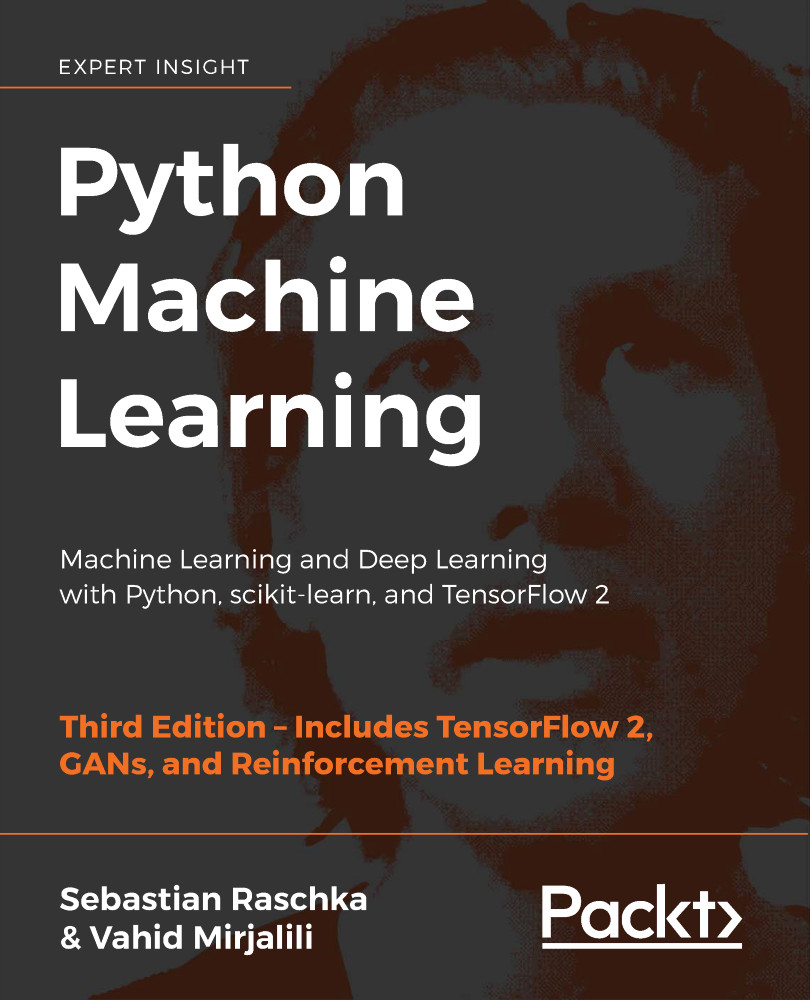
Python Machine Learning, Third Edition is a comprehensive guide to machine learning and deep learning with Python. It acts as both a step-by-step tutorial, and a reference you'll keep coming back to as you build your machine learning systems.
Packed with clear explanations, visualizations, and working examples, the book covers all the essential machine learning techniques in depth. While some books teach you only to follow instructions, with this machine learning book, Raschka and Mirjalili teach the principles behind machine learning, allowing you to build models and applications for yourself.
Updated for TensorFlow 2.0, this new third edition introduces readers to its new Keras API features, as well as the latest additions to scikit-learn. It's also expanded to cover cutting-edge reinforcement learning techniques based on deep learning, as well as an introduction to GANs. Finally, this book also explores a subfield of natural language processing (NLP) called sentiment analysis, helping you learn how to use machine learning algorithms to classify documents.
This book is your companion to machine learning with Python, whether you're a Python developer new to machine learning or want to deepen your knowledge of the latest developments.
Table of Contents (21 chapters)
Preface


 Free Chapter
Giving Computers the Ability to Learn from Data
Training Simple Machine Learning Algorithms for Classification
A Tour of Machine Learning Classifiers Using scikit-learn
Building Good Training Datasets – Data Preprocessing
Compressing Data via Dimensionality Reduction
Learning Best Practices for Model Evaluation and Hyperparameter Tuning
Combining Different Models for Ensemble Learning
Applying Machine Learning to Sentiment Analysis
Embedding a Machine Learning Model into a Web Application
Predicting Continuous Target Variables with Regression Analysis
Working with Unlabeled Data – Clustering Analysis
Implementing a Multilayer Artificial Neural Network from Scratch
Parallelizing Neural Network Training with TensorFlow
Going Deeper – The Mechanics of TensorFlow

Classifying Images with Deep Convolutional Neural Networks
Modeling Sequential Data Using Recurrent Neural Networks
Generative Adversarial Networks for Synthesizing New Data
Reinforcement Learning for Decision Making in Complex Environments
Other Books You May Enjoy
Index
 . This evaluation can be represented as a computation graph, as shown in the following figure:


