Sign In Start Free Trial
Account

Add to playlist

Create a Playlist

Modal Close icon
You need to login to use this feature.
  • Book Overview & Buying Python GUI Programming Cookbook
  • Table Of Contents Toc
  • Feedback & Rating feedback
Python GUI Programming Cookbook

Python GUI Programming Cookbook

By : Burkhard Meier
4.4 (11)
close
close
Python GUI Programming Cookbook

Python GUI Programming Cookbook

4.4 (11)
By: Burkhard Meier

Overview of this book

Python is a multi-domain, interpreted programming language. It is a widely used general-purpose, high-level programming language. It is often used as a scripting language because of its forgiving syntax and compatibility with a wide variety of different eco-systems. Its flexible syntax enables developers to write short scripts while at the same time, they can use object-oriented concepts to develop very large projects. Python GUI Programming Cookbook follows a task-based approach to help you create beautiful and very effective GUIs with the least amount of code necessary. This book uses the simplest programming style, using the fewest lines of code to create a GUI in Python, and then advances to using object-oriented programming in later chapters. If you are new to object-oriented programming (OOP), this book will teach you how to take advantage of the OOP coding style in the context of creating GUIs written in Python. Throughout the book, you will develop an entire GUI application, building recipe upon recipe, connecting the GUI to a database. In the later chapters, you will explore additional Python GUI frameworks, using best practices. You will also learn how to use threading to ensure your GUI doesn’t go unresponsive. By the end of the book, you will be an expert in Python GUI programming to develop a common set of GUI applications.
Table of Contents (13 chapters)
close
close
12
Index

Using scrolled text widgets

ScrolledText widgets are much larger than simple Entry widgets and span multiple lines. They are widgets like Notepad and wrap lines, automatically enabling vertical scrollbars when the text gets larger than the height of the ScrolledText widget.

Getting ready

This recipe extends the previous recipes. You can download the code for each chapter of this book from the Packt Publishing website.

How to do it...

By adding the following lines of code, we create a ScrolledText widget:

# Add this import to the top of the Python Module    # 1
from tkinter import scrolledtext      # 2

# Using a scrolled Text control       # 3
scrolW  = 30                          # 4
scrolH  =  3                          # 5
scr = scrolledtext.ScrolledText(win, width=scrolW, height=scrolH, wrap=tk.WORD)                         # 6
scr.grid(column=0, columnspan=3)      # 7

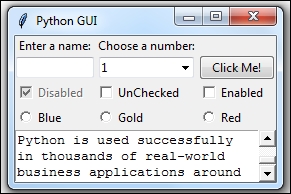
We can actually type into our widget, and if we type enough words, the lines will automatically wrap around!

How to do it...

Once we type in more words than the height of the widget can display, the vertical scrollbar becomes enabled. This all works out-of-the-box without us needing to write any more code to achieve this.

How to do it...

How it works...

In line 2 we are importing the module that contains the ScrolledText widget class. Add that to the top of the module, just below the other two import statements.

Lines 4 and 5 define the width and height of the ScrolledText widget we are about to create. These are hard-coded values we are passing into the ScrolledText widget constructor in line 6.

These values are magic numbers found by experimentation to work well. You might experiment by changing srcolW from 30 to 50 and observe the effect!

In line 6 we are setting a property on the widget by passing in wrap=tk.WORD.

By setting the wrap property to tk.WORD we are telling the ScrolledText widget to break lines by words, so that we do not wrap around within a word. The default option is tk.CHAR, which wraps any character regardless of whether we are in the middle of a word.

The second screenshot shows that the vertical scrollbar moved down because we are reading a longer text that does not entirely fit into the x, y dimensions of the SrolledText control we created.

Setting the columnspan property of the grid widget to 3 for the SrolledText widget makes this widget span all three columns. If we did not set this property, our SrolledText widget would only reside in column one, which is not what we want.

Visually different images
CONTINUE READING
83
Tech Concepts
36
Programming languages
73
Tech Tools
Icon Unlimited access to the largest independent learning library in tech of over 8,000 expert-authored tech books and videos.
Icon Innovative learning tools, including AI book assistants, code context explainers, and text-to-speech.
Icon 50+ new titles added per month and exclusive early access to books as they are being written.
Python GUI Programming Cookbook
notes
bookmark Notes and Bookmarks search Search in title playlist Add to playlist font-size Font size

Change the font size

margin-width Margin width

Change margin width

day-mode Day/Sepia/Night Modes

Change background colour

Close icon Search
Country selected

Close icon Your notes and bookmarks

Confirmation

Modal Close icon
claim successful

Buy this book with your credits?

Modal Close icon
Are you sure you want to buy this book with one of your credits?
Close
YES, BUY

Submit Your Feedback

Modal Close icon
Modal Close icon
Modal Close icon