Sign In Start Free Trial
Account

Add to playlist

Create a Playlist

Modal Close icon
You need to login to use this feature.
  • Book Overview & Buying Python GUI Programming Cookbook
  • Table Of Contents Toc
  • Feedback & Rating feedback
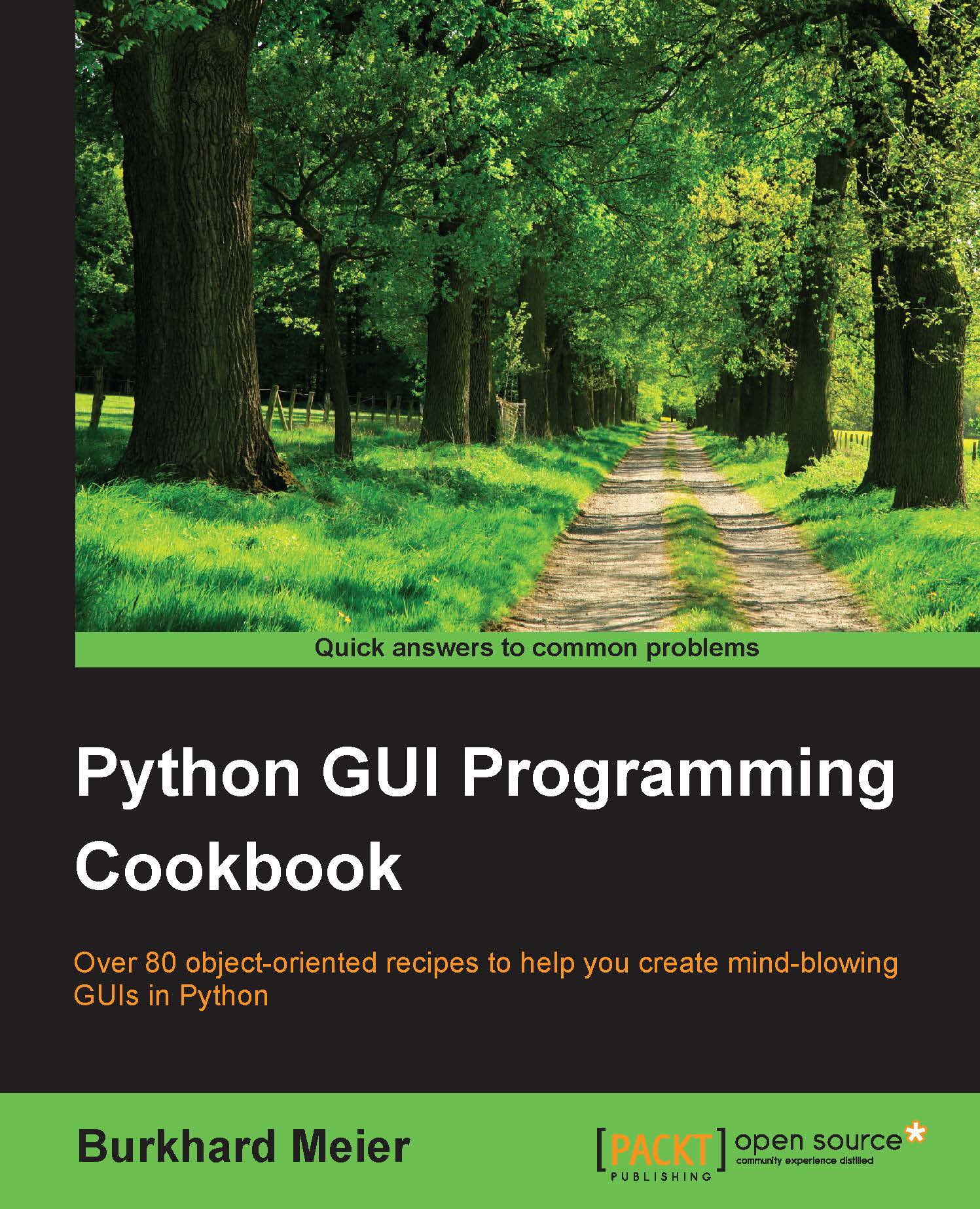
Python GUI Programming Cookbook

Python GUI Programming Cookbook

By : Burkhard Meier
4.4 (11)
close
close
Python GUI Programming Cookbook

Python GUI Programming Cookbook

4.4 (11)
By: Burkhard Meier

Overview of this book

Python is a multi-domain, interpreted programming language. It is a widely used general-purpose, high-level programming language. It is often used as a scripting language because of its forgiving syntax and compatibility with a wide variety of different eco-systems. Its flexible syntax enables developers to write short scripts while at the same time, they can use object-oriented concepts to develop very large projects. Python GUI Programming Cookbook follows a task-based approach to help you create beautiful and very effective GUIs with the least amount of code necessary. This book uses the simplest programming style, using the fewest lines of code to create a GUI in Python, and then advances to using object-oriented programming in later chapters. If you are new to object-oriented programming (OOP), this book will teach you how to take advantage of the OOP coding style in the context of creating GUIs written in Python. Throughout the book, you will develop an entire GUI application, building recipe upon recipe, connecting the GUI to a database. In the later chapters, you will explore additional Python GUI frameworks, using best practices. You will also learn how to use threading to ensure your GUI doesn’t go unresponsive. By the end of the book, you will be an expert in Python GUI programming to develop a common set of GUI applications.
Table of Contents (13 chapters)
close
close
12
Index

Using module-level global variables


Encapsulation is a major strength in any programming language that enables us to program using OOP. Python is both OOP and procedural. We can create global variables that are localized to the module they reside in. They are global only to this module, which is one form of encapsulation. Why do we want this? Because, as we add more and more functionality to our GUI, we want to avoid naming conflicts, which could result in bugs in our code.

Note

We do not want naming clashes creating bugs in our code! Namespaces are one way to avoid these bugs, and in Python, we can do this by using Python modules (which are unofficial namespaces).

Getting ready

We can declare module-level globals in any module just above and outside of functions.

We then have to use the global Python keyword to refer to them. If we forget to use global in functions, we will accidentally create new local variables. This would be a bug and something we really do not want to do.

Note

Python is a...

Visually different images
CONTINUE READING
83
Tech Concepts
36
Programming languages
73
Tech Tools
Icon Unlimited access to the largest independent learning library in tech of over 8,000 expert-authored tech books and videos.
Icon Innovative learning tools, including AI book assistants, code context explainers, and text-to-speech.
Icon 50+ new titles added per month and exclusive early access to books as they are being written.
Python GUI Programming Cookbook
notes
bookmark Notes and Bookmarks search Search in title playlist Add to playlist font-size Font size

Change the font size

margin-width Margin width

Change margin width

day-mode Day/Sepia/Night Modes

Change background colour

Close icon Search
Country selected

Close icon Your notes and bookmarks

Confirmation

Modal Close icon
claim successful

Buy this book with your credits?

Modal Close icon
Are you sure you want to buy this book with one of your credits?
Close
YES, BUY

Submit Your Feedback

Modal Close icon
Modal Close icon
Modal Close icon