


-
Book Overview & Buying
-
Table Of Contents

Extreme C
By :


Extreme C
By:
Overview of this book
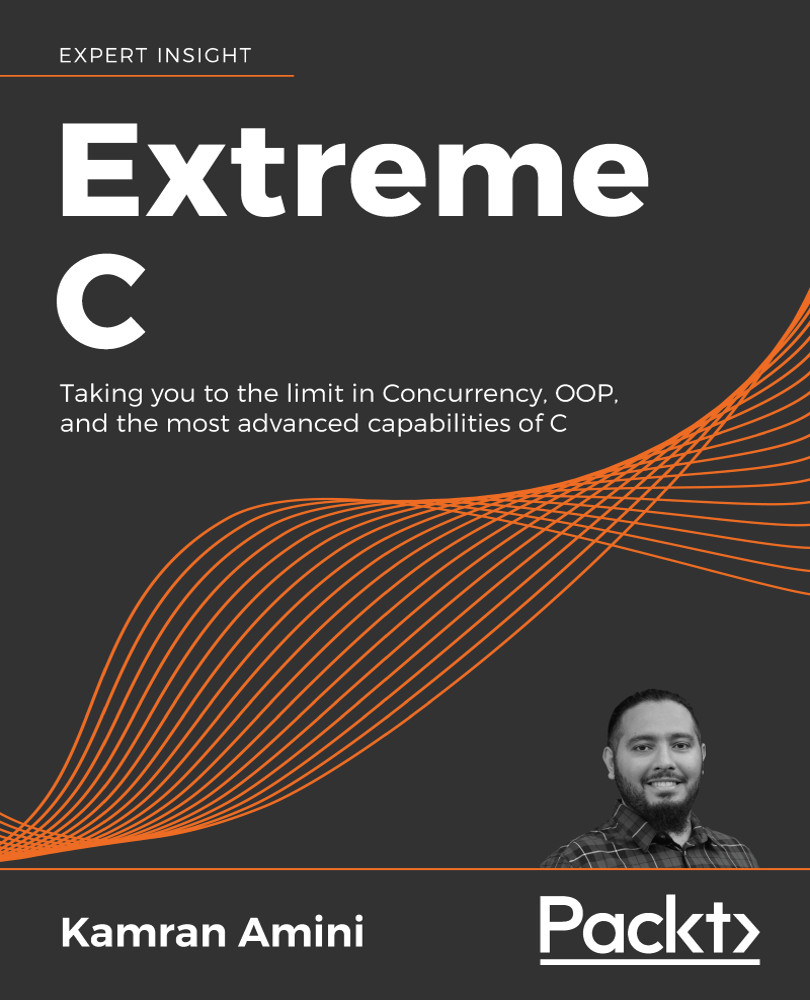
There’s a lot more to C than knowing the language syntax. The industry looks for developers with a rigorous, scientific understanding of the principles and practices. Extreme C will teach you to use C’s advanced low-level power to write effective, efficient systems. This intensive, practical guide will help you become an expert C programmer.
Building on your existing C knowledge, you will master preprocessor directives, macros, conditional compilation, pointers, and much more. You will gain new insight into algorithm design, functions, and structures. You will discover how C helps you squeeze maximum performance out of critical, resource-constrained applications.
C still plays a critical role in 21st-century programming, remaining the core language for precision engineering, aviations, space research, and more. This book shows how C works with Unix, how to implement OO principles in C, and fully covers multi-processing.
In Extreme C, Amini encourages you to think, question, apply, and experiment for yourself. The book is essential for anybody who wants to take their C to the next level.
Table of Contents (27 chapters)
Preface


 Free Chapter
Essential Features
From Source to Binary
Object Files
Process Memory Structure
Stack and Heap
OOP and Encapsulation
Composition and Aggregation

Inheritance and Polymorphism
Abstraction and OOP in C++
Unix – History and Architecture
System Calls and Kernels
The Most Recent C
Concurrency
Synchronization
Thread Execution
Thread Synchronization
Process Execution
Process Synchronization
Single-Host IPC and Sockets
Socket Programming
Integration with Other Languages
Unit Testing and Debugging
Build Systems
Other Books You May Enjoy
Leave a review - let other readers know what you think
Index


