Sign In Start Free Trial
Account

Add to playlist

Create a Playlist

Modal Close icon
You need to login to use this feature.
  • Book Overview & Buying Build Your Own Programming Language
  • Table Of Contents Toc
Build Your Own Programming Language

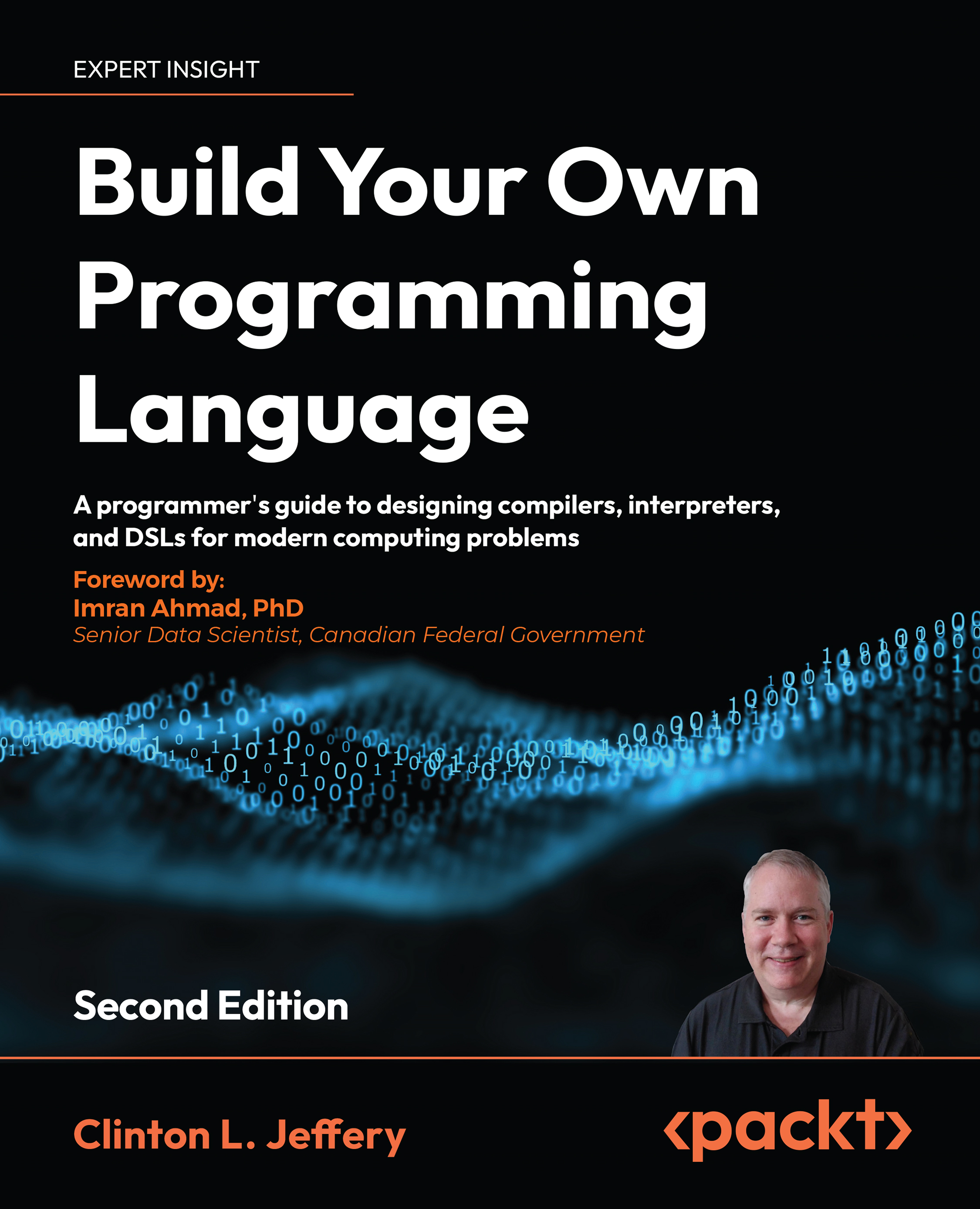
Build Your Own Programming Language - Second Edition

By : Clinton L. Jeffery
4.5 (33)
close
close
Build Your Own Programming Language

Build Your Own Programming Language

4.5 (33)
By: Clinton L. Jeffery

Overview of this book

There are many reasons to build a programming language: out of necessity, as a learning exercise, or just for fun. Whatever your reasons, this book gives you the tools to succeed. You’ll build the frontend of a compiler for your language and generate a lexical analyzer and parser using Lex and YACC tools. Then you’ll explore a series of syntax tree traversals before looking at code generation for a bytecode virtual machine or native code. In this edition, a new chapter has been added to assist you in comprehending the nuances and distinctions between preprocessors and transpilers. Code examples have been modernized, expanded, and rigorously tested, and all content has undergone thorough refreshing. You’ll learn to implement code generation techniques using practical examples, including the Unicon Preprocessor and transpiling Jzero code to Unicon. You'll move to domain-specific language features and learn to create them as built-in operators and functions. You’ll also cover garbage collection. Dr. Jeffery’s experiences building the Unicon language are used to add context to the concepts, and relevant examples are provided in both Unicon and Java so that you can follow along in your language of choice. By the end of this book, you'll be able to build and deploy your own domain-specific language.
Table of Contents (27 chapters)
close
close
1
Section I: Programming Language Frontends
7
Section II: Syntax Tree Traversals
13
Section III: Code Generation and Runtime Systems
22
Section IV: Appendix
23
Answers
24
Other Books You May Enjoy
25
Index

Preface

This second edition was begun primarily at the suggestion of a first edition reader, who called me one day and explained that they were using the book for a programming language project. The project was not generating code for a bytecode interpreter or a native instruction set as covered in the first edition. Instead, they were creating a transpiler from a classic legacy programming language to a modern mainstream language. There are many such projects, because there is a lot of old code out there that is still heavily used. The Unicon translator itself started as a preprocessor and then was extended until it became in some sense, a transpiler. So, when Packt asked for a second edition, it was natural to propose a new chapter on that topic; this edition has a new Chapter 11 and all chapters (starting from what was Chapter 11 in the previous edition) have seen their number incremented by one. A second major facet of this second edition was requested by Packt and not my idea at all. They requested that the IDE syntax coloring chapter be extended to deal with the topic of adding syntax coloring to mainstream IDEs that I did not write and do not use, instead of its previous content on syntax coloring in the Unicon IDEs. Although this topic is outside my comfort zone, it is a valuable topic that is somewhat under-documented at present and easily deserves inclusion, so here it is. You, as the reader, can decide whether I have managed to do it any justice as an introduction to that topic.

After 60+ years of high-level language development, programming is still too difficult. The demand for software of ever-increasing size and complexity has exploded due to hardware advances, while programming languages have improved far more slowly. Creating new languages for specific purposes is one antidote for this software crisis.

This book is about building new programming languages. The topic of programming language design is introduced, although the primary emphasis is on programming language implementation. Within this heavily studied subject, the novel aspect of this book is its fusing of traditional compiler-compiler tools (Flex and Byacc) with two higher-level implementation languages. A very high-level language (Unicon) plows through a compiler’s data structures and algorithms like butter, while a mainstream modern language (Java) shows how to implement the same code in a more typical production environment.

One thing I didn’t really understand after my college compiler class was that the compiler is only one part of a programming language implementation. Higher-level languages, including most newer languages, may have a runtime system that dwarfs their compiler. For this reason, the second half of this book spends quality time on a variety of aspects of language runtime systems, ranging from bytecode interpreters to garbage collection.

CONTINUE READING
83
Tech Concepts
36
Programming languages
73
Tech Tools
Icon Unlimited access to the largest independent learning library in tech of over 8,000 expert-authored tech books and videos.
Icon Innovative learning tools, including AI book assistants, code context explainers, and text-to-speech.
Icon 50+ new titles added per month and exclusive early access to books as they are being written.
Build Your Own Programming Language
notes
bookmark Notes and Bookmarks search Search in title playlist Add to playlist download Download options font-size Font size

Change the font size

margin-width Margin width

Change margin width

day-mode Day/Sepia/Night Modes

Change background colour

Close icon Search
Country selected

Close icon Your notes and bookmarks

Confirmation

Modal Close icon
claim successful

Buy this book with your credits?

Modal Close icon
Are you sure you want to buy this book with one of your credits?
Close
YES, BUY

Submit Your Feedback

Modal Close icon
Modal Close icon
Modal Close icon