
Sign In Start Free Trial
Account

Add to playlist

Create a Playlist

Modal Close icon
You need to login to use this feature.
  • Book Overview & Buying Solutions Architect's Handbook
  • Table Of Contents Toc
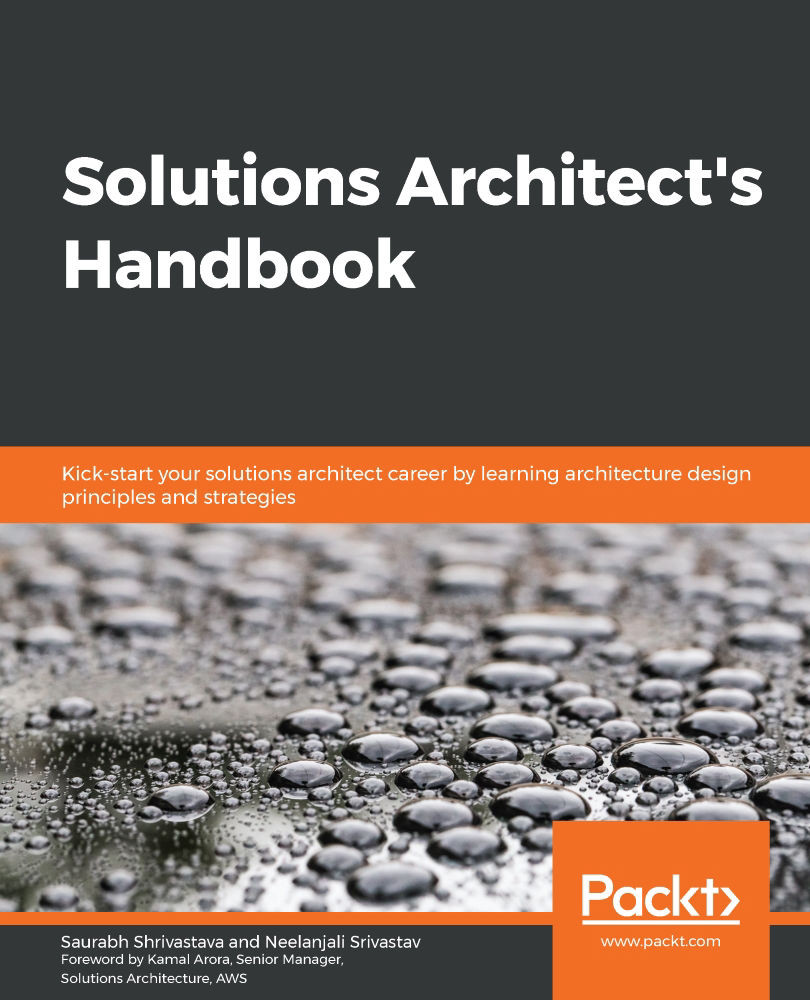
Solutions Architect's Handbook

Solutions Architect's Handbook

By : Saurabh Shrivastava, Neelanjali Srivastav
4.2 (20)
close
close
Solutions Architect's Handbook

Solutions Architect's Handbook

4.2 (20)
By: Saurabh Shrivastava, Neelanjali Srivastav

Overview of this book

Becoming a solutions architect gives you the flexibility to work with cutting-edge technologies and define product strategies. This handbook takes you through the essential concepts, design principles and patterns, architectural considerations, and all the latest technology that you need to know to become a successful solutions architect. This book starts with a quick introduction to the fundamentals of solution architecture design principles and attributes that will assist you in understanding how solution architecture benefits software projects across enterprises. You'll learn what a cloud migration and application modernization framework looks like, and will use microservices, event-driven, cache-based, and serverless patterns to design robust architectures. You'll then explore the main pillars of architecture design, including performance, scalability, cost optimization, security, operational excellence, and DevOps. Additionally, you'll also learn advanced concepts relating to big data, machine learning, and the Internet of Things (IoT). Finally, you'll get to grips with the documentation of architecture design and the soft skills that are necessary to become a better solutions architect. By the end of this book, you'll have learned techniques to create an efficient architecture design that meets your business requirements.
Table of Contents (18 chapters)
close
close

Creating a floating IP pattern

It's common that monolithic applications have lots of dependencies on the server where they are deployed. Often, application configuration and code have hardcoded parameters based on server DNS name and IP address. Hardcoded IP configuration creates challenges if you want to bring up a new server in case of an issue with the original server. Additionally, you don't want to bring down the entire application for the upgrade, which may cause significant downtime.

To handle such a situation, you need to create a new server keeping the same server IP address and DNS name. It can be achieved by moving the network interface from a problematic instance to the new server. The network interface is generally a Network Interface Card (NIC), which facilitates communication between servers over a network. It can be in the form of hardware or software. Moving the network interface means that now your new server assumes the identity of the old server. With that...

CONTINUE READING
83
Tech Concepts
36
Programming languages
73
Tech Tools
Icon Unlimited access to the largest independent learning library in tech of over 8,000 expert-authored tech books and videos.
Icon Innovative learning tools, including AI book assistants, code context explainers, and text-to-speech.
Icon 50+ new titles added per month and exclusive early access to books as they are being written.
Solutions Architect's Handbook
notes
bookmark Notes and Bookmarks search Search in title playlist Add to playlist font-size Font size

Change the font size

margin-width Margin width

Change margin width

day-mode Day/Sepia/Night Modes

Change background colour

Close icon Search
Country selected

Close icon Your notes and bookmarks

Confirmation

Modal Close icon
claim successful

Buy this book with your credits?

Modal Close icon
Are you sure you want to buy this book with one of your credits?
Close
YES, BUY

Submit Your Feedback

Modal Close icon
Modal Close icon
Modal Close icon