Sign In Start Free Trial
Account

Add to playlist

Create a Playlist

Modal Close icon
You need to login to use this feature.
  • Book Overview & Buying Advanced Deep Learning with TensorFlow 2 and Keras
  • Table Of Contents Toc
Advanced Deep Learning with TensorFlow 2 and Keras

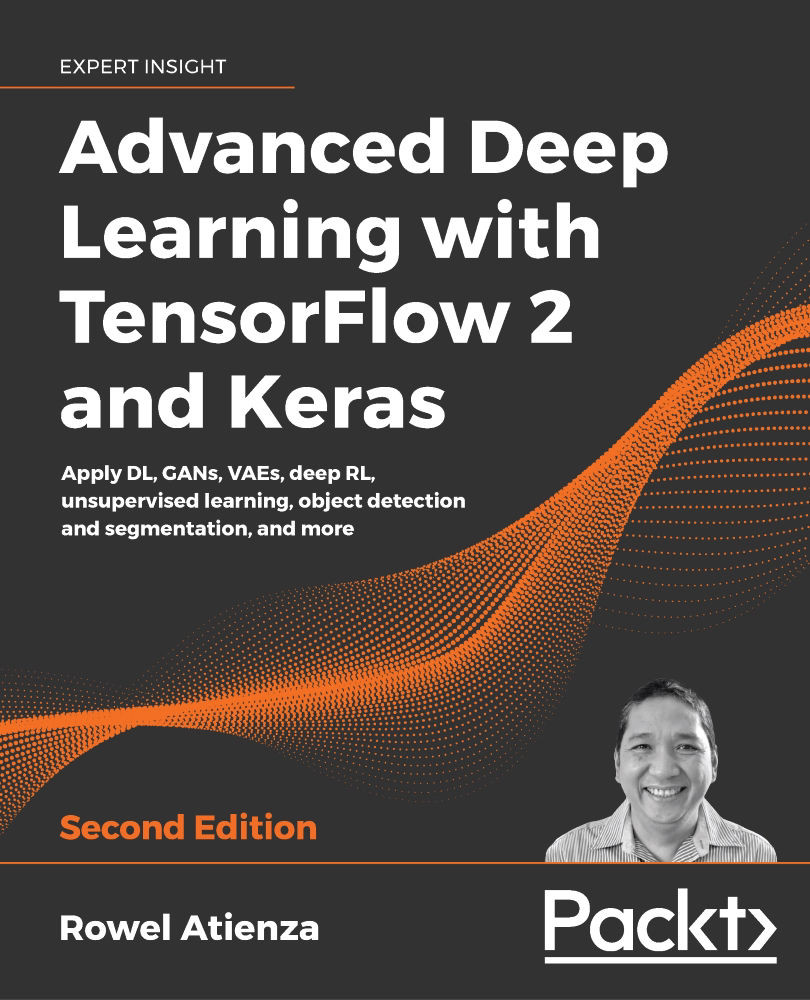
Advanced Deep Learning with TensorFlow 2 and Keras - Second Edition

By : Rowel Atienza
4.4 (11)
close
close
Advanced Deep Learning with TensorFlow 2 and Keras

Advanced Deep Learning with TensorFlow 2 and Keras

4.4 (11)
By: Rowel Atienza

Overview of this book

Advanced Deep Learning with TensorFlow 2 and Keras, Second Edition is a completely updated edition of the bestselling guide to the advanced deep learning techniques available today. Revised for TensorFlow 2.x, this edition introduces you to the practical side of deep learning with new chapters on unsupervised learning using mutual information, object detection (SSD), and semantic segmentation (FCN and PSPNet), further allowing you to create your own cutting-edge AI projects. Using Keras as an open-source deep learning library, the book features hands-on projects that show you how to create more effective AI with the most up-to-date techniques. Starting with an overview of multi-layer perceptrons (MLPs), convolutional neural networks (CNNs), and recurrent neural networks (RNNs), the book then introduces more cutting-edge techniques as you explore deep neural network architectures, including ResNet and DenseNet, and how to create autoencoders. You will then learn about GANs, and how they can unlock new levels of AI performance. Next, you’ll discover how a variational autoencoder (VAE) is implemented, and how GANs and VAEs have the generative power to synthesize data that can be extremely convincing to humans. You'll also learn to implement DRL such as Deep Q-Learning and Policy Gradient Methods, which are critical to many modern results in AI.
Table of Contents (16 chapters)
close
close
14
Other Books You May Enjoy
15
Index

Preface

In recent years, Deep Learning has made unprecedented success stories in difficult problems in vision, speech, natural language processing and understanding, and all other areas with abundance of data. The interest in this field from companies, universities, governments, and research organizations has accelerated the advances in the field. This book covers select important topics in Deep Learning with three new chapters, Object Detection, Semantic Segmentation, and Unsupervised Learning using Mutual Information. The advanced theories are explained by giving a background of the principles, digging into the intuition behind the concepts, implementing the equations and algorithms using Keras, and examining the results.

Artificial Intelligence (AI), as it stands today, is still far from being a well-understood field. Deep Learning (DL), as a sub field of AI, is in the same position. While it is far from being a mature field, many real-world applications such as vision-based detection and recognition, autonomous navigation, product recommendation, speech recognition and synthesis, energy conservation, drug discovery, finance, and marketing are already using DL algorithms. Many more applications will be discovered and built. The aim of this book is to explain advanced concepts, give sample implementations, and let the readers as experts in their field identify the target applications.

A field that is not completely mature is a double-edged sword. On one edge, it offers a lot of opportunities for discovery and exploitation. There are many unsolved problems in deep learning. This translates into opportunities to be the first to market – be that in product development, publication, or recognition. The other edge is it would be difficult to trust a not-fully-understood field in a mission-critical environment. We can safely say that if asked, very few machine learning engineers will ride an auto-pilot plane controlled by a deep learning system. There is a lot of work to be done to gain this level of trust. The advanced concepts that are discussed in this book have a high chance of playing a major role as the foundation in gaining this level of trust.

No DL book will be able to completely cover the whole field. This book is not an exception. Given time and space, we could have touched interesting areas like natural language processing and understanding, speech synthesis, automated machine learning (AutoML), graph neural networks (GNNs), Bayesian deep learning, and many others. However, this book believes in choosing and explaining select areas so that readers can take up other fields that are not covered.

As the reader who is about to embark upon reading this book, keep in mind that you chose an area that is exciting and can have a huge impact on society. We are fortunate to have a job that we look forward to working on as we wake up in the morning.

CONTINUE READING
83
Tech Concepts
36
Programming languages
73
Tech Tools
Icon Unlimited access to the largest independent learning library in tech of over 8,000 expert-authored tech books and videos.
Icon Innovative learning tools, including AI book assistants, code context explainers, and text-to-speech.
Icon 50+ new titles added per month and exclusive early access to books as they are being written.
Advanced Deep Learning with TensorFlow 2 and Keras
notes
bookmark Notes and Bookmarks search Search in title playlist Add to playlist download Download options font-size Font size

Change the font size

margin-width Margin width

Change margin width

day-mode Day/Sepia/Night Modes

Change background colour

Close icon Search
Country selected

Close icon Your notes and bookmarks

Confirmation

Modal Close icon
claim successful

Buy this book with your credits?

Modal Close icon
Are you sure you want to buy this book with one of your credits?
Close
YES, BUY

Submit Your Feedback

Modal Close icon
Modal Close icon
Modal Close icon