Sign In Start Free Trial
Account

Add to playlist

Create a Playlist

Modal Close icon
You need to login to use this feature.
  • Book Overview & Buying Ext.NET Web Application Development
  • Table Of Contents Toc
Ext.NET Web Application Development

Ext.NET Web Application Development

By : Anup K Shah
3 (1)
close
close
Ext.NET Web Application Development

Ext.NET Web Application Development

3 (1)
By: Anup K Shah

Overview of this book

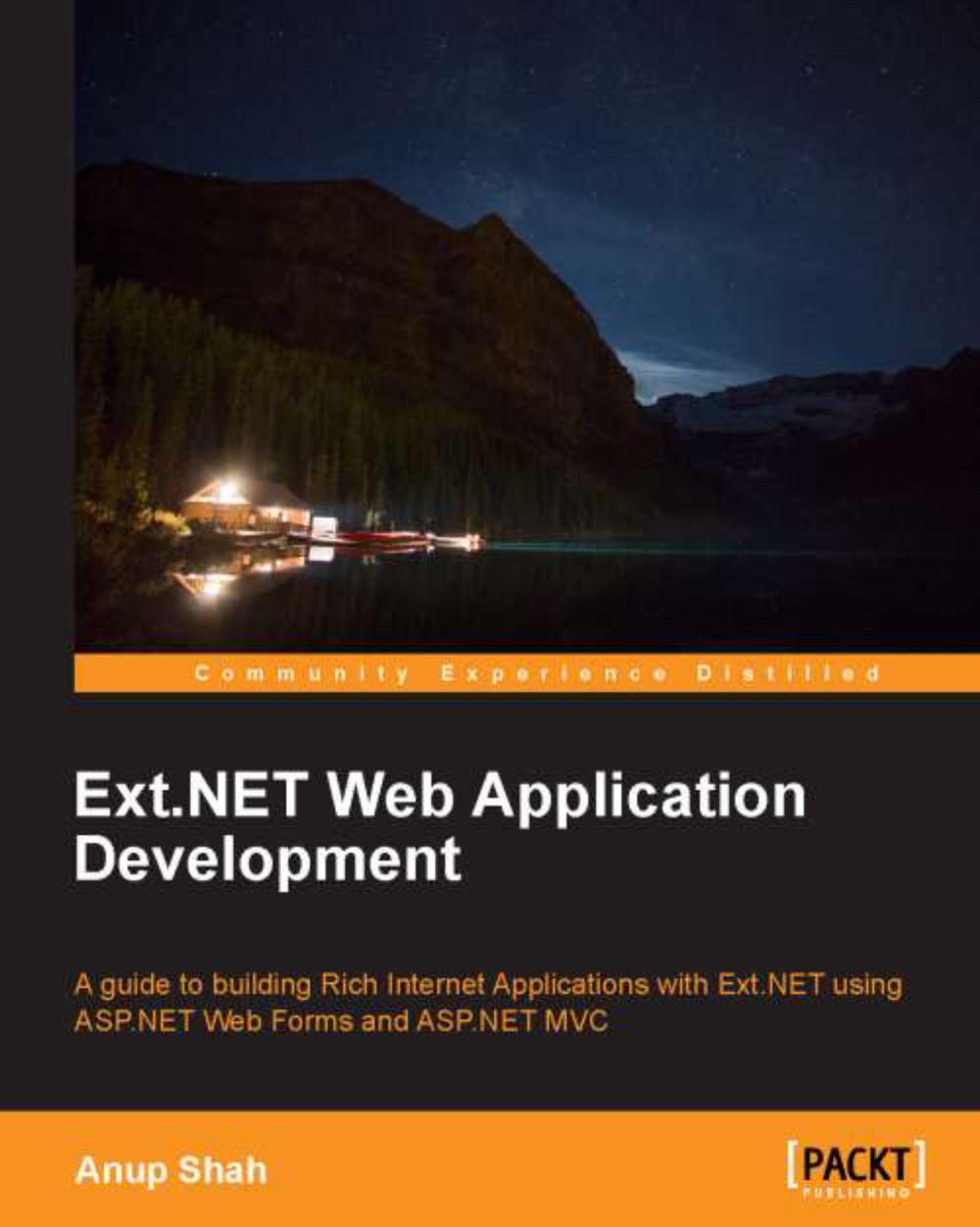
To build a rich internet application, you need to integrate a powerful client side JavaScript framework with a server side framework. Ext.NET achieves this by integrating Sencha's Ext JS framework with the power of ASP.NET. The result ñ a sophisticated framework offering a vast array of controls, layout, and powerful AJAX and server bindings, which can be used to build rich, highly usable web applications. "Ext.NET Web Application Development" shows you how to build rich applications using Ext.NET. Examples guide you through Ext.NET's various components using both ASP.NET Web Forms and MVC examples. You will also see how Ext.NET handles data binding and server integration. You will also learn how to create reusable components and put them together in great looking applications. This book guides you through the various Ext.NET components and capabilities to enable you to create highly usable Ext.NET components and web applications. You will learn about various UI components and numerous layout options through examples. You will see how the AJAX architecture enables you to create powerful data-oriented applications easily. This book will also teach you how to create reusable custom components to suit your needs. "Ext.NET Web Application Development" shows you how to create rich and usable applications using Ext.NET through numerous examples.
Table of Contents (17 chapters)
close
close
Ext.NET Web Application Development
Credits
About the Author
About the Reviewers
www.PacktPub.com
Preface
8
Trees and Tabs with Ext.NET
1
Index

Stores


A Store is a component that manages data for you on the client. It is typically used with grids and repeating lists of data, but also with hierarchical data such as TreePanels, as we will see in a later chapter. A Store manages features such as sorting and filtering data (locally or remotely). To achieve this, a Store has two important aspects to it as follows:

  • A Model, to define the items in the Store, their data types, validation requirements, and so on

  • A Proxy, to help retrieve and synchronize any changes back from the original data source

Note

Ext JS 4 has various subclasses for the Store component, such as ArrayStore, JsonStore, JsonPStore, BufferStore, and XmlStore. These stores are very simple subclasses that simply instantiate the corresponding proxy for you. When Ext.NET generates an Ext JS Store for you, all the various proxies that Ext JS defines are created appropriately, so Ext.NET itself doesn't need explicit classes corresponding to these Store subclasses.

Models

A Model...

CONTINUE READING
83
Tech Concepts
36
Programming languages
73
Tech Tools
Icon Unlimited access to the largest independent learning library in tech of over 8,000 expert-authored tech books and videos.
Icon Innovative learning tools, including AI book assistants, code context explainers, and text-to-speech.
Icon 50+ new titles added per month and exclusive early access to books as they are being written.
Ext.NET Web Application Development
notes
bookmark Notes and Bookmarks search Search in title playlist Add to playlist font-size Font size

Change the font size

margin-width Margin width

Change margin width

day-mode Day/Sepia/Night Modes

Change background colour

Close icon Search
Country selected

Close icon Your notes and bookmarks

Confirmation

Modal Close icon
claim successful

Buy this book with your credits?

Modal Close icon
Are you sure you want to buy this book with one of your credits?
Close
YES, BUY

Submit Your Feedback

Modal Close icon
Modal Close icon
Modal Close icon